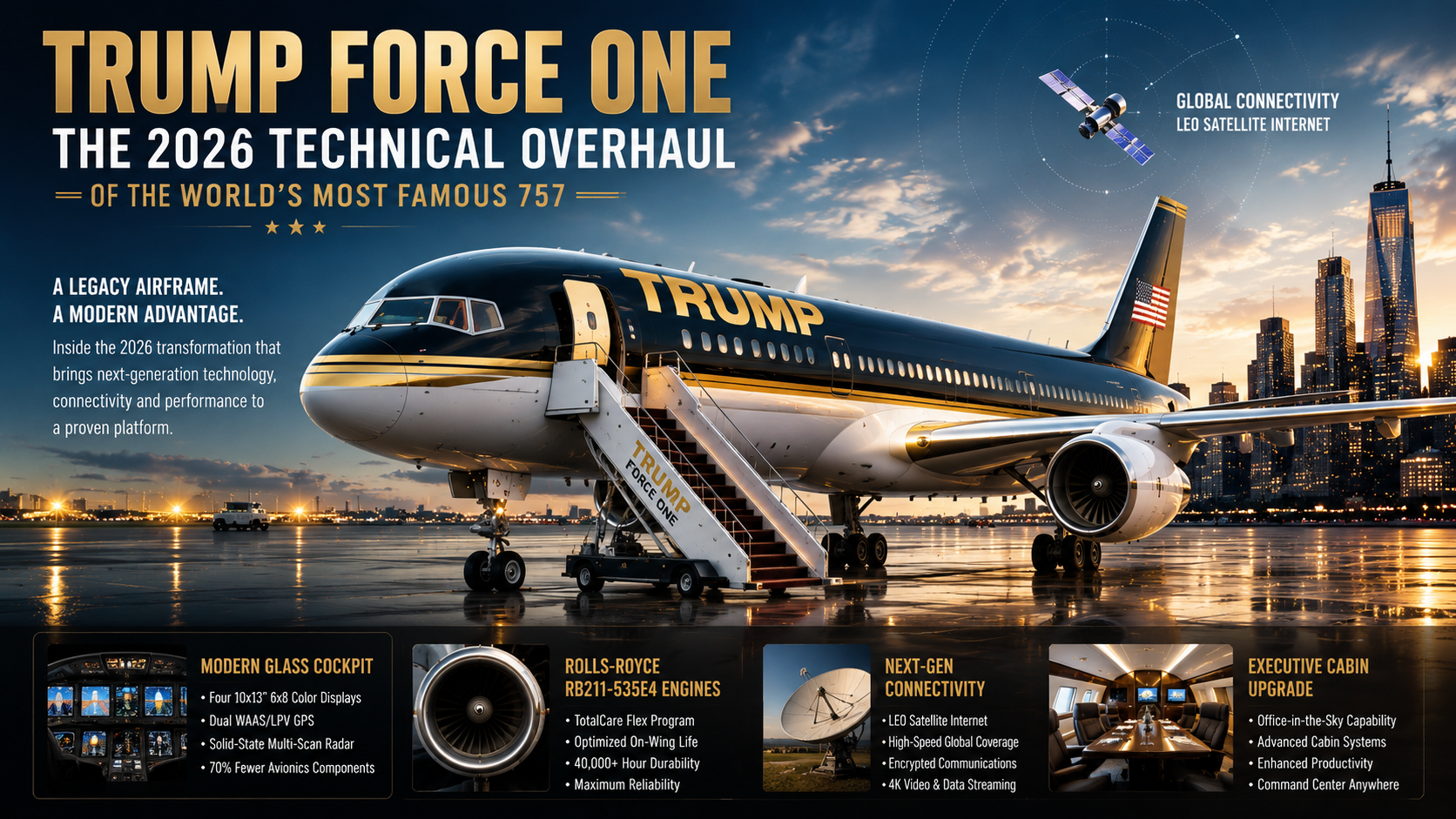
Trump Force One: The 2026 Technical Overhaul Of The World’s Most Famous 757
May 22, 2026
In the private aviation sector, the line between legacy narrow-body aircraft and modern strategic assets is increasingly defined by technological retrofits. There’s no better evidence for this than the fact that, while many operators are eyeing newer airframes, the strategic overhaul of “Trump Force One” — the nickname for the President’s personal Boeing 757 — proves that capital liquidity is better served by retrofitting proven platforms with next-generation avionics and propulsion.
According to market data from Fact.MR, narrow-body jets like the 757 now command a 46% share of the interior modernization sector in 2026. As BlackJet, a private jet card service, explains below, this trend confirms that for owners with specific mission profiles, the capital expenditure of a new aircraft struggles to compete with the return on investment (ROI) of a deep technical refresh.
Modernizing The Flight Deck Hierarchy
The 2026 revamp of Donald Trump’s best-known aircraft centers on a total transition from legacy electromechanical gauges to a fully integrated glass cockpit. Beyond aesthetics, this upgrade represents a fundamental shift in operational safety and in the predictability of maintenance.
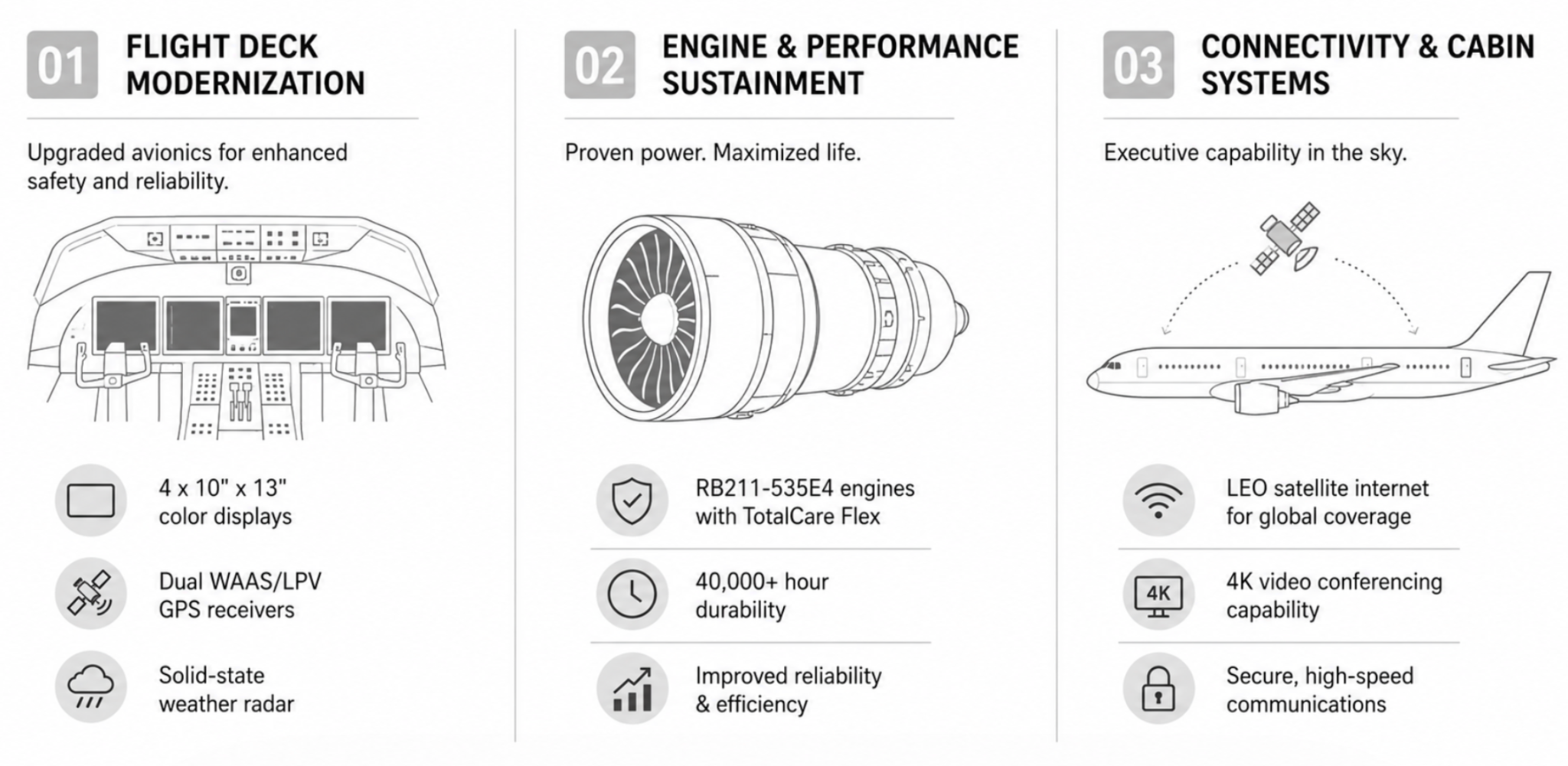
Installing the Innovative Solutions & Support Flat Panel Display System lets the aircraft achieve a 70% reduction in total component count within the avionics suite. Such a massive drop in hardware translates directly to lower mean time between failure (MTBF) rates, ensuring that the aircraft remains mission-ready without the chronic unscheduled downtime common in aging fleets.
The flight deck now mirrors the capabilities of the most modern long-range jets through three primary upgrades:
Installation of four 10-by-13 inch 6x8 color active matrix liquid crystal displays.
Integration of dual WAAS/LPV GPS receivers for precision approach capability.
Replacement of the legacy weather radar with a solid-state multi-scan system.
Sustaining Propulsion And Performance
The heart of the 757 remains its pair of Rolls-Royce RB211-535E4 engines, which are widely considered the most reliable powerplants in their thrust class. The strategy for these engines shifted from reactive maintenance to the TotalCare Flex program offered by Rolls-Royce.
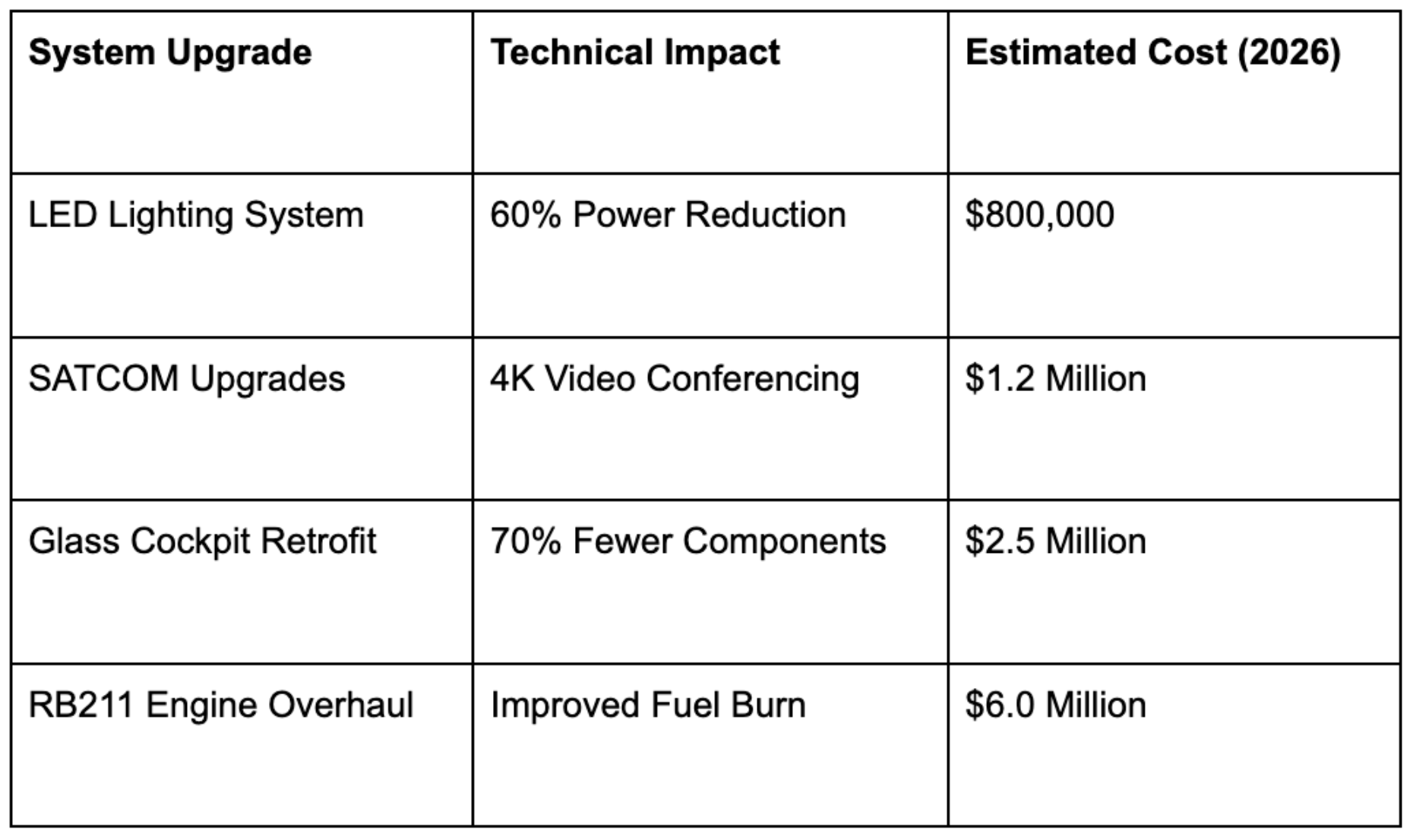
This program prioritizes asset accumulation by managing the engines based on their remaining on-wing life, allowing the owner to maximize the 40,000-plus hour durability of the core components. Executives seeking equivalent reliability may be better served by fractional ownership, as maintenance responsibilities like these are shifted elsewhere. For an airframe of this profile, maintaining engine health is the single largest factor in preserving the aircraft's residual value, looking at cost estimates and technical impact data based on 2026 market analysis from Coherent Market Insights and data on executive airlift SATCOM costs..
Advanced Connectivity And Cabin Systems
Beyond the engines and cockpit, the 2026 refresh focused heavily on the office-in-the-sky requirement for executive leadership. Modern aviation demands more than just satellite phone capability; it requires the same bandwidth expected in a terrestrial C-Suite.
The integration of low-earth orbit (LEO) satellite internet enables global, high-speed data transfer, supporting encrypted communications and real-time media streaming. This ensures that the 757 remains a functional command center even during transcontinental crossings.
In fact, the comparative affordability of connectivity upgrades makes them even more relevant for both Donald Trump and other major decision-makers. Being able to host high-stakes meetings with full 4K video support while flying eliminates the productivity losses traditionally associated with extended flight times.
Sustaining The Executive 757 Advantage
The technical overhaul of Trump Force One serves as a blueprint for the 2026 executive aviation market. It proves that with the right combination of avionics retrofits and engine management, a 30-year-old airframe can outperform modern rivals in both reliability and brand presence.
By merging historical airframe durability with modern digital infrastructure, fleet operators can protect capital reserves while significantly extending the operational lifespan of a proven asset.


 Sign up with google
 Sign up with Apple