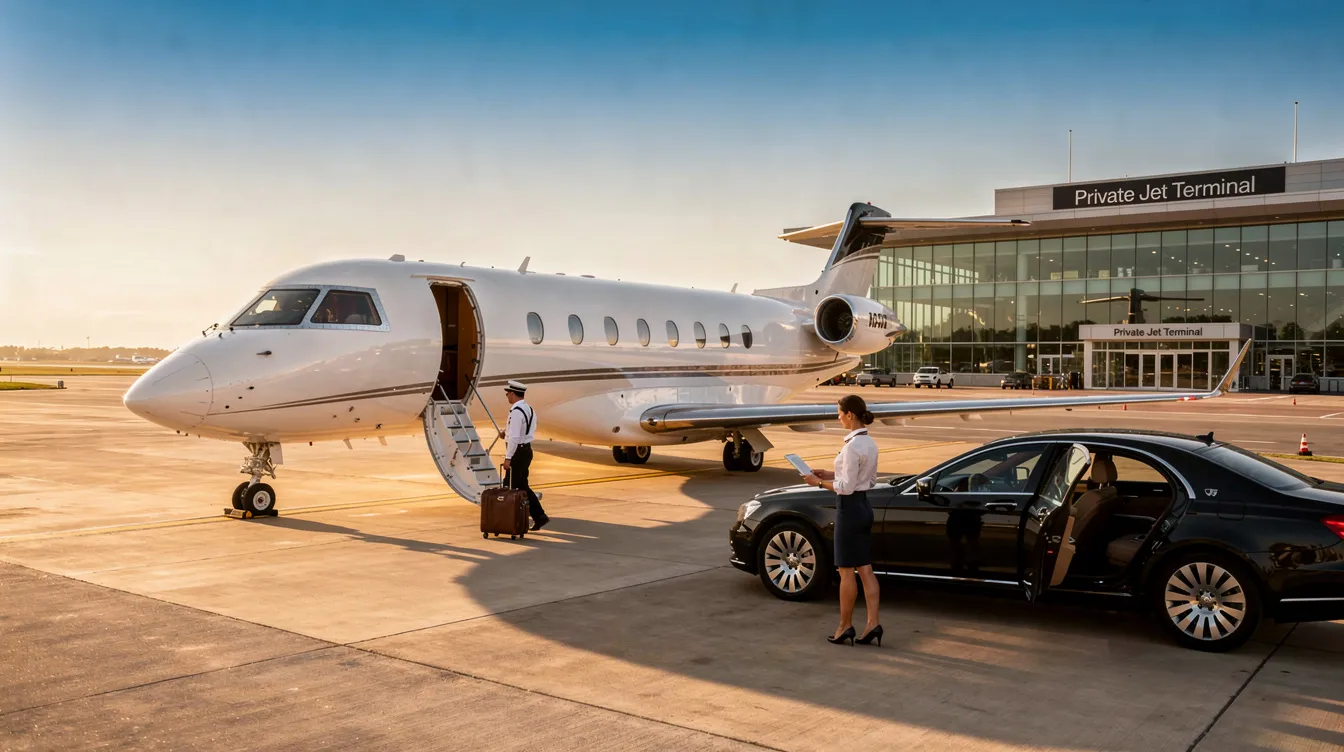
For executives and high-net-worth travelers, the decision to enter private aviation represents far more than acquiring a luxury asset—it’s a strategic recalibration of how time translates into opportunity. Consider a routine New York to Miami trip: commercial first class involves 3-5 hours of total airport time, including security, baggage, and boarding delays. A private flight eliminates most of that friction, often cutting total trip time by 30-50%.
This article walks through the complete landscape of airplane buying: defining your mission, selecting the right ownership model, evaluating aircraft for safety and sustainability, and navigating the purchase process. Whether you ultimately buy an aircraft or discover that a BlackJet jet card better serves your needs, the goal is clarity.
Why Purchasing an Airplane (Or Private Access) Is a Strategic Advantage
The phrase “purchasing an airplane” encompasses more options than outright aircraft ownership. Today’s buyers can choose fractional shares, partnerships, leasebacks, or prepaid jet card programs like BlackJet’s 25- or 50-hour memberships. Each model offers distinct advantages depending on how you fly.
High-net-worth individuals flying 25-150 hours annually often reclaim 100+ hours yearly by avoiding commercial aviation bottlenecks. This isn’t merely convenience—it’s leveraged productivity. Business jets cruise at 400-500 knots versus commercial’s effective 300-350 knots when you factor in ground time, enabling same-day roundtrips that commercial schedules simply cannot match.
The cost of purchasing an airplane varies significantly based on its category, ranging from $8,000 for entry-level ultralights to over $400 million for top-tier commercial airliners, and understanding the broader private jet price list and access options helps put these figures in context. Acquisition costs for used single-engine piston planes range from $15,000 to $100,000, while new light jets can exceed $10 million.
BlackJet’s perspective centers on providing premier jet card access for travelers who value flexibility without management burdens. For those flying under 150 hours annually, our programs deliver guaranteed availability, professional crews, and carbon-neutral flights—without hangar costs, crew salaries, maintenance surprises, or the need to manage an account for tracking costs, insurance, and ongoing expenses, as well as taxes and related financial responsibilities that come with ownership.
Define Your Mission Before You Purchase
Understanding your typical mission is crucial when purchasing an airplane, as it helps identify suitable options and avoid impulsive choices. Your mission should consider factors such as the number of passengers, distance, frequency of flights, and the type of cargo or equipment you will carry, all of which influence aircraft selection and operational budgeting. This understanding is the foundation of all successful acquisitions and helps avoid costly mistakes.
The purpose of the aircraft strongly affects specifications: business aircraft often prioritize speed, privacy, and advanced technology, while personal aircraft might focus more on ease of operation and comfort. Whether your mission involves business, leisure, or cargo transport, knowing your needs early shapes the entire buying process.
Every successful purchase starts with this understanding, not fixating on an airframe brand. Mission parameters include passenger count, destinations, frequency, and scheduling flexibility. A regional business traveler has fundamentally different needs than a family flying transcontinental for ski trips.
Consider three sample missions and their ideal solutions:
Mission Type | Typical Route | Aircraft/Access Option | Cost Consideration |
|---|
Regional business hops | Los Angeles to San Francisco (~400nm) | Light jet via jet card | $6,000-8,000/hour; outperforms $1-2M acquisition + $500K annual fixed costs |
Transcontinental family trips | New York to Aspen (~1,500nm) | Super-midsize aircraft (e.g., Challenger 350) | Fractional or jet cards avoid overhead |
Transatlantic travel | Teterboro to London (3,000+ nm) | Large-cabin jets (e.g., Gulfstream G450) | Full ownership viable at 300+ hours annually |
What Will You Be Carrying – People, Pets, Or Cargo?
Quantifying your typical passengers shapes every subsequent decision. A solo executive needs compact light jets with 4-6 seats. Families of four require a midsize cabin configuration with club seating and pet-friendly amenities. Teams of eight demand large cabins with work tables for investor roadshows.
Payload matters beyond headcount. Golf bags to Scottsdale, ski equipment to Jackson Hole, or presentation materials for multi-city tours all affect aircraft selection. A Phenom 300 can carry a 1,200 lb useful load, a Challenger 350 can carry 2,500 lb with flat floors, and a Gulfstream G450 can carry 4,000+ lb, including medical equipment.
Certain aircraft types are better suited for family travel, offering larger cabins and multiple seating configurations, while others are designed for cargo transport, emphasizing load capacity and ease of loading.
BlackJet jet cards allow switching cabin class trip-by-trip, avoiding the limitation of being locked into a single aircraft’s capability. Your mission to Aspen with kids might need a different aircraft than your solo flight to Chicago.
How Far, How Fast, And How Often Will You Fly?
Flight distance dictates aircraft category requirements:
Distance Range | Typical Routes | Recommended Aircraft Types | Notes |
|---|
Sub-500nm | Dallas to Houston | Turboprops burning 80-100 gal/hour | Efficient for short hops |
500-1,500nm | Chicago to Palm Beach | Jets at 450-500 knots | Minimize headwind penalties |
1,500+ nm (including transatlantic) | Various | Large jets with 4,000+ nm range and NBAA IFR reserves | Essential for long-range travel |
Cruise speed interacts with headwinds significantly—eastbound New York to Miami effectively adds 50-100nm due to prevailing winds. Frequency determines economics: 1-2 trips monthly differs vastly from weekly travel in terms of which ownership model makes sense.
Aircraft with great range and speed can be flown more economically at slower speeds, making them ideal for business travel, while leisure flyers may prioritize lower fuel costs over speed.
The frequency of your flights also helps determine your budget for operational costs. Older aircraft may be less expensive initially, but often require more maintenance, increasing variable costs. These variable operating costs primarily consist of fuel, which is typically the largest expense, alongside maintenance, both of which scale with use and can amount to a significant percentage of the aircraft’s value annually.
Single Engine, Twin, Turboprop, Or Jet?
Aircraft categories range from piston singles like the Cessna 182 (900nm range, 140 knots, $300K-600K) through twin-engine aircraft like the Beech Baron offering redundancy over mountains and water, to turboprops like the King Air 350 (1,800nm, 300 knots, $3-7M), and finally jets spanning light to large-cabin models.
Modern single-engine turboprops like the TBM 940 boast excellent safety records with autoland systems, challenging the assumption that twins are inherently safer. However, twin-engine aircraft remain preferred for night flying, mountainous terrain, or large bodies of water due to added safety, despite higher operating costs compared to single-engine planes. High-net-worth and corporate travelers typically gravitate toward jets for 45,000-foot altitudes above weather, pressurized cabins, and speed.
With BlackJet, clients access professionally flown turboprops and jets without personally managing engine-type trade-offs. Aircraft owners operating complex multi-engine equipment need extensive training and currency—considerations that evaporate when professional crews handle flight operations.
Match Aircraft Complexity To Pilot Experience
Two paths exist for aircraft acquisition: owner-pilots who fly their own planes versus those hiring professional crews or using BlackJet’s crewed aircraft through jet cards.
Stepping into turbine aircraft requires an instrument rating, often 250-500 total hours, and type-specific experience to satisfy insurance requirements. Insurers typically demand recurrent training at facilities like FlightSafety ($20K+ annually) and specific make/model time before covering pilots in aircraft like a Citation CJ4. In many cases, insurance coverage is limited to pilots who meet strict experience or qualification thresholds, restricting eligibility to those with sufficient hours and recent training.
The daunting task of building qualifications while managing a high-value asset leads many buyers toward professional crews. With BlackJet, customers don’t need any pilot qualifications—flight decks are handled by ATP-rated pilots with 5,000+ hours and type-specific experience.
Ownership Models: From Jet Cards To Full Ownership
The spectrum of private aviation access spans jet card membership, on-demand charter, fractional ownership, partnerships, and sole ownership. Each model suits different hours, capital availability, and management tolerance, and comparing jet card membership pricing and structures to these alternatives clarifies the trade-offs.
BlackJet’s jet cards represent the premium entry into private aviation that sidesteps the complexities of the buying process. Before committing capital, coordinate with tax and legal advisors—implications differ severely between leasing, fractional shares, and full ownership.
Jet Card Membership (BlackJet) vs On-Demand Charter
Jet cards like BlackJet’s 25-hour programs and 50-hour jet card options provide prepaid hours at fixed, transparent rates across multiple cabin categories. This contrasts sharply with ad hoc charter: variable pricing with peak-day surcharges of 20-50%, potential aircraft substitutions, and repositioning fees exceeding $1,000.
BlackJet members enjoy:
24/7 digital booking with guaranteed availability on 24-48 hours' notice
No repositioning fees on most missions
Carbon-neutral flights via verified offset projects
Multi-cabin-class access without single-airframe limitations
Consider a New York-Miami monthly commuter: predictable hourly rates and guaranteed aircraft class eliminate the uncertainty that makes on-demand charter stressful for regular travelers, especially when evaluating a 100-hour jet card cost structure for frequent use.
Fractional Shares, Partnerships, And Leasebacks
Fractional ownership means purchasing a share—for example, 1/16th of a Citation XLS, yielding approximately 50 hours annually. Pros include ownership pride, scheduled access, and potential tax advantages. Cons involve long contracts (often 5+ years), upfront capital ($300K+ for entry-level shares), residual value risk, and management fees, leading many frequent travelers to evaluate the best jet cards for regular flyers as a simpler alternative.
Partnerships and flying clubs work for smaller aircraft, requiring detailed operating agreements covering scheduling, maintenance reserves, and hangar allocation. Choosing partners carefully and establishing solid agreements is crucial to avoiding conflicts.
Leaseback arrangements allow owners to lease their aircraft to a flight school or FBO, offsetting ownership costs, although it involves the risk of strangers flying the aircraft.
Full Ownership: Controlling Your Own Aircraft
Owning a specific tail number delivers emotional appeal: customized interiors, aircraft always ready, complete control. Sole ownership provides the greatest flexibility, allowing the owner to make all decisions regarding the aircraft and access it whenever needed.
However, ownership generally makes sense if you fly over 200 hours annually; otherwise, fractional ownership or leasing may be better options. For business use, owners may qualify for 100% bonus depreciation under certain laws if the aircraft is used at least 50% for qualified business purposes.
Fixed costs accumulate quickly for a $5M jet:
Fixed Cost Item | Annual Cost Estimate |
|---|
Hangar at major airports | $50,000 |
Insurance premiums | $50,000 |
Crew salaries | $300,000 |
Annual inspections | Variable |
Variable operating costs primarily consist of fuel, which is typically the largest variable expense. Variable costs include fuel ($1.5M annually at 300 gal/hour for heavy users), maintenance reserves ($200/hour for engine overhauls), de-icing ($5K/trip), and interior refurbishments ($100K every 5 years). Aircraft with great range and speed can be flown more economically at slower speeds, making them ideal for business travel, while leisure flyers may prioritize lower fuel costs over speed and even explore the cheapest private aircraft options before upgrading.
Knowing how and when to sell an aircraft is crucial for maximizing return, as market demand and timing can significantly affect resale value.
Some aircraft owners still use jet cards like BlackJet for missions their own aircraft handles poorly—long-range trips when they own a light jet, or high-passenger-count flights exceeding their cabin space.
Financial Planning And Total Cost Of Ownership
The purchase price is merely the entry ticket. Ongoing cost defines whether airplane buying remains sustainable. Build a multi-year budget using conservative assumptions—fixed costs often equal 10-20% of aircraft value annually for actively used business jets.
At 50 annual hours, a jet card at $400K compares favorably to ownership exceeding $800K in fixed costs alone. At 150 hours, jet cards at $1.2M approach ownership’s $1.5M breakeven. Only at 300+ hours does ownership potentially drop below $7K/hour total.
Purchase Price, Financing, And Depreciation
Typical financing involves 15-25% down payments and 5-10 year loan terms at 4-6% through aviation-specialized lenders like Global Jet Capital. New aircraft experience 20-30% first-year depreciation, while well-maintained 10-20-year-old used aircraft may hold 70-80% of value, making an essential guide to financing an airplane invaluable during planning.
Work with lenders, understanding engine programs like JSSI and ESP, maintenance tracking systems, and resale dynamics. Bonus depreciation (100% Section 179 in eligible years) can be powerful but requires professional tax guidance. A notional $5M jet with 20% down puts $1M at immediate risk with an estimated 5-year residual value uncertainty.
Operating Costs, Reserves, And Hidden Line Items
Primary operating costs include fuel, oil, crew travel, catering, navigation fees, and routine maintenance. Maintenance plans can cover various components of the aircraft, such as engines, avionics, and airframes, helping protect the aircraft's value and reduce unexpected repair costs. Reserves—funds set aside per flight hour for engines and landing gear overhauls—often surprise first-time buyer expectations.
Hidden expenses accumulate: hangar rent, insurance deductibles, database subscriptions, training for pilots, and interior refurbishments. Contrast this with BlackJet’s all-in hourly rate, where maintenance and crew costs are embedded. When you spend money on a jet card, you know exactly what each hour costs.
Build detailed line-item budgets, then add 25-50% contingency for surprises—especially in initial ownership years when deferred maintenance surfaces.
Evaluating Aircraft: Safety, Technology, And Sustainability
Beyond interior aesthetics lie fundamentals that matter: safety pedigree, avionics suite, manufacturer support network, and environmental impact. Modern business travelers increasingly demand robust safety standards and credible carbon strategies.
Whether you buy a plane or use BlackJet’s jet cards, insist on transparent safety credentials and sustainability policies. Involve an aviation consultant early when evaluating aircraft types and operators. Seek advice from experienced pilots, mechanics, industry professionals, and even a friend who owns an aircraft to ensure informed decisions and avoid costly mistakes. Additionally, carefully consider the choice of airports for aircraft storage and operations, as airport amenities, runway specifications, customs services, and storage options can significantly impact maintenance, convenience, and your overall ownership experience, particularly if you plan to charter a small plane into more remote fields.
Safety Standards, Certification, And Pilot Training
Key safety benchmarks include ARGUS Platinum, Wyvern Wingman, and IS-BAO Stage 3 ratings for operators. These certifications indicate robust safety management systems, regular audits, and 99.9%+ dispatch reliability.
Pilot qualifications matter: total hours, time in type, and recent simulator training quarterly. For pre-owned aircraft purchases, review maintenance history, logbooks, and compliance with FAA airworthiness directives. BlackJet only partners with operators exceeding top-tier safety and training standards, providing an additional safety layer for members.
Avionics, Connectivity, And Cabin Comfort
Modern glass cockpits like Garmin G3000 or Collins Pro Line Fusion enhance situational awareness and reduce pilot workload by 30%. For passengers, cabin features affecting experience include stand-up height (6ft+ in larger jets), flat floors, noise levels under 50dB, and seating configurations.
Connectivity expectations have evolved: Wi-Fi for video conferences on routes like Los Angeles to Chicago, streaming for family entertainment, and secure VPN access for executives. Cabin refurbishment and avionics upgrades can be major cost items in older aircraft—price these during negotiations. BlackJet’s curated fleet access ensures members select aircraft profiles meeting modern cabin and connectivity standards, similar in some ways to the convenience of unlimited private jet flight memberships but with more tailored trip-by-trip control.
Sustainable Aviation And Carbon-Neutral Travel
Sustainable aviation fuel (SAF) availability grows at major hubs like Van Nuys, Teterboro, and London Farnborough. SAF blends cut CO2 emissions up to 80% compared to conventional Jet-A.
Carbon offsetting calculates emissions per flight hour and funds verified projects—reforestation, renewable energy deployment—that neutralize the impact. BlackJet provides carbon-neutral flights as standard, with offsets embedded in membership at no additional cost.
Sustainability increasingly affects long-run asset value, brand reputation, and compliance with corporate ESG mandates. Buyers and charter users should ask operators about fuel efficiency, SAF usage, and emissions transparency for each aircraft type.
The Purchase Process: From Search To Closing
For those proceeding to acquire an aircraft, the process runs 3-6 months from initial search to delivery. Purchasing an aircraft is a significant deal that requires careful planning, negotiation, and patience; buyers should be prepared to wait for the right opportunity rather than rushing into a purchase. While BlackJet jet card access activates in days, aircraft purchases demand patience and methodical decision-making.
The complete process follows a linear path: define mission, assemble advisory team, search market, evaluate candidates, negotiate terms, conduct pre-buy inspection, pay using secure methods such as escrow services with proper documentation, close transaction, and transition into operations, a structure that becomes even more critical when arranging large charter planes for 100 passengers or other complex missions.
Building Your Advisory Team
Assemble experienced specialists: aircraft broker (1-2% commission), aviation attorney ($10-20K), tax advisor, lender, and trusted maintenance expert. Independent representation proves vital—some brokers may be biased toward inventory they control.
Check references and track records, especially for turbine aircraft above $3M. Even experienced aviation entrepreneurs rely on specialists for regulatory and technical nuances. Those not ready for such complexity might consider starting with BlackJet jet cards while learning the landscape.
Market Search, Shortlisting, And Pre-Buy Inspection
Buyers identify candidates through platforms like Controller.com, Trade-A-Plane, broker networks, and off-market opportunities. Filter options ruthlessly by mission fit, maintenance status, and upgrade history—not paint schemes or interior colors.
The pre-buy inspection engages an independent maintenance facility for detailed airframe, engine, and logbook review ($10-20K over 3-5 days). Review engine program enrollment (JSSI, ESP) and upcoming calendar-based inspections when evaluating true cost, especially if you’re comparing premium aircraft to the cheapest private jet options on the market.
Skipping or rushing inspections remains one of the most expensive mistakes aircraft buyers make. A thorough pre-buy protects against hidden discrepancies that surface post-closing.
Negotiation, Contracts, And Closing Logistics
Negotiation covers purchase price (typically 5-15% off asking via comparable sales), included equipment, discrepancy resolution from pre-buy, and delivery timelines. An escrow and title company holds funds, verifies liens, and coordinates ownership transfer.
Standard U.S. documents include the FAA Bill of Sale (Form 8050-2) and the Aircraft Registration Application (Form 8050-1). Plan for initial repositioning, crew ferry, and insurance activation so the aircraft operates safely immediately after closing.
Contrast this with joining a BlackJet jet card: no title work, no lien searches, no FAA paperwork. Members focus solely on itinerary planning and service preferences through flexible options like the BlackJet 25+ Hour Jet Card.
Conclusion: Is Purchasing An Airplane Right For You? (And When To Choose A Jet Card Instead)
The decision framework distills to three paths based on annual flight hours and operational appetite:
Option | Annual Flight Hours | Capital Requirement | Management Complexity | Ideal For |
|---|
Full ownership | 150+ | $5M+ | High | Frequent flyers with consistent mission and capital |
Jet card membership | 25-150 | Low to moderate prepaid | Low | Travelers seeking flexibility without operational burden |
On-demand charter | Under 25 | None | Minimal | Occasional travelers with variable schedules |
BlackJet jet card membership represents the strategic choice for travelers who value their time but recognize that aircraft ownership demands significant capital, expertise, and attention. Our programs deliver the benefits of private aviation—time savings, flexibility, safety, sustainability—without the complexities of maintenance, crew management, or depreciation risk.
Private aviation isn’t merely about fun or status—it’s an integrated component of business and lifestyle planning that compounds value over the years. For a first-time buyer curious about ownership, starting with a jet card provides education and access while you determine whether full commitment makes sense, and others may prefer simply to buy a seat on a private jet for occasional access.
Explore BlackJet’s jet card programs as your entry into premium private aviation. Whether you eventually decide to purchase an aircraft or discover that jet card membership perfectly serves your mission, the journey begins with understanding your needs—and matching them to the right solution.


 Sign up with google
 Sign up with Apple