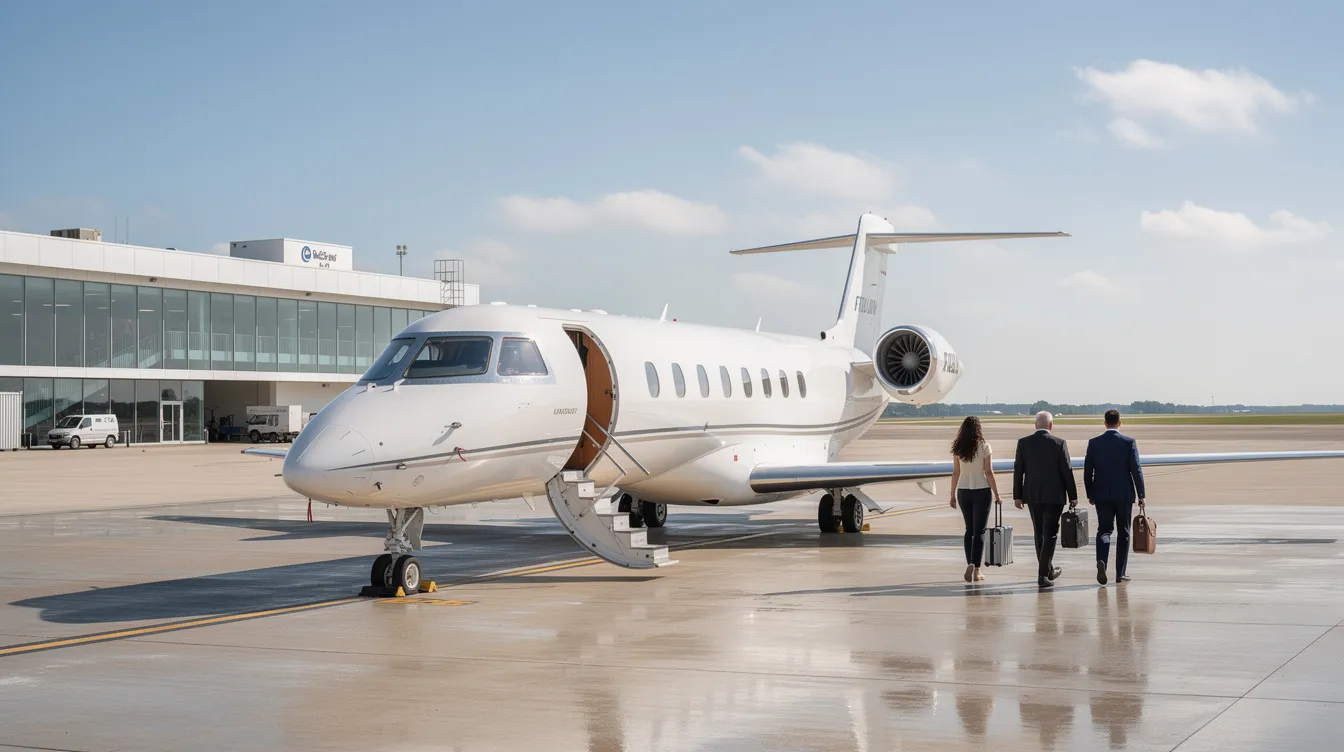
For most of its history, private aviation meant one thing: chartering an entire aircraft for yourself. That model still dominates, but a parallel approach has gained serious traction - private plane rideshare, where travelers buy individual seats or split costs on a private jet instead of shouldering the full expense alone. The result is a per-seat experience that delivers most of the advantages of flying private at a fraction of the regular private airplane price.
Consider a winter 2026 trip from New York to Miami. The flight duration is roughly 2.5 hours either way, whether you sit in a commercial cabin or a private one. The difference is everything that surrounds the flight itself. Commercial airlines require arriving two to three hours early, navigating TSA queues, and enduring gate delays. Private jet rideshare flights operate from private terminals, skipping TSA lines entirely - meaning you show up 20 minutes before departure and walk straight to the aircraft. Rideshare flights can save travelers two to three hours per trip, and on a round-trip itinerary, that adds up to nearly a full recovered workday.
This is why private air travel isn't simply a luxury. It's a strategic tool for frequent business travelers, executives, high-net-worth leisure travelers, and groups that want more flexibility, privacy, and control without paying for a full charter every time. A few key concepts frame the landscape: "rideshare" (per-seat or cost-split access), "empty legs" (discounted repositioning flights), and "jet cards" (prepaid hourly programs like BlackJet's 25- and 50-hour options that guarantee availability and fixed rates). From how rideshare models work and what aircraft and routes are most common to safety rules, booking technology, environmental tradeoffs, and how rideshare compares with jet cards and full charters, the goal is to help you judge when this option makes sense.
What is a private plane rideshare? (And What It Isn't)
Private jet rideshare allows booking individual seats on jets rather than renting the entire plane. Instead of paying for a full aircraft, you purchase one or several seats on a shared flight - either through a per-seat shuttle service on popular routes or by splitting costs among friends, family, or colleagues who charter together.
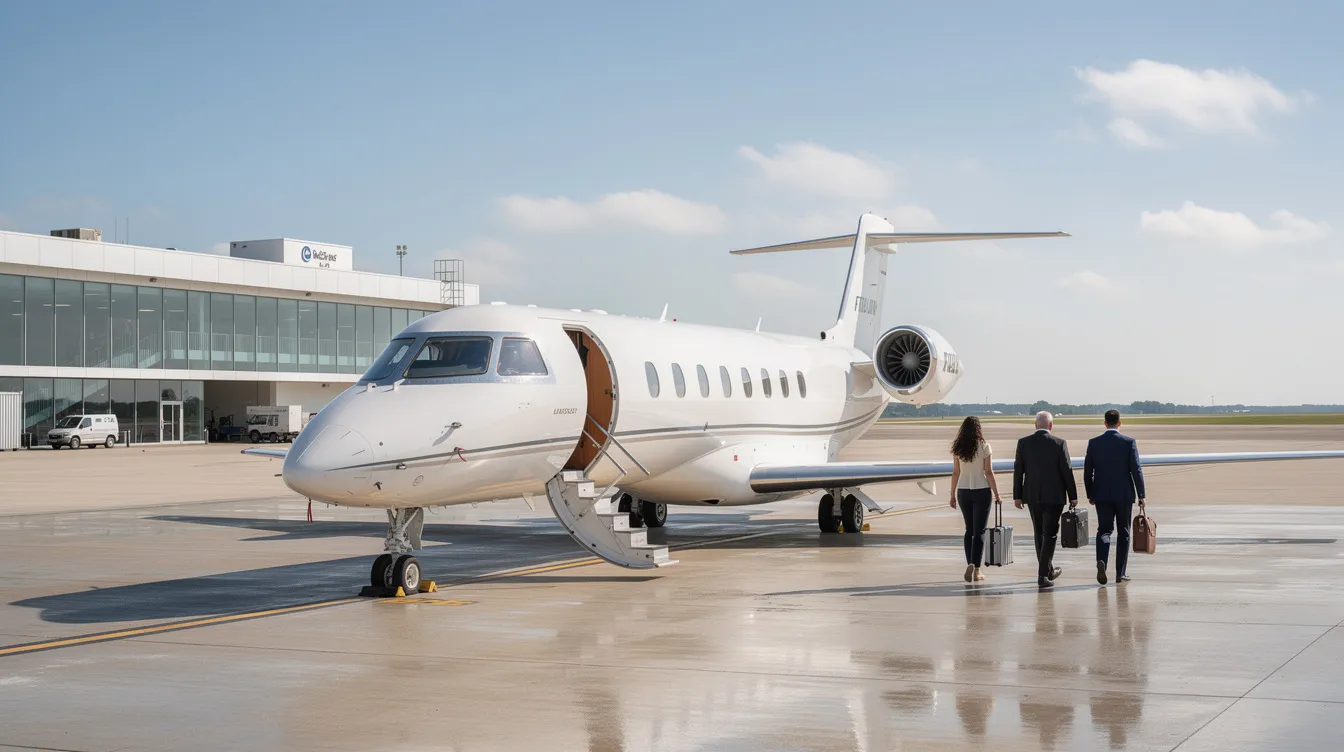
Common setups include semi-private shuttles operating high-demand corridors (New York to Miami, Los Angeles to Las Vegas) and group cost-splitting where a primary booker fills remaining seats from their circle. In all cases, passengers use private Fixed-Base Operators (FBOs) rather than commercial terminals, avoiding long security lines and crowded gates. The FAA has specific rules governing expense-sharing flights in the U.S., and all legitimate shared flights must operate under FAA Part 135 commercial charter regulations or equivalent oversight.
What rideshare is not: unlicensed "gray market" arrangements where private aircraft owners sell seats without proper certification. It's also distinct from fractional ownership, where you buy a share of a specific aircraft, or full jet ownership. Private aviation encompasses services that provide flexibility without ownership, and rideshare sits at the most accessible end of that spectrum. Note that shared flights mean traveling alongside strangers, which limits personal space compared to a private charter.
Full Charter vs Rideshare vs Commercial First Class
Cost per traveler: Charter is highest solo; rideshare splits it 40–70%; commercial first class varies by route
Privacy: Charter is fully private; rideshare is semi-private; first class is shared with 20+ passengers
Schedule control: Charter offers full control; rideshare is moderate; commercial follows fixed timetables
BlackJet primarily focuses on Jet Card and full-charter solutions, but members frequently "self-rideshare" by splitting aircraft costs inside their own group - capturing the economics of rideshare with the reliability of a structured program, much like other affordable private plane rideshare options that make per-seat flying more accessible.
Key Takeaways: Private Plane Rideshare in 60 Seconds
Rideshare can reduce costs per passenger by 40–70% compared to chartering the same aircraft solo, and discounted empty leg flights can be up to 75% off standard pricing.
Travelers typically arrive 20–30 minutes before departure at airports like Teterboro (New York), Van Nuys (Los Angeles), or Henderson (Las Vegas), saving two to three hours versus commercial hubs.
Private jets can access smaller regional airports not served by commercial airlines, getting you closer to your final destination and cutting ground transportation time.
Boarding happens through private lounges with no overhead-bin scrambles, quiet cabins with Wi-Fi, and space for work or relaxation en route.
All legitimate rideshare flights operate under certified charter operators; BlackJet adds carbon-neutral offsets and digital booking platforms for its members.
Rideshare is usually best for flexible leisure travel or group trips on popular routes, while frequent flyers often step up to a BlackJet Jet Card for guaranteed access, fixed rates, and non-expiring hours.
Why Travelers Choose Private Plane Rideshare Over Commercial Flights
The core motivations are straightforward: time, control, comfort, and reduced exposure to crowded terminals. Booking flexibility is a significant consideration for private plane ridesharing, but the time arithmetic alone makes a compelling case.
Take an early Monday departure from New York to Miami in January 2026. On a commercial airline, the 2.5-hour flight balloons into a 6- to 7-hour ordeal once you factor in arriving at JFK two hours early, clearing security, boarding, taxiing, deplaning, and navigating ground transportation on the Miami side. Ridesharing services often use private Fixed-Base Operators (FBOs) to save time - you arrive 20 minutes before wheels-up, walk directly to the tarmac, and land at a general aviation airport like Opa-locka Executive, often closer to your destination. Total elapsed time: roughly 3.5 hours, door to door.
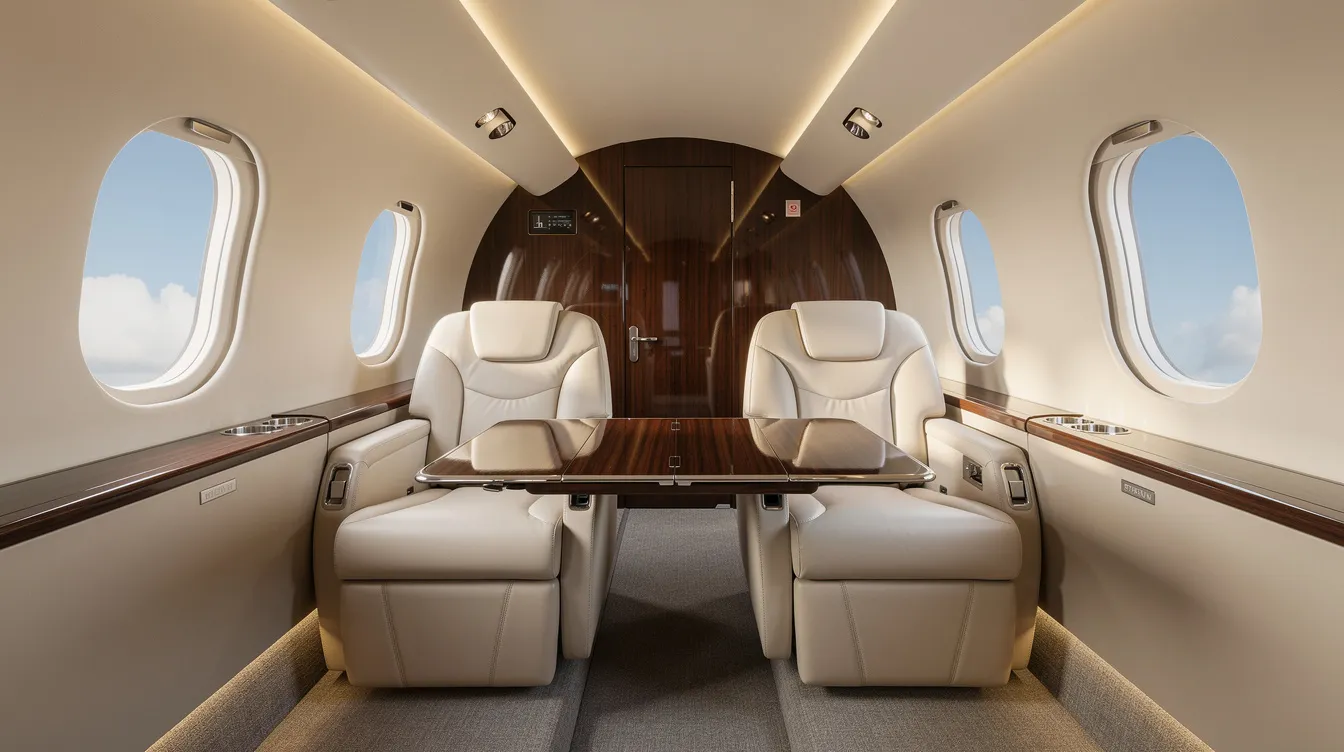
Productivity advantages compound from there. Private flights offer uninterrupted Wi-Fi, table seating for laptops, and quiet cabins where a team can hold a full strategy session instead of whispering over armrests. There's no fighting for overhead bin space, no middle-seat neighbor, and no waiting at a baggage carousel.
Rideshare vs Commercial - At a Glance
Check-in: 20–30 min at FBO vs 2–3 hrs at commercial terminal
Boarding: Walk from lounge to aircraft vs gate queues
Baggage: Generous and handled planeside vs weight limits and carousels
Post-flight: Deplane in minutes at private terminal vs taxi, gate hold, terminal walk
How Private Plane Rideshare Actually Works
Imagine four friends planning a spring 2026 trip from New York to Las Vegas. One person takes the lead, searches available aircraft on a digital platform, and selects a light jet that seats six. The remaining two seats can be offered to acquaintances or left empty - the cost splits among whoever is on the manifest.
Digital platforms simplify private jet bookings with upfront pricing. Travelers search by departure airport, destination, date, passenger count, and preferred aircraft type. Results typically display full charters, shared flights, and empty leg offerings with transparent cost breakdowns. Booking a private jet can be done through mobile apps, and rideshare models generally operate on a pay-as-you-go basis, meaning no long-term commitment for travelers buying a seat on a private jet.
Once a flight is selected, passengers submit manifest details - government IDs, any special requirements like pets, skis, or golf bags - and the charter operator handles compliance with aviation regulations. BlackJet members typically book flights through their Jet Card account, then divide costs internally among their group.
On the day of travel, the process is remarkably simple:
Search & quote - browse routes, aircraft options, and pricing online
Select aircraft - choose the cabin class suited to your group size and route
Confirm & pay - secure the booking digitally with transparent pricing
Receive itinerary - get confirmation with FBO address and ground transportation services details
Arrive & board - park near the FBO, check in, and walk to the jet
Fly - wheels-up within minutes of boarding
Shared Charters, Empty Legs, and Other Rideshare Setups
A shared charter is the simplest form: one organizer books the entire aircraft - say, a light jet from Los Angeles to Las Vegas - and splits the cost among four to eight travelers. Everyone benefits from lower per-seat pricing while retaining more schedule control than a public shuttle.
Empty legs deserve special attention. These are repositioning flights where the aircraft must fly without passengers to reach its next assignment. Roughly 40% of private flights are "ghost flights" without passengers, which is why operators discount empty legs aggressively - often up to 75% off the standard rate. Empty leg flights can be booked at discounts up to 75%, making them the cheapest entry point into private flying. The trade-off: limited routes, short notice (often 24–72 hours), and less control over departure times. They're ideal for travelers with flexible travel plans.
Rideshare flights generally operate on fixed schedules and popular routes. Recurring corporate shuttles - monthly New York–Chicago rotations, for instance - and seasonal leisure runs to ski towns or major events (Art Basel Miami, CES in Las Vegas) represent the more structured end of the spectrum. Rideshare flights often operate on high-demand corridors where demand supports regular departures.
Full Charter vs Shared Charter vs Empty Leg
Cost: Full charter highest; shared charter moderate; empty leg lowest
Flexibility: Full charter maximum; shared charter moderate; empty leg limited
Predictability: Full charter guaranteed; shared charter depends on group; empty leg last-minute
BlackJet Jet Card members enjoy fixed-rate hours for core trips and can layer in empty leg deals for spontaneous getaways when schedules align.
Understanding Costs: What You Really Pay to Fly Rideshare
Private aviation pricing revolves around hourly rates by aircraft category, plus taxes, airport fees, and optional extras like catering or de-icing. Private jet rental prices range from $2,000 to over $20,000 per hour, depending on the aircraft, and understanding how much to rent a private jet in different scenarios helps benchmark whether a rideshare offer is actually a good deal.
Current 2025–2026 North American rate ranges by category:
Aircraft Class | Approx. Hourly Rate |
|---|
Turboprops | ~$6,600/hr |
Light Jets | ~$8,300/hr |
Midsize Jets | ~$9,600/hr |
Super Midsize | ~$12,300/hr |
Large Cabin | ~$15,300/hr |
Ultra-Long-Range | ~$19,200/hr |
The cost structure of ridesharing usually reduces expenses compared to traditional charters by dividing these hourly costs across multiple passengers. A $16,000 light-jet leg from Teterboro to Miami, shared among six travelers, drops to roughly $2,700 per person. Shared flights can reduce costs by 40–70% compared to full charters, and a seat on a shared light jet might start in the low thousands on competitive routes. KinectAir offers empty leg flights starting as low as $111 per person on certain short flights, though availability is limited and routes vary.
Factors that shift per-seat pricing include flight prices varying with route length, seasonality, aircraft size, and cabin fill rate. Empty leg deals can drop per-seat pricing to levels approaching - or occasionally undercutting - last-minute commercial business fares on specific routes.
BlackJet's Jet Card model provides prepaid, transparent hourly rates that eliminate hidden fees and repeated phone calls. For more granular comparisons, travelers can review Jet Card cost-per-hour benchmarks across providers. Cardholders still organize their own internal "rideshares," capturing group economics within a predictable cost framework.
Example Routes and Cost Scenarios (New York, Las Vegas & Beyond)
Popular routes include New York to Miami and Los Angeles to Las Vegas - two of the busiest private aviation corridors in North America, where travelers often seek the cheapest private aircraft options that still deliver a premium experience. Here are illustrative scenarios for 2025–2026:
New York (Teterboro) → Miami (Opa-locka): Flight duration ~2.5 hours on a midsize jet. Full-charter estimate: ~$22,000–$26,000. Split among six passengers: ~$3,700–$4,300 per person. An empty leg deal on the same route could push per-seat pricing below $2,000.
Los Angeles (Van Nuys) → Las Vegas (Henderson): Roughly one hour on a light jet or turboprop. Full charter: ~$7,000–$10,000. Per-seat rideshare among four to six travelers: ~$1,200–$2,500. Commercial business class on this route runs $300–$600 but adds two to three hours of airport overhead.
New York → London: A long-range heavy jet at ~$15,000–$19,000 per hour over a six- to eight-hour crossing totals $100,000–$150,000 for the entire aircraft. Ten executives sharing: ~$10,000–$15,000 per person - comparable to flexible business-class fares but with complete privacy, schedule control, and productive cabin time.
Regional Hops: Dallas to Houston is commonly serviced by turboprop aircraft in about one hour, with full charter costs around $7,000. Toronto to Vancouver typically requires a super midsize jet for approximately five hours. Boston to Nantucket shared shuttles can run as low as $695 per seat during the summer season through operators like Slate Aviation.
For a leisure scenario - two families sharing a light jet to Las Vegas - per-family cost considerations become very manageable. For an executive using a BlackJet Jet Card, the hourly rate is locked in advance and hours never expire, making private jet travel costs predictable regardless of seasonal surges.
Aircraft Options: From Turboprops to Long‑Range Jets
The right aircraft type depends on your route, group size, and mission. BlackJet's diverse fleet access spans every cabin class, so members can step up or down depending on the trip rather than being locked into a specific aircraft.
Turboprops (e.g., Beechcraft King Air 350): Seats 7–9, ideal for short flights under 500 miles. Best for regional hops like Dallas–Houston or island shuttles. Lower operating costs per hour translate to affordable shared flights.
Light Jets (e.g., Embraer Phenom 300): Seats 6–8, cruise at higher speeds, aircraft suited for two- to three-hour flights. Popular for New York–Miami or LA–Vegas runs.
Midsize / Super-Midsize (e.g., Citation XLS+, Challenger 350): Greater cabin height, more baggage capacity, and coast-to-coast range. Comfortable for four- to five-hour flights with full catering and stand-up cabins.
Heavy / Long-Range Jets (e.g., Gulfstream G600, Bombardier Global 6000): Seats 10–16, built for transatlantic crossings and flights exceeding six hours. These aircraft offer lie-flat seating, full galleys, and connectivity for productive long-range missions, and they are often the starting point when evaluating the best private jet for 20 passengers or other larger-group missions.
Best for 1–2-hour leisure trips: turboprops or light jets
Best for 3–4-hour business flights: midsize or super-midsize
Best for coast-to-coast or overnight returns: super-midsize
Best for international crossings: heavy/long-range jets
Safety, Regulation, and Environmental Impact
Operating a chartered flight requires FAA certification for safety compliance - this is non-negotiable. All legitimate private charters and rideshare flights in the U.S. must hold a Part 135 certificate, which mandates strict pilot qualifications, maintenance schedules, insurance minimums, and operational control. There are currently over 1,800 Part 135 certificate holders in the U.S. overseeing roughly 11,500 authorized private aircraft.
Safety records in the private jet industry can vary widely among operators. Passengers should verify credentials through industry rating programs like ARGUS and Wyvern. Avoid "gray market" seat-selling by unlicensed owners - the savings aren't worth the risk. Whether a jet is fully chartered or shared, the safety standards are identical: the charter operator bears full regulatory responsibility.
On the environmental side, transparency matters. Private jets emit approximately 15–16 million tonnes of CO₂ annually, and private jets emit 5–14 times more CO₂ per passenger-kilometer than commercial flights. Private aviation expanded by 31% between 2005 and 2019, intensifying scrutiny. However, rideshare-style flying can cut per-person emissions by 40–70% by improving load factors - filling seats that would otherwise fly empty- all while maintaining the high safety standards outlined in analyses of whether private jets are safe.
BlackJet addresses this directly: every flight is carbon-neutral through verified offsets covering CO₂ and non-CO₂ emissions (water vapor, aerosols, nitrous oxide), built into Jet Card pricing at no additional cost. Where available, BlackJet supports Sustainable Aviation Fuel (SAF) and careful aircraft selection to match the mission - avoiding oversized jets for short flights. The emerging development of electric and hybrid aircraft may further reduce the environmental footprint of private flying in the years ahead.
How Private Plane Rideshare Compares to Jet Cards and Full Charter
Three primary access models serve different traveler profiles:
Ad-hoc rideshare / per-seat flights: Best for occasional travelers, leisure travelers chasing empty leg deals, and groups that don't want long-term commitments. Ridesharing typically involves less flexibility than traditional charter options, and shared flights may have stricter cancellation penalties compared to full charters.
On-demand full charter: Maximum control over timing, routing, and cabin privacy. Necessary when your group fills the entire plane or when departure points are off the beaten path, and best understood in the broader context of a private jet price list that compares charter, ownership, and membership models.
Jet Card programs (e.g., BlackJet's 25- or 50-hour cards): Designed for business travelers and frequent flyers who need guaranteed aircraft availability, fixed hourly rates, and priority support. BlackJet members can still capture rideshare economics by inviting colleagues, friends, or family to share the cost of the flight.
Which Model Fits?
You fly 2–3 times a year for leisure: Rideshare or empty legs offer significant savings without commitment
You fly monthly or more for business: A Jet Card delivers predictability, guaranteed access, and personalized service
You fly 200+ hours annually: Fractional ownership or full ownership may warrant the fixed investment
Ownership and fractional programs remain higher-commitment options with substantial membership fees and capital outlay. For most travelers in the private flight market, a Jet Card paired with occasional rideshare offers the best balance of cost, flexibility, and operational excellence, especially when you compare the best Jet Cards for frequent flyers and how they handle availability and service.
Technology, Booking Experience, and Avoiding Phone Calls
The old model of multiple startups and faxed contracts has given way to digital booking platforms that deliver real-time pricing, aircraft comparison, and digital signatures. The booking process for private flights in 2026 feels closer to reserving a boutique hotel suite than negotiating with a broker.
BlackJet leverages 24/7 digital tools and a mobile-friendly experience for Jet Card holders: instant estimates, multi-leg route planning, and real-time support via chat or phone when needed. Transparent pricing screens show a clear breakdown of base rate, taxes, FBO fees, and any surcharges - no surprise invoices weeks later, consistent with the broader BlackJet premium private Jet Card programs' positioning.
KinectAir uses AI-backed software for private flight bookings, optimizing available aircraft and routes in real time. Private Jets Inc. is another on-demand charter operator leaning into digital booking and app-style access. Jettly connects travelers to over 20,000 private aircraft worldwide. JSX offers scheduled routes with quicker boarding than commercial flights on semi-private aircraft. These platforms collectively reflect a broader shift: making private aviation as intuitive to book flights as any modern travel service, while maintaining the high-touch personalized service that distinguishes private flying and echoing trends seen among top private jet companies for luxury travel.
Itinerary management features - digital confirmations, ground-transport coordination, automatic weather updates - give travelers a sense of control that phone calls alone never provided.
Use Cases: Business, Leisure Travel, and Event‑Driven Rideshare
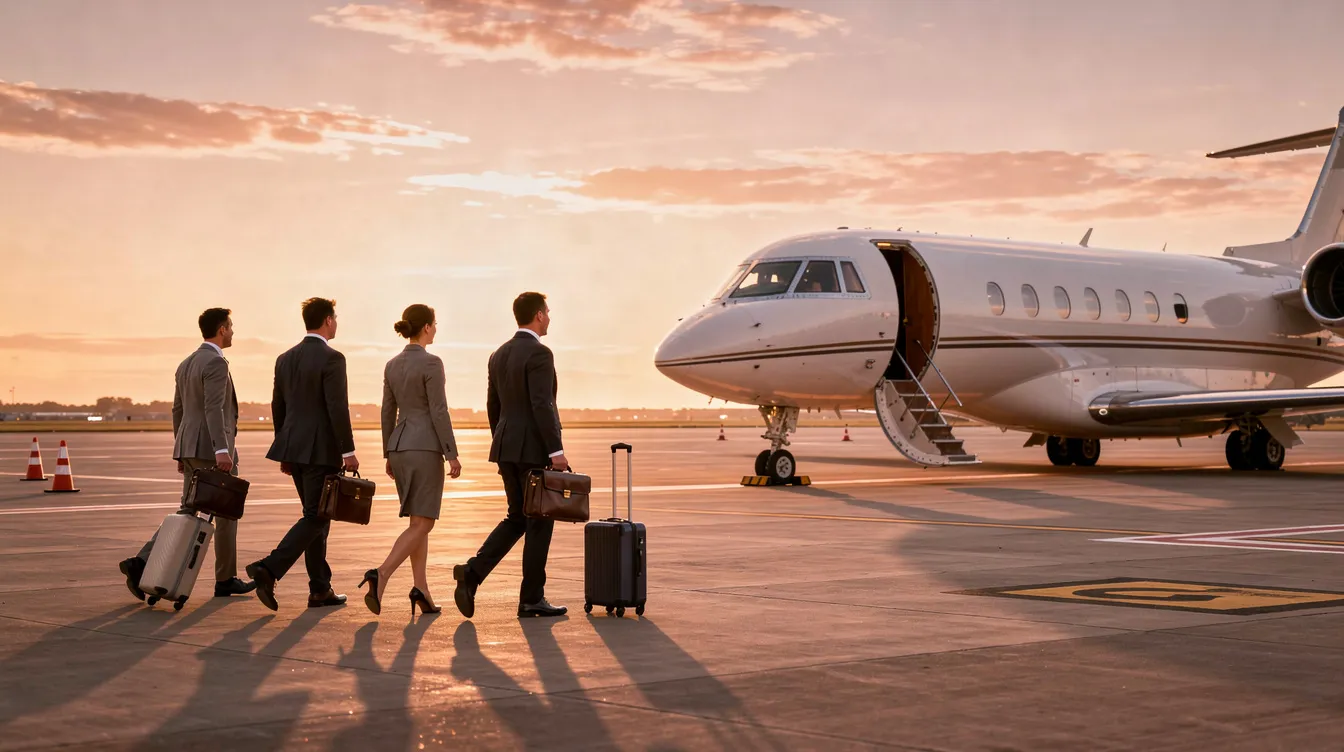
The Executive Shuttle: A New York-based executive team needs to be in Chicago for a morning client meeting and back by dinner. Six colleagues book a midsize jet through their BlackJet Jet Card, turning the two-hour flight into a strategy session with Wi-Fi, whiteboards, and catering. The per-person cost - split six ways - is less than two last-minute flexible schedules business-class tickets, and they avoid an overnight hotel stay entirely.
The Leisure Getaway: Two families from Los Angeles want a long weekend in Las Vegas. They find an empty leg deal on a light jet departing Van Nuys on Thursday afternoon - the aircraft needs to reposition for a Saturday charter. The four adults and three kids board with luggage, golf bags, and a small dog, all impossible to manage smoothly through commercial airport operations. Total per-family cost: roughly $2,500, with door-to-door time under two hours.
The Event Flight: A group of eight art collectors coordinates a shared charter from New York to Miami for Art Basel week. By filling every seat, they reduce per-person charter flight costs to roughly what a premium commercial ticket would run - but they depart on their schedule, arrive at a private terminal, and skip the chaos of MIA during peak event season, applying many of the strategies described in guides on how to fly private cheaply with shared charters.
Private terminals and FBOs also simplify gear-heavy leisure travel - skis, surfboards, golf clubs - and pet-friendly flying private is standard on most charter operations, with animals welcomed in the cabin rather than confined to cargo. Even helicopter rides to nearby destinations become seamless when departing from the same FBO network.
FAQ: Private Plane Rideshare and BlackJet
Can I book just one seat on a private jet?
Yes. Per-seat public shuttles and private jet rideshare platforms like Slate, JetShare, and JSX sell individual seats on scheduled or event-driven routes. BlackJet focuses on Jet Cards and full private jet charters, but members frequently split costs among their own group - a private jet rideshare lets them capture similar economics.
How far in advance should I plan a rideshare flight?
Scheduled per-seat shuttles can be booked weeks to months ahead. Empty leg flights typically become available 24–72 hours before departure - empty leg flights can be up to 75% cheaper than regular prices, but require flexible travel plans and an understanding of how to buy a seat on a private jet and choose among affordable private plane rideshare options.
Can I bring pets or oversized luggage?
Most charter operations welcome pets in the cabin and accommodate golf clubs, skis, and surfboards. Communicate requirements during the booking process so the operator can confirm the aircraft has adequate space.
What happens if someone in my group is late?
Depending on the operator and airport operations schedule, a short delay may be possible. However, private aviation runs on tight windows - if a departure slot is missed, the flight may leave without the late passenger, forfeiting their seat.
How does BlackJet ensure carbon-neutral flying?
BlackJet calculates emissions for every flight - including non-CO₂ impacts like water vapor and aerosols - and purchases verified offsets. These costs are built into Jet Card pricing with no surcharge. This approach connects travelers to responsible private flying without requiring separate offset purchases.
How do I verify that an operator is safe?
Request the operator's Part 135 certificate, review their maintenance programs, and check for ARGUS or Wyvern safety ratings. BlackJet selects only certified operators that meet or exceed industry benchmarks, providing peace of mind through its proprietary vetting process. Pilot qualifications, insurance documentation, and incident history should all be transparent.
Is a rideshare or a Jet Card a better value?
It depends on frequency. For two to three trips a year, rideshare flights and empty legs offer significant savings. For monthly or more frequent travel, a BlackJet Jet Card with its most extensive fleet access, fixed rates, and guaranteed availability is typically the smarter long-term investment - and members can still share costs with colleagues or family on any flight, especially once they understand Jet Card cost structures across the market.
Conclusion: Elevating Access with BlackJet
Private plane rideshare has reshaped expectations about who can access private flying. By splitting costs across passengers and making use of empty legs and shared charters, the model brings private jets within reach of travelers who never considered them before. But the real value - the reason this matters beyond a single discounted flight - lies in safety, reliability, and strategic time savings that compound trip after trip.
BlackJet's positioning reflects this reality. With Jet Card programs offering non-expiring hours, fixed rates across cabin classes, carbon-neutral flying at no extra cost, and technology-driven booking that rivals the simplicity of any modern travel platform, BlackJet delivers rideshare-like ease without compromising on certification standards or personalized service. Members choose the aircraft suited to each mission from a diverse fleet, and they share costs among their circle whenever it makes sense.
Think beyond one-off deals. A 25- or 50-hour BlackJet Jet Card can anchor your travel strategy for the year - covering business shuttles, family getaways, and everything in between - while still allowing the flexibility to split costs and fly smarter; comparing 50 hour Jet Card costs, 100 hour Jet Card pricing, and broader Jet Card pricing structures or even unlimited private jet flight memberships can clarify which commitment level fits your travel profile best.
Explore BlackJet membership, request sample itineraries from New York, Miami, or Las Vegas, or speak with an aviation advisor about tailoring aircraft options to your calendar, from the cheapest private jet options up through NetJets-style Jet Card cost comparisons and even private jets for 50 passengers for large groups. Your time is the one asset that doesn't replenish - invest it wisely.


 Sign up with google
 Sign up with Apple