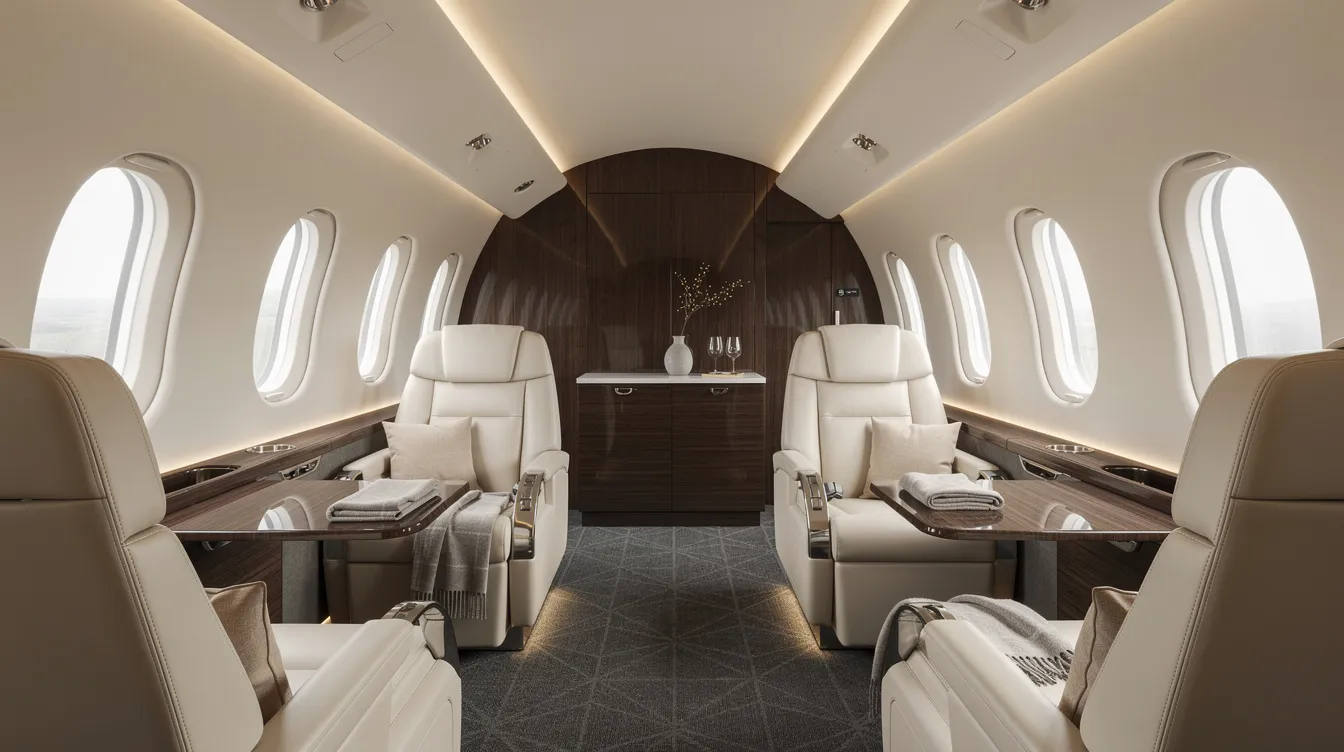
For executives closing deals at 40,000 feet and families flying to mountain retreats, the private jet kitchen transforms airborne hours into productive, restorative time. Unlike commercial flights, where meals arrive on someone else’s schedule, flying private means dining when you want, eating what you prefer, and doing so in complete privacy.
The contrast with commercial first class is significant. Even top-tier airline cabins serve fixed menus at predetermined times, share galley facilities with hundreds of passengers, and offer limited flexibility for dietary restrictions. Private jet passengers enjoy on-demand service—meals served whenever the passenger wants them—with menus tailored to individual preferences and the ability to work through a video call without interruption from cart service.
BlackJet’s Jet Card members benefit from consistent galley standards across our network. Whether you’re boarding a midsize jet for a New York-to-Miami working lunch or a large-cabin aircraft for a Los Angeles-to-Aspen family ski trip, you’ll find galley amenities matched to your journey type, with predictable Jet Card membership pricing underpinning the experience. Our approach integrates four pillars: safety and certification of all galley equipment, seamless integration with modern cabin technology, sustainability through carbon-neutral flights, thoughtful provisioning, and 24/7 support for catering logistics.
Evolution of Private Jet Kitchens
Private jet kitchens have evolved from basic functionality, primarily serving simple snacks and beverages, to sophisticated spaces designed for high-quality meal preparation. In the 1960s and 1970s, early business jets like the Learjet 23 and Gulfstream II carried only insulated ice chests, thermos coffee, and packaged crackers. Full cooking posed fire and weight risks in compact fuselages.
The increasing demand for fresher, higher-quality, and more varied food options has significantly propelled advancements in the design and functionality of private jet kitchens over the years. By the 1990s, aircraft like the Gulfstream IV and Bombardier Challenger 604 introduced hot galleys with convection ovens capable of 350-400°F, chilled storage, and stainless-steel counters for basic plating.
Today’s ultra-long-range jets—the Gulfstream G700 (certified August 2023) and Bombardier Global 7500 (in service since 2018)—support multi-course, chef-designed tasting menus with dedicated forward or aft private jet galleys, sitting among the top private jets in the world. Passenger expectations shifted from “something to eat” to fully bespoke, dietary-compliant menus—gluten-free, kosher, keto—served at any time during the flight. BlackJet’s Jet Card programs leverage this evolution by matching members to aircraft whose kitchens deliver the dining experience they expect.
Design Considerations for a Private Jet Kitchen
Every inch of galley space must justify its weight, cost, and impact on passenger comfort. A well-kept kitchen in a private jet ensures food safety and contributes to the overall comfort of the flight. Modern private jet kitchens are equipped with high-performing appliances such as mini-fridges, fully functioning ovens, and even coffee machines, reflecting a blend of practicality and luxury.
Key design priorities include FAA and EASA regulatory compliance, ergonomics for flight crew, noise and heat management (keeping cabin temperatures within 2°C of ambient), and the visual impression passengers receive on boarding. Cabin class—light jets, midsize, super-midsize, large cabin, ultra-long-range—drives the scale of the kitchen and service capability, and it also shapes where each aircraft sits on the broader private jet price spectrum, so understanding the different private jet sizes helps align galley expectations with mission profile.
Spatial Constraints and Layout
The layout of a private jet kitchen must be efficient due to limited space, often utilizing U-shaped or galley designs to facilitate easy movement and access to appliances. Light jets like the Cessna Citation CJ4 use straight-line galleys with vertical stacking—overhead cabinets and pull-out refrigerated drawers—to preserve 18-inch aisles. Large-cabin aircraft like the Dassault Falcon 8X feature L-shaped or U-shaped configurations with pocket doors or curtains providing visual separation from the main cabin.
Light jets allocate just 4-6 square feet to galley space, while large-cabin models dedicate 20-40 square feet. Forward galleys minimize service disruption on work-focused private flights, while aft placement suits family trips where social dining takes priority.
Aircraft Category | Galley Type | Typical Galley Size (sq ft) | Layout Style | Placement | Typical Use Case |
|---|
Light Jets | Refreshment Centers | 4-6 | Straight-line, vertical stacking | Forward | Short hops, snacks, beverages |
Midsize/Super-Midsize | Hot Galleys | 8-15 | U-shaped or L-shaped | Forward | 3-6 hour flights, hot meals |
Large Cabin Jets | Full-Service Galleys | 20-40 | U-shaped or L-shaped | Forward or Aft | Long flights, multi-course meals |
Ultra-Long-Range Jets | Full-Service Galleys | 25-40+ | U-shaped, pocket doors | Forward or Aft | Intercontinental, bespoke menus |
Materials and Durability
Materials used in private jet kitchens must be durable and lightweight, with stainless steel being a popular choice for its strength and ease of cleaning, while also ensuring compliance with aviation safety standards. Carbon-fiber reinforced polymers (40% lighter than aluminum), titanium-edged stainless steel, and low-VOC laminates mimicking Calacatta marble are standard.
Regulatory requirements mandate low-smoke, low-toxicity, and fire-resistant materials. On charter and Jet Card flights with high utilization (300-500 hours annually), seamless welds reduce bacteria traps, and rounded corners facilitate wipe-downs in 5-10 minutes at FBOs. Daily cleaning tasks in a private jet kitchen are essential to maintain hygiene and prevent foodborne illnesses during flights.
Safety and Compliance
Safety considerations in private jet kitchen design include using fire-resistant materials, securing appliances during flight, and installing smoke detectors and fire extinguishing systems to meet aviation regulations. Every heating element, door latch, storage drawer, and appliance must be certified for use under turbulence up to 3.8g forces, rapid deceleration, and varying cabin pressure.
Core safety features include secured latching systems, gimbaled containers, dedicated circuit protection (15-20A) for ovens and induction hobs, and aircraft-specific smoke detection with Halon-alternative suppressors. BlackJet works exclusively with ARGUS Platinum and Wyvern Wingman-rated operators whose aircraft and flight attendants meet or exceed these requirements. Weekly maintenance tasks for private jet kitchens include checking appliances and ensuring that all surfaces are clean and sanitized to uphold safety standards.
Essential Appliances and Equipment in a Private Jet Kitchen
Private jet kitchens require compact and high-performing appliances to ensure efficient meal preparation in a limited space. The core toolkit differs from ground kitchens—reheating and finishing rather than full raw cooking due to power limits (typically 5-10kW galley draw on 28V DC systems).
Advanced equipment like convection ovens, microwaves, induction cooktops, and professional-grade espresso machines is common in larger private jets. BlackJet curates aircraft with consistent minimum galley standards for each cabin category, so members know what level of service to expect as part of our broader premium private jet card programs.
Ovens and Microwaves
High-Speed Convection Ovens are staples for finishing gourmet meals that are often partially prepared on the ground. Large-cabin jets feature compact convection or steam-combination units (e.g., B/E Aerospace Slimline, 1.2 cubic feet) that crisp pastries, reheat beef tenderloin to 140°F core, and finish sauces without over-drying.
Ovens and microwaves in private jet kitchens should be versatile, allowing for quick reheating and cooking while fitting the limited onboard space. Midsize jets combine convection ovens and microwave functions in a single unit to save space and reduce power draw. A New York-Miami BlackJet flight might use the oven to finish a pre-seared filet mignon or warm sourdough bread right before serving.
Refrigeration Solutions
Efficient refrigeration solutions are crucial in private jet kitchens, with models designed to keep food fresh under varying cabin pressures and temperatures. Under-counter fridges and refrigerated drawers maintain food-safe temperatures despite frequent door openings.
Dual-zone systems separate raw ingredients and chilled starters (0-4°C) from desserts and beverages (4-8°C)—essential for longer flights like Los Angeles-Honolulu. Engineering features include vibration-tolerant compressors and spill-proof liners. BlackJet’s preferred operators maintain documented pre-flight checks on galley cooling systems, especially on long-range missions where food remains onboard for 10-12 hours.
Cooking Surfaces
Induction cooktops are favored in private jet kitchens for their efficiency and safety, as they only heat the cookware, making them ideal for confined spaces. Modern surfaces (1.5-2.2kW, 2-3 zones) feature automatic shutoff upon pan removal or turbulence detection.
Use is controlled: finishing sauces, reheating soups, gently cooking scrambled eggs, or risotto. Some aircraft feature fold-down cooktops that retract into counters when not in use. A morning BlackJet departure from Teterboro to Sun Valley might see the crew preparing fresh omelets and oat bowls on an induction surface while passengers work, even on more affordable entry-level private jets used for shorter missions, similar to the best small private aircraft options for tailored missions.
Coffee Machines and Beverage Centers
Large-cabin jets feature plumbed espresso machines (dual boilers for espresso at 93°C), while midsize jets use capsule/pod systems (19-bar pressure). Smaller aircraft rely on premium thermal carafes. Beverage centers integrate racks for Champagne, temperature-controlled wine storage (12-14°C), and secure holders for premium spirits.
BlackJet members specify brand-level culinary preferences during pre-flight coordination—single-origin espresso, particular Champagne houses, fresh-squeezed juices, or non-alcoholic soft drinks. All equipment and bottles are secured to withstand turbulence at the higher cruise altitudes typical of private jets.
Food Storage and Waste Management at 30,000 Feet
Storage space and waste handling are critical to hygiene, odor control, and overall comfort in a pressurized environment. Needs differ significantly between 2-hour hops, 5-hour transcontinental flights, and 10+ hour transpacific missions.
Regulatory rules for international private flights influence what happens to leftovers upon landing. Controlled waste protocols apply when arriving in the U.S., EU, and UK—no meat residuals into the UK per DEFRA rules, for example. BlackJet coordinates with FBOs for compliant, seamless waste removal.
Refrigerated Drawers and Cold Storage
Refrigerated drawers are organized by course (starters, mains, desserts) or timing (early-flight light snacks vs. late-night service) to keep service efficient. Labeling systems include date/time stickers from caterers and color-coded containers for different passengers—one gluten-free, one nut-free—especially on family or executive team flights.
Quiet, low-vibration drawer mechanisms avoid disturbing sleeping private jet passengers on overnight transatlantic flights.
Dry Storage Innovations
Pull-out pantries, slim racks, and custom dividers hold snacks, teas, coffee capsules, and shelf-stable items without rattling during climb and descent. Typical dry-stocked items for BlackJet flights include premium nuts, dark chocolate, artisanal crackers, children’s snack boxes, and single-serve condiments.
For regular clients who fly multiple times monthly with the same food choices, certain items—high-end olive oils, specialty salts, gourmet crisps—remain pre-stocked aboard, much like the bespoke provisioning common on a 20 million dollar private jet and other most expensive private jet options for luxury travel.
Waste Compaction and Disposal
Compactors or tightly sealed waste bins compress packaging and food scraps, reducing volume by 70% and controlling odors on longer sectors. Waste is segregated onboard (recyclables, food, and regulated international waste) and handed to the FBO under local environmental rules.
BlackJet’s carbon-neutral model extends to encouraging operators and caterers who minimize single-use plastics and use recyclable packaging—70% recyclable materials where regulations allow.
Serving and Presentation in the Cabin
For high-net-worth travelers, the manner in which a meal is served is just as important as the food itself. Private jet catering focuses on culinary excellence, delivering gourmet meals crafted to please the palate, with meticulous attention to preparation and presentation to ensure every dish onboard matches restaurant-quality standards.
Service differs from restaurant dining: personalized pacing, minimal interruptions during calls or presentations, and the ability to reset the cabin between main courses to keep the environment serene. BlackJet works with operators whose cabin crews are trained in fine-dining etiquette and discreet hospitality, layered on top of the strong safety record of private jets, a standard mirrored in the Saudi prince's private plane luxury environment, where bespoke service and safety are equally critical.
Tableware and Utensils
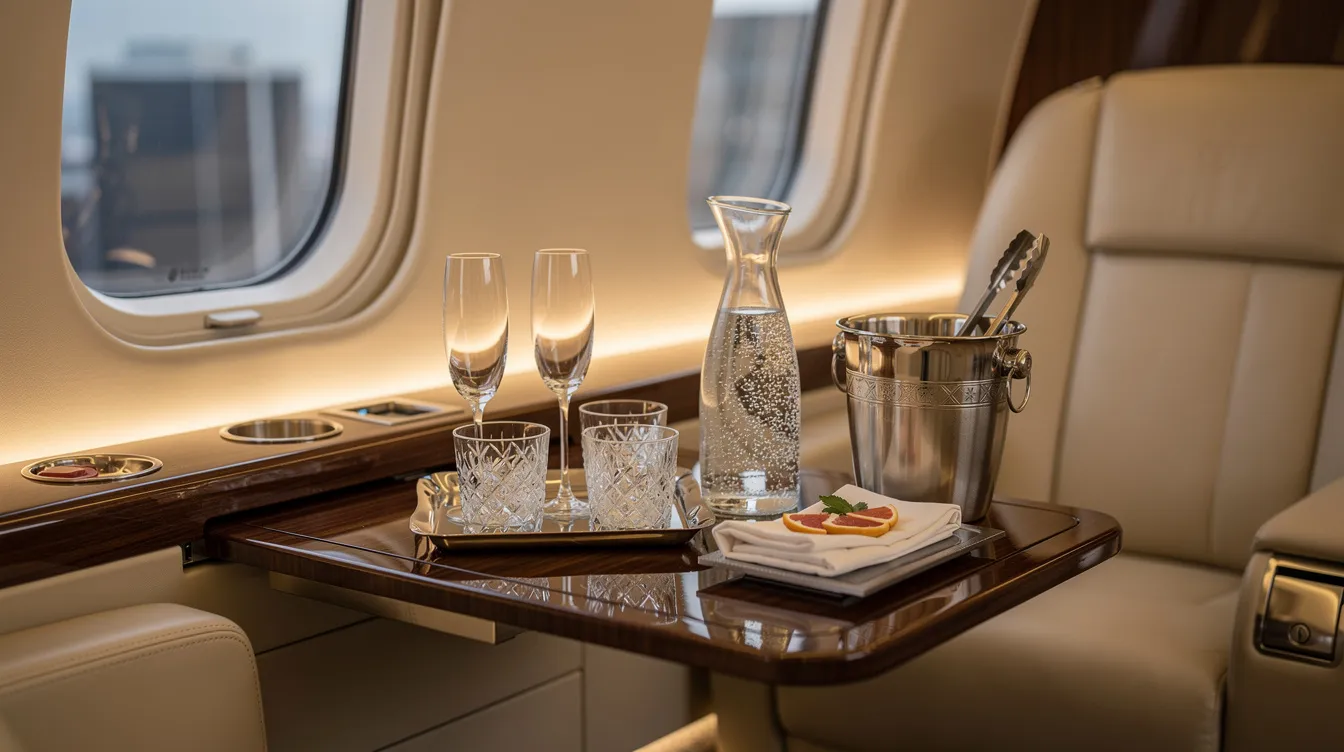
In a private jet, tableware and utensils are chosen with care to match the luxury of the setting, often featuring fine china, crystal glassware, and silver cutlery. Porcelain plates (10-12 inches) fit fold-out tables from seats and divans.
Everything is stowed in fitted foam or felt-lined drawers, with straps for crystal glassware and soft separators preventing noise and breakage. Frequent BlackJet users may find monogrammed napkins or branded espresso cups on select aircraft.
Serving Equipment
Larger cabins use foldable or narrow-profile service carts (18 inches wide), while smaller jets rely on handheld tray service where aisle width is limited. Warming drawers or hot boxes hold plates at a temperature while passengers finish video calls.
A working lunch on a San Francisco-Dallas flight sees courses plated in the galley and quietly delivered one by one—laptops and documents remain undisturbed, illustrating how onboard dining complements the time savings outlined when chartering a private jet is worth it.
Presentation Techniques
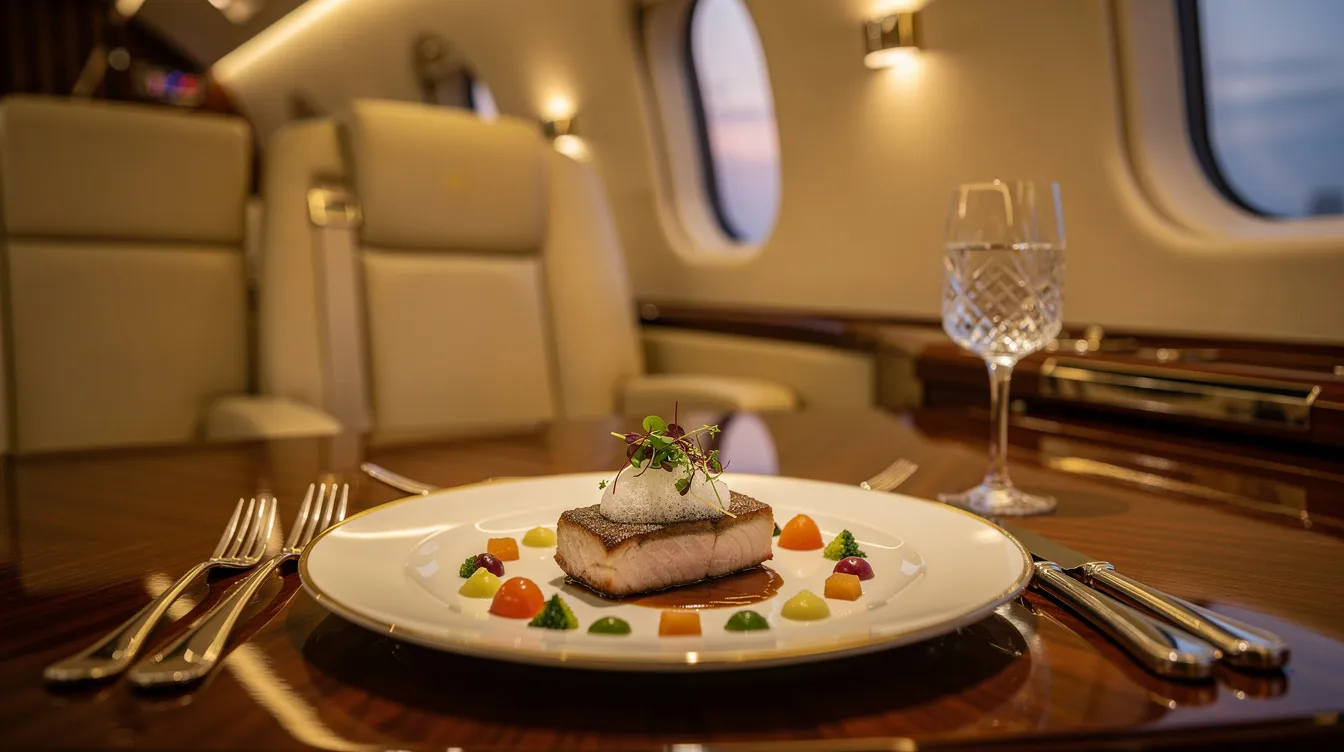
Meals on private jets are plated with precision and styled to enhance visual appeal, often using garnishes and thoughtful plating techniques. Restaurant-style plating adapts for aircraft movement: tight compositions, controlled sauces (viscosity >500 cP), and garnishes chosen to stay attractive despite vibration.
The presentation of meals on private jets extends to the overall table setting, which may include elements like flowers or elegant cloths to create a luxurious dining atmosphere. Adjustable cabin lighting creates a dining “scene” distinct from work or sleep modes—dimmed to 300 lux for intimate dinners or celebratory champagne service.
Customization, Branding, and Integration with Cabin Systems
On many owner-operated and large-cabin aircraft in the BlackJet network, the jet kitchen and dining experience reflects a client’s brand or personal style. Pre-stocked favorite dishes for regular Jet Card members create seamless, personalized private jet travel.
Customization and Branding Options
Galley cabinets, countertops, and splashbacks can match wider cabin aesthetics—dark wood with warm lighting for a club-like feel, or light veneers and white stone for a contemporary vibe. Branding appears subtly: menu cards with corporate logos on investor roadshow flights, signature dishes always onboard for a family’s children.
BlackJet’s client team maintains preference profiles. A particular Bordeaux, curated wine pairings, or plant-based dessert appears automatically on repeat flights without re-specifying—mirroring the personalization owners expect from a 15 million dollar private jet.
Integration with Cabin Management Systems
Crew controls galley power, lighting, and equipment from the CMS, enabling quick transitions between pre-boarding prep, service, and nighttime quiet mode. Passenger-side controls via touchscreens or mobile apps adjust lighting to “dining” setting, temperature around seating areas, or background music during meals.
BlackJet’s technology platform complements this onboard tech—travelers specify flight catering requirements and meal timing preferences during booking. Pre-scheduled breakfast service an hour before landing in London on an overnight flight? Handled seamlessly.
Private Jet Kitchens by Aircraft Category
“Private jet kitchen” means different things depending on aircraft type. A light jet for 90 minutes differs dramatically from an ultra-long-range jet for 12 hours, especially on the largest private jets for global travel, reflecting the broader types of private jets available for every traveler. This section walks through typical galley capabilities by cabin class.
Aircraft Category | Kitchen Features | Typical Meal Service | Flight Duration Range | Example Aircraft |
|---|
Light Jets | Refreshment center, cold storage | Snacks, cold platters | Up to 2 hours | Embraer Phenom 300, Citation CJ4 |
Midsize/Super-Midsize | Hot galley with convection oven | Full meals, 1-2 meal services | 3-6 hours | Citation Latitude, Praetor 600 |
Large Cabin Jets | Full galley, dual ovens, warming drawers | Multi-course meals, fine dining | 6-12 hours | Dassault Falcon 8X, Gulfstream G650 |
Ultra-Long-Range Jets | Advanced full galley, dishwashers | Multi-course tasting menus, bespoke | 8-14+ hours | Gulfstream G700, Bombardier Global 7500 |
Light Jets: Smart Snacks and Simple Service
Light and Midsize Jets often feature ‘Refreshment Centers’ rather than full kitchens, limited to cold storage and beverage setups. Common light jets (Embraer Phenom 300, Citation CJ4) have compact refreshment centers: chilled beverage storage, ice drawer, coffee/tea setup, and premium snack baskets, aligning with many of the cheapest private aircraft options for cost-conscious flyers.
No full oven or induction cooktop means food focuses on high-quality cold platters, salads, gourmet sandwiches, and ambient simple snacks—ideal for 60-120 minute hops. A Boston-Washington, D.C. BlackJet itinerary might feature curated charcuterie boards, smoked salmon, fresh fruit, and snacks matching special diets for travelers who may also occasionally book individual seats on private jets instead of whole-aircraft charters or explore regional options such as private jet charters in Karachi when flying internationally.
Midsize and Super-Midsize Jets: Elevated Dining
Aircraft like the Citation Latitude, Hawker 900XP, and super-midsize Praetor 600 add hot galley capabilities: combination ovens, larger chilled storage, and better work surfaces. Typical missions (3-6 hours) allow one or two structured meal services.
A Chicago-San José flight might see sushi starters, hot lamb chops, or grilled salmon with seasonal vegetables, and plated dessert—all finished in the onboard galley. Vegan dishes and pasta dishes are increasingly common menu options on the types of 10-million-dollar private jets many travelers consider for ownership or frequent access, similar to curated cabins among the best private jets for sale under 10 million.
Large Cabin and Ultra-Long-Range Jets: Full Culinary Experience
Heavy and Ultra-Long-Range Jets are equipped with ‘Full-Service Galleys’ that can include dual ovens, warming drawers, and advanced technology like in-flight dishwashers. Ultra-long-range private jets for sale and other largest private jet options often feature full-height galleys enabling world-class multi-course service for 10-16 passengers on flights of 8-14 hours, especially on the newest generation of private jets blending innovation and luxury.
Realistic menus include caviar and champagne on departure, mid-flight tasting menus with complex meals, and made-to-order breakfast before landing. More complex meals, like elaborate tasting courses, are served with precision. Many BlackJet members flying transatlantic or transpacific opt for larger Jet Card blocks specifically for this caliber of in-flight dining experience, often choosing 16-seat private jet cabins to balance space, range, and galley capability, similar in spirit to unlimited private jet flight membership models for frequent travelers.
Private Jet Catering Logistics: From Order to Onboard
Even the most advanced kitchen facilities rely on a well-coordinated catering plan. Typically, catering orders for private jets must be placed 24 to 48 hours in advance to ensure all details are meticulously managed, allowing chefs to source fresh ingredients and craft customized dishes tailored to individual preferences, just as careful planning underpins decisions around how much it costs to rent a private jet.
BlackJet’s team coordinates with operators 24-72 hours before departure, depending on menu complexity and departure country. Remote airports or exotic ingredients require 72+ hours of advance planning. FBOs receive, store, and transfer catering to the aircraft right before boarding, maintaining cold chain and presentation standards, whether a client books the whole aircraft or simply buys a seat on a private jet.
Safety, Hygiene, and Sustainability in the Private Jet Kitchen
High-net-worth travelers increasingly expect robust hygiene protocols and environmental responsibility alongside luxury. Food safety practices include temperature logging every 2 hours (critical at 8,000-foot cabin altitude where bacterial growth accelerates 20% faster), sealed containers, handwashing protocols for crew, and avoidance of high-risk foods on long-haul flights.
Cabin and galley cleaning routines before and after each leg include sanitizing high-touch areas, disinfecting worktops, and rotating stock. BlackJet’s carbon-neutral commitment extends to catering—encouraging sustainable sourcing, mindful packaging, and efficient loading to minimize waste, principles that also support emerging private plane rideshare options for more efficient flying and align with strategies to fly private more cheaply without sacrificing comfort. Menus for private jet catering are fully customizable, allowing passengers to request signature dishes or specific cuisines to suit their tastes, including options for dietary restrictions such as vegan, gluten-free, and kosher meals.
Frequently Asked Questions About Private Jet Kitchens and Dining with BlackJet
What kind of kitchen facilities can I expect?
Galley amenities vary by cabin class. Light jets feature refreshment centers; midsize/super-midsize add hot capabilities; large-cabin and ultra-long-range offer full galleys with dual ovens and warming drawers. BlackJet advisors confirm galley details before each trip.
How far in advance do I need to finalize my catering order?
Standard menu options require 24-48 hours. Special requests, rare fresh ingredients, or remote airports need 72+ hours.
Can BlackJet accommodate complex dietary restrictions?
Yes. Kosher (with separate utensils), gluten-free, keto, plant-based, and special diets are accommodated through pre-flight coordination with caterers.
How does private jet dining compare to commercial first class?
Commercial airlines offer fixed menus at predetermined times. Flying private enables anytime service, 100% dietary compliance vs. approximately 70% on commercial aircraft, complete privacy, and no shared galley serving hundreds of commercial flight passengers, benefits that are often factored into comprehensive Jet Card pricing and value guides.
Are private jet kitchens safe during turbulence?
Yes. All appliances feature automatic shut-offs, secured latching engaging at 1.5g forces, and crew trained in galley fire response. The private jet experience prioritizes safety alongside luxury for small groups, as well as those exploring private jets that seat around 20 passengers or evaluating the best private jets for 15 passengers on longer missions.
What happens to leftover food when landing internationally?
Leftovers are disposed of per CBP, DEFRA, and local regulations—no re-use permitted for international waste. BlackJet coordinates seamless FBO handoff so passengers never think about it.
Conclusion: Choosing the Right Private Jet Kitchen Experience with BlackJet
Galley design, appliance capability, flight catering logistics, and crew training converge to define your dining experience. The detail extends from convection ovens to crystal glassware, from refrigerated drawers to plating techniques that survive turbulence while delighting continually evolving taste buds.
For busy executives and families, the strategic benefit is clear: work, rest, and dine properly in a controlled, private environment instead of managing around commercial airlines' schedules and meal limitations, especially when partnered with one of the top private jet companies for luxury travel. The difference between smaller aircraft with basic kitchens and heavy jets with full galleys shapes what’s possible—from gourmet sandwiches to multi-course tasting menus.
BlackJet’s Jet Card model simplifies access: one relationship, predictable standards across aircraft categories, carbon-neutral flights at no extra cost, and a team that learns your individual preferences, comparable to the service benchmarks set by top private jet charter companies in the USA and supported by advisory expertise for buyers exploring premium UK private jets for sale. Catering plays a crucial role in the private aviation experience, and our network of certified operators ensures your favorite dishes arrive fresh and served to perfection.
Explore BlackJet membership to discover which aircraft and kitchen setups match your lifestyle. Whether your typical routes call for working lunches or celebratory dinners at altitude, our team is ready to reshape your private jet travel.


 Sign up with google
 Sign up with Apple