For the modern executive or high-net-worth traveler, the difference between a productive day and a wasted one often comes down to how you move between cities. A private jet center transforms the airport experience from a multi-hour ordeal into something measured in minutes, and BlackJet makes that transformation available on every flight, without the burden of owning a single aircraft.
Why a Private Jet Center Is a Strategic Advantage in Private Aviation, Not Just a Luxury
A private jet center is a private aviation terminal where a trip begins and ends, usually operated by a Fixed Base Operator, or FBO, that provides fueling, maintenance, hangar space, VIP lounges, direct ramp access, and ground support at smaller regional airports. For modern executives, high-net-worth leisure travelers, corporate travel managers, and family offices that want flexible, safe, efficient private jet access without owning an aircraft, understanding how these terminals work is central to making faster, less stressful travel decisions.
Consider the arithmetic of a typical commercial departure from a major hub like Pittsburgh International Airport. You drive to the terminal, park in an economy lot or arrange a rideshare, walk through the terminal, pass through TSA security screening, reach your gate, wait for boarding groups, and finally settle into your seat. On a good day, that process consumes ninety minutes. On a bad day—holiday travel, weather delays, overbooked flights—it can stretch well past two hours.
Now contrast that with arriving at a regional jet center such as Zelienople Municipal Airport (KPJC), located just northwest of Pittsburgh in Pennsylvania. You pull up to a private driveway, step into a quiet lounge, and walk directly to your aircraft on the ramp. The pre-flight process at these facilities involves minimal wait times and zero TSA lines. Total elapsed time from curb to cabin: twenty to thirty minutes. Research from Booz Allen Hamilton confirms that private aviation can save significant time for travelers compared to commercial flights—roughly 127 minutes per trip, even when the fastest commercial option is selected.
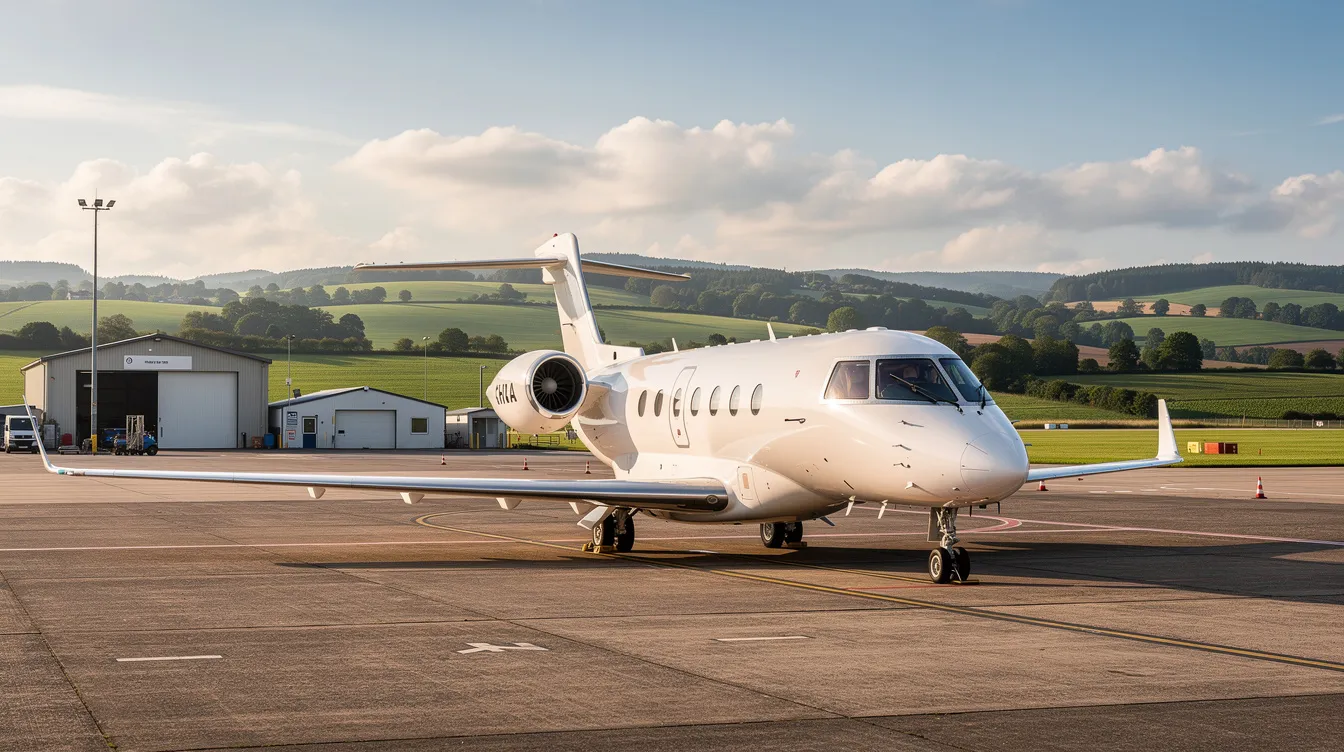
This time advantage is not merely a comfort. It is a strategic lever for travelers who need privacy, schedule control, and reliable access to smaller airports that commercial airlines do not serve efficiently. Private aviation is particularly beneficial for executives with multiple meetings in different cities on the same day—think a 7:30 a.m. departure from New York to Chicago for a board meeting, followed by a same-evening return. It equally supports last-minute leisure escapes: a Friday afternoon flight from Los Angeles to Aspen with ski gear, family, and pets in tow. In both cases, the private jet center is where the journey begins and ends, and the quality of that experience determines whether your travel feels effortless or encumbered.
So what exactly is a jet center? In practical terms, it is the private aviation equivalent of a commercial airline terminal, operated by what the FAA describes as a Fixed Base Operator-a business providing services such as fueling, maintenance, hangar space, and ground support at an airport. The term dates to the 1920s, when permanently located airport businesses were distinguished from traveling barnstormers. Today, there are over 4,700 FBOs across more than 3,500 airports in the United States alone, meaning private jets can utilize thousands of smaller regional airports not served by commercial airlines.
BlackJet is a private aviation company built around this infrastructure. Through its Jet Card memberships and broader premium private jet card programs, the company gives discerning travelers access to an entire network of private jet centers across the U.S. and internationally, without the capital commitment of aircraft ownership or the unpredictability of on-demand charter. In the sections that follow, you will see how private jet centers create strategic advantages, what facilities and services FBOs actually provide, which aircraft categories and cabin classes are typically available, how safety and sustainability standards are applied, and how BlackJet memberships enhance the private aviation experience with consistent, cost-predictable access for frequent private flyers. At the core of BlackJet's model are three pillars that matter at every jet center touchpoint:
Safety: Every flight is operated by FAA Part 135-certified carriers, with operators vetted through ARGUS Platinum or Wyvern Wingman audits and additional internal standards.
Sustainability: carbon-neutral flights on every leg, at no extra cost, through automatic high-quality carbon offsets and strategic use of Sustainable Aviation Fuel where available.
Technology: a 24/7 mobile booking platform with real-time support, weather monitoring, and operations coordination across thousands of airports.
The sections that follow will show exactly how these pillars come to life—at the jet center, in the air, and throughout your membership.
Inside a Modern Private Jet Center: Facilities, Fleet Access, and On‑the‑Ground Service
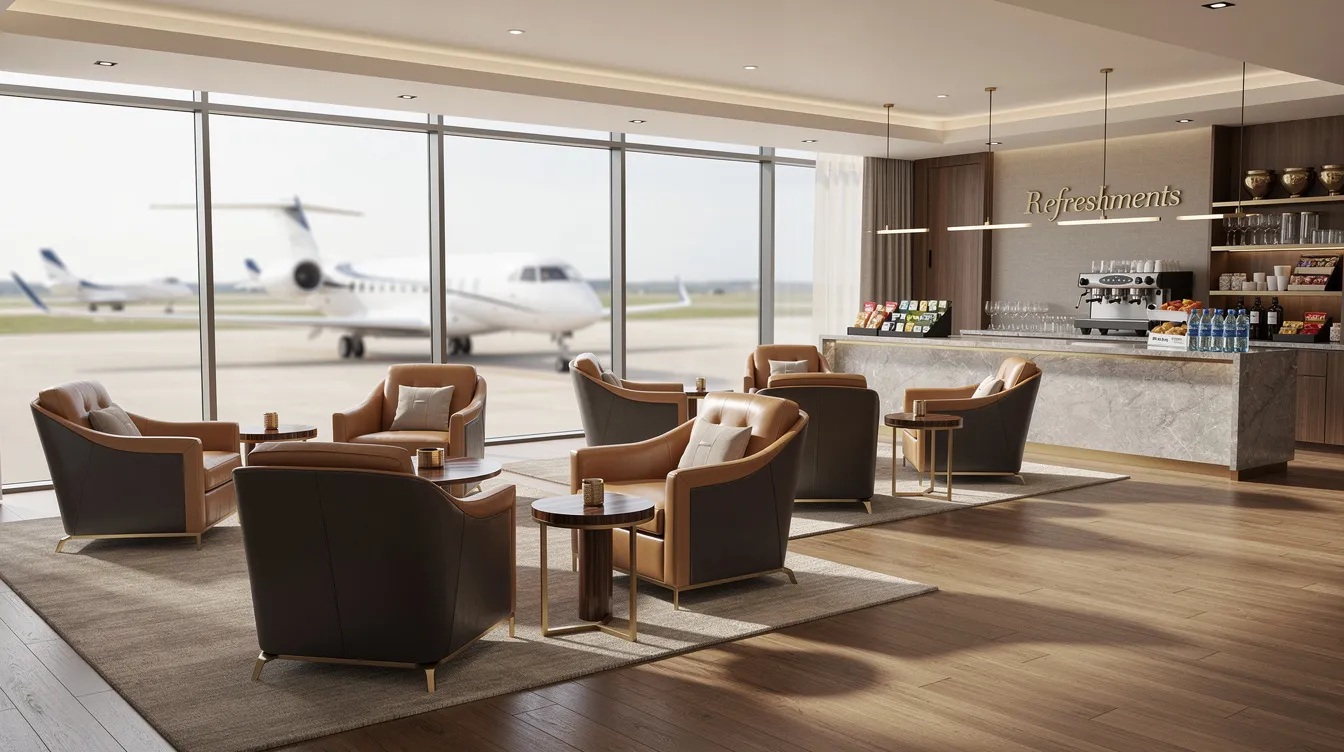
Walk into a well-run private jet center, and the contrast with a commercial terminal is immediate. There are no crowds, no overhead announcements, no queues snaking toward a security checkpoint. Instead, you find a glass-front lobby, a private lounge with leather seating and natural light, and a staff member who already knows your name. FBOs provide VIP lounges and direct ramp access for private passengers, and the entire facility is designed around one principle: getting you from your car to your aircraft with precision and minimal friction.
Leading jet centers—whether it is the Hollywood Burbank Jet Center in California or the Private Jet Center at 1859 Route 588 in Zelienople, PA 16063—share a common set of amenities that define the modern FBO experience. These typically include:
Executive lounges with complimentary Wi-Fi, refreshments, and business-ready workspaces. FBOs usually have private passenger lounges with amenities like Wi-Fi and refreshments to keep travelers productive or relaxed before departure.
Conference rooms and private offices for pre-flight meetings or calls.
Concierge and catering coordination, with meals and snacks arranged to your specifications before you board.
Ground transportation services that include rental cars and chauffeured vehicles, organized by the FBO team so a car is waiting when you land.
FBOs also assist with customs and immigration coordination for international arrivals, streamlining what can otherwise be a lengthy process at commercial terminals.
The ground logistics are equally seamless. You park in a reserved space-often just steps from the entrance-or hand your keys to valet. FBOs provide personalized care, including greeting staff who handle luggage and escort you directly to the aircraft. There is no boarding pass to scan, no gate to locate, no jetway to navigate. FBOs charge for services such as aircraft parking and fueling, which may vary by location, but these costs are typically managed behind the scenes by your jet card provider or charter operator, so the passenger experience remains uninterrupted.
Behind the lounge, the FBO team handles the operational details that keep a departure on schedule. Fueling with Jet A, de-icing during winter months at hubs like Pittsburgh or New York, baggage loading, lavatory service, and hangar positioning are all managed by ground crews working in coordination with the flight crew. For the passenger, this work is invisible. What you experience is a lounge, a short walk, and a cabin ready for departure.
Private Jet Fleet Access and Aircraft at the Jet Center
Private jet centers serve as the staging ground for a wide range of aircraft categories. A regional facility like KPJC, with its approximately 5,000-foot runway, regularly accommodates light and midsize jets well suited to domestic routes. Larger facilities handle super-midsize and heavy jets for coast-to-coast or international missions.
Common aircraft you will encounter at these jet centers include:
The Cessna Citation CJ3 seats up to 7 passengers and is ideal for regional hops—New York to Boston, Pittsburgh to Nashville, or Dallas to Denver.
The Cessna Citation XLS can accommodate 8 to 9 passengers, offering a wider cabin and the range for cross-country legs like Los Angeles to Miami or Chicago to Seattle.
Super-midsize jets such as the Challenger 350 or Praetor 600 cover routes exceeding 3,000 nautical miles, suitable for coast-to-coast or U.S.-to-Caribbean flights.
Large cabin jets like the Gulfstream G550 or Global 6000 handle transatlantic and intercontinental missions, seating 10 to 16 passengers with full galley and lie-flat configurations that make them ideal 16-seat private jet options for larger groups.
You can explore the full spectrum of options through BlackJet's aircraft categories, including what a typical $15 million private jet offers in terms of cabin design, performance, and ownership versus access tradeoffs.
Private Jet Center offers access to over 23,465 unique private aircraft, and private jet charter services provide on-demand booking options across this fleet, meaning the right aircraft for your mission is almost always available at or near your preferred departure point—whether you are chartering a small private plane for a short hop or arranging a larger jet for a longer journey. All flights must be operated by licensed air carriers, and operators must hold FAA Part 135 or Part 121 certifications. Charter flights are operated by licensed air carriers only, and BlackJet layers its own BlackJet Certified standard-requiring ARGUS Platinum or Wyvern Wingman audits, aircraft age limits, cabin quality checks, and crew currency verification on top of these regulatory requirements.
On the sustainability front, an increasing number of jet centers now stock Sustainable Aviation Fuel. Over 55 FBO locations across North America and Europe offer physical SAF supply, and BlackJet routes flights through these locations when operationally feasible. Where SAF is not physically available, BlackJet complements its approach with automatic carbon offsetting on every member flight, maintaining carbon-neutral operations across the entire network.
How BlackJet Jet Card Members Use Private Jet Centers Day to Day
Jet cards provide prepaid access to private jets, and the way that access translates into daily use is best understood through real scenarios; for frequent travelers, understanding the best jet cards for regular flyers helps frame how these programs deliver availability and value.
Scenario one: the same-day business trip. A New York-based executive holds a BlackJet 25-hour Jet Card, a format explained in detail in our guide to 25-hour jet cards. She has a 10:00 a.m. board meeting in Chicago and needs to be back in Manhattan by dinner. Here is how her day unfolds:
The evening before, she logs into the BlackJet mobile platform-one of the 24/7 digital booking tools included with every jet card. She selects a departure from Teterboro (KTEB), chooses a midsize cabin class, and confirms the booking in minutes. Jet cards offer real-time support for travelers, so BlackJet's operations team immediately begins monitoring weather, slot times, and FBO traffic at both ends.

On the morning of the flight, she arrives at the Teterboro jet center roughly fifteen to twenty minutes before departure—passengers at FBOs generally arrive 15 to 20 minutes before departure, not the ninety-plus minutes commercial terminals demand. The passenger experience at FBOs is designed to minimize waiting times, and her visit is no exception. She parks, walks into the lounge, and is greeted by name. BlackJet's operations team has already coordinated with the FBO: the crew is briefed, catering is onboard, and ground transport is arranged at Chicago Midway.
In the air, a cabin in a private jet can function as a secure, airborne boardroom. She reviews board materials, holds a brief call with her team, and arrives in Chicago focused and prepared. After the meeting, she returns to the jet center for her evening departure home. Two cities, one day, zero wasted hours.
Scenario two: the weekend leisure escape. A family of four uses a BlackJet 50-hour Jet Card. Late Thursday, they decide on a long weekend in Jackson Hole. Jet card programs typically offer 25-hour or 50-hour options, and the family's 50-hour card gives them ample flexibility for spontaneous trips—a structure explored in our 50-hour jet card cost guide. Private jet charter can be booked for both business and leisure travel, and the booking process is identical: open the app, select a departure from a jet center near Los Angeles—say, Hollywood Burbank—choose a super-midsize cabin for the ski gear and the family dog, and confirm.
Friday afternoon, they drive to the jet center. No checked-bag counters, no pet carrier restrictions, no connecting flights through Denver. Jet card users can access multiple cabin types, so the family selects an aircraft with a full galley for snacks and enough cabin space for comfort during the two-hour flight. Private jet travel allows for customized luxury and comfort during flights, and private jet charter ensures personalized travel experiences-from the catering choices to the temperature of the cabin on arrival.
This flexibility extends across hundreds of jet centers worldwide. A member based in the Pittsburgh area might depart from Zelienople (KPJC) for a regional flight, then use Teterboro for a subsequent New York departure, and Van Nuys for a West Coast leg. There is no need to base aircraft at any specific facility. The focus is on matching the right aircraft to the right mission, at the most convenient jet center for that particular journey.
This is precisely where the jet card model outperforms aircraft ownership. Owning a private jet means paying for hangar space, crew salaries, aircraft management, and maintenance at a home base-whether you fly that week or not, realities that become especially clear when you examine what a $15 million private jet entails in terms of acquisition and operating costs. With BlackJet, there are no long-term commitments to hold at any specific jet center. You access the right cabin class for each trip, from light jets for short hops to large cabin aircraft for transatlantic crossings, and the operational overhead stays with BlackJet's team.
Choosing the Right Private Jet Center Through BlackJet: Safety, Sustainability, and Membership Benefits
Not all jet centers deliver the same experience. While the fundamental concept is consistent—private terminal, ramp access, ground support—the quality of your journey depends on three factors: the safety standards behind every flight, the sustainability commitment of your aviation partner, and the membership structure that governs access and pricing. BlackJet orchestrates all three, so the results are consistent regardless of which jet center you depart from.
Safety as a Non-Negotiable Standard
Private aviation services prioritize safety and reliability, and BlackJet treats this as the foundation rather than a selling point. Every operator in the BlackJet network must meet or exceed FAA Part 135 standards. But regulatory compliance is a floor, not a ceiling. BlackJet's certification process requires operators to carry ARGUS Platinum or Wyvern Wingman ratings, independent, third-party safety audits that evaluate maintenance programs, pilot training records, insurance, and operational history. You can learn more about what makes private jets safe through these layered standards.
Beyond operator vetting, the company focuses on crew quality. Pilots must maintain current type ratings for the specific aircraft they fly-whether that is a Citation CJ3, a Citation XLS, or a Gulfstream G550. Recurrent training, simulator checks, and flight-hour currency are all verified. Pilot qualifications for jet card programs are a critical differentiator that discerning travelers should evaluate when comparing providers.
BlackJet's real-time operations desk monitors NOTAMs, TAFs, and surface conditions at over 12,000 airports. If weather threatens your departure jet center, the team proactively adjusts—rerouting to an alternate airport, shifting departure times, or repositioning aircraft to meet your schedule. This level of precision is what separates a reliable private aviation partner from a booking platform.
Private Jet Center has a record of operational excellence, and when BlackJet matches members with operators and facilities that share that standard, the experience is consistent trip after trip.
Sustainability Built into Every Flight
Environmental responsibility is no longer optional in private aviation. BlackJet provides carbon-neutral flights for all Jet Card members at no added cost by automatically purchasing high-quality carbon offsets for every leg flown. This is not an opt-in program or an add-on fee—it is built into the membership.
At the facility level, the company works with jet centers that stock Sustainable Aviation Fuel when available. SAF is a drop-in replacement for conventional Jet A that reduces lifecycle carbon emissions significantly. The distinction matters: SAF usage happens at the FBO level, while carbon offsetting operates at the program level. Together, they form a comprehensive sustainability strategy that addresses both direct emissions and the broader environmental footprint of private flight.
For corporate travel managers and family offices who need to report on environmental impact, BlackJet provides sustainability reporting across all trips, making it straightforward to meet ESG commitments without sacrificing the speed and flexibility that private aviation delivers. Chip Schultz and other industry leaders have noted that this kind of integrated approach is where the market is heading, and BlackJet's commitment to making it standard rather than premium reflects a forward-looking philosophy.

Membership and Pricing: Jet Cards vs. the Alternatives
The economics of accessing private jet centers come down to how you pay for flight time. Here is how the primary options compare, and why understanding overall jet card pricing structures is essential when weighing membership against ownership or on-demand charter:
Model | Capital Outlay | Operational Overhead | Jet Center Flexibility | Price Predictability |
|---|
Aircraft Ownership | $5M–$70M+ acquisition | Crew, hangar, maintenance, aircraft management, insurance | Tied to home base | Variable: fuel, crew, and parts costs fluctuate |
Fractional Ownership / Co-Ownership | $1M–$10M+ share | Reduced but still includes management fees, repositioning | Limited to operator bases | Monthly management fees + hourly rates often comparable to leading NetJets jet card pricing tiers |
On Demand Charter | None | None | High, but availability not guaranteed | Volatile; quotes vary by demand, season, fuel, especially when chartering smaller private planes for shorter routes |
BlackJet Jet Card | $50,000–$450,000 (depending on card and funding model) | None | Full network access; hundreds of jet centers | Fixed, all-inclusive hourly rates that reflect competitive jet card cost per hour benchmarks |
Jet card programs lock in transparent hourly rates across multiple cabin classes. A BlackJet 25-hour Jet Card starts at approximately $50,000 in the pay-as-you-fly model, with base hourly rates beginning around $5,484 depending on cabin class. For travelers considering larger commitments, our 100-hour jet card cost guide explains how pricing scales with volume. Hours do not expire, so there is no pressure to fly by a deadline. The 50-hour card offers additional value for higher-volume travelers, while the BlackJet 25+ Hour Jet Card provides flexible, fixed-rate access across mid, super-mid, and large cabin categories.
Members benefit from guaranteed access windows, priority scheduling during peak seasons, and consistent exceptional service at partner jet centers. Private jet centers offer personalized services like catering and concierge support, and BlackJet coordinates these details so the member experience remains uniform whether departing from Van Nuys, Teterboro, or KPJC.
It is worth noting that commercial business class may remain the better choice for many trips due to cost-particularly on high-frequency, well-served routes where schedule flexibility is not critical. The jet card model is designed for travelers whose time, privacy, and itinerary complexity justify the premium, and who fly frequently enough to benefit from the tailored solutions a membership provides; analyzing jet card cost per flight hour against your typical missions is a practical way to make that call.
Private jet charter offers access to over 23,465 aircraft, and private jet charter services provide on-demand booking options for those who prefer single-trip flexibility or simply want to buy a seat on a private jet rather than book the entire aircraft. But the consistency, safety vetting, and pricing transparency of a jet card program make it the superior choice for frequent travelers who want to standardize their private aviation experience.
For Corporate Travel Managers and Family Offices in Private Aviation
Organizations that manage travel for multiple executives or family members can use BlackJet to build a standardized private aviation policy:
Choose preferred jet centers in key markets—Van Nuys for Los Angeles, Teterboro for New York, KPJC for Pittsburgh—based on convenience, security, and proximity.
Rely on BlackJet to handle aircraft selection, operator vetting, and sustainability reporting across all trips, eliminating the need for internal aviation expertise.
Maintain flexibility across cabin classes, matching light jets to short regional flights and large cabin aircraft to international missions—without managing a fleet.
Private jet centers allow travelers to bypass busy commercial terminals, and when that access is managed through a single membership with clear terms, the business gains both operational efficiency and cost predictability—especially when benchmarked against top private jet companies and their various ownership and access models.

Elevate Your Next Departure
The private jet center is where strategy, comfort, and precision converge. Every element-from the lounge you wait in to the aircraft you board to the safety standards governing your flight-reflects the quality of your aviation partner.
BlackJet's Jet Card membership delivers effortless, consistent access to premier jet centers worldwide. Whether your typical route runs from Pittsburgh to Dallas, New York to London, or Los Angeles to Aspen, the experience is built to meet the expectations of travelers who demand more from every journey.
Explore BlackJet Jet Card options to find the right fit for your travel style. Request a tailored consultation to identify your ideal departure jet centers, review aircraft category options, or speak with a BlackJet advisor about how to reshape the way you fly. Your next departure is waiting.


 Sign up with google
 Sign up with Apple