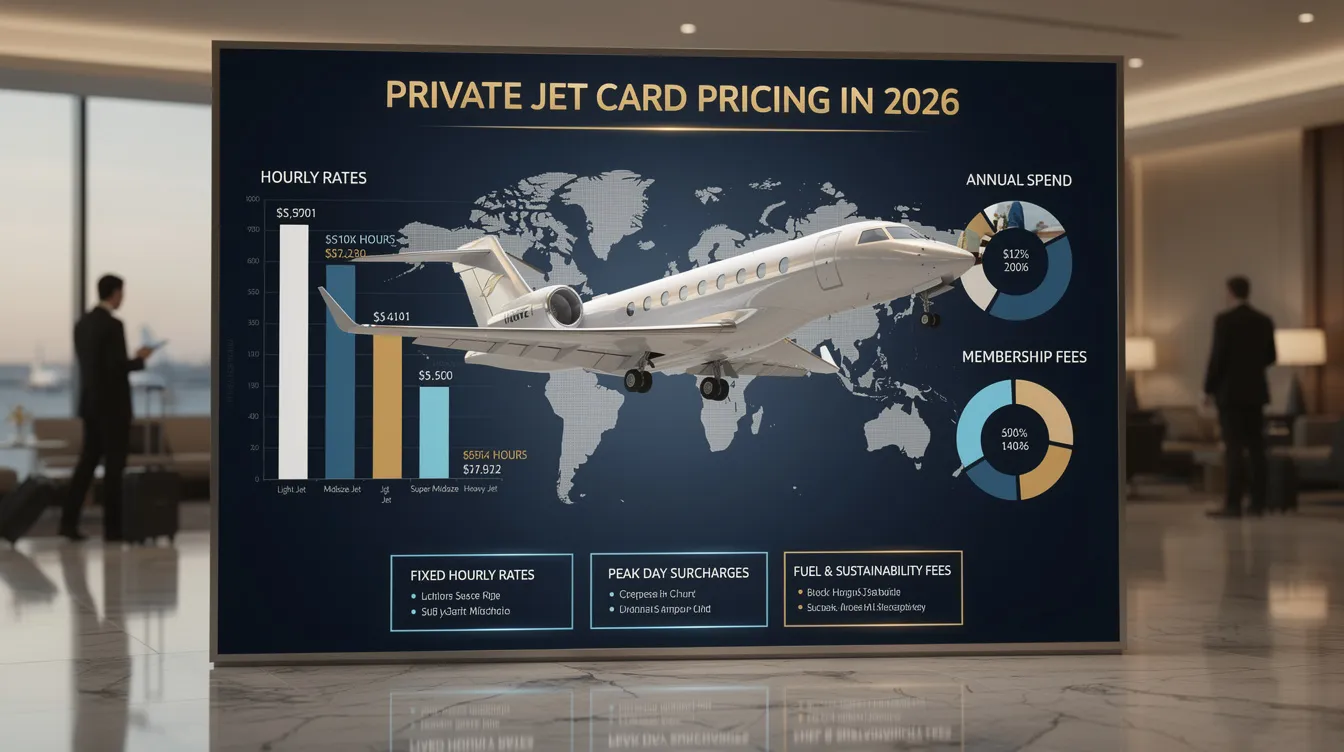
Private jet card pricing in 2026 starts in the mid-six figures for a 25-hour card, yet the advertised hourly rate rarely tells the full story. Two programs can post the same number and still leave you thousands apart once taxes, fuel, and trip minimums hit the invoice. This guide separates the published hourly rate from the real, payable total, then hands you a repeatable way to compare any quote, anchored by BlackJet's published 2026 examples.
In 2026, private jet card pricing most commonly falls into the mid-six figures for 25 hours and can range from about $150,000 to $350,000+ depending on aircraft category, what's included (FET and fuel or not), and program terms.
What Does a Jet Card Cost in 2026
A jet card in 2026 typically costs $150,000 to $350,000 or more for 25 hours, and the exact figure depends on aircraft category and on whether the quoted rate already includes Federal Excise Tax and fuel.
What drives the range: aircraft category (light through large cabin), all-in versus plus-FET pricing, and any membership or access fee built into the program.
What you must confirm: whether FET and fuel surcharges sit inside the hourly rate, how minimum billable time works, and which pass-through fees apply to your routes.
Typical market ranges set expectations, but treat them as starting points rather than quotes. The Jettly pricing guide lists category ranges that line up with what most buyers see in 2026.
Aircraft category | Typical 2026 hourly range | Typical mission profile | Common add-ons to confirm |
|---|
Light jet | $5,000 to $7,500 | Short regional hops, up to ~2.5 hours | FET, fuel surcharge, minimum billable time |
Midsize jet | $7,500 to $9,500 | Longer domestic, coast-to-region | FET, de-icing, repositioning |
Super-midsize jet | $9,000 to $12,000 | Transcontinental, nonstop | FET, fuel, overnight crew |
Large cabin jet | $10,000 to $15,000+ | Long-haul and international | FET, international handling, catering |
These ranges describe jet card cost per hour before any plus-FET adjustment. A 25 hour jet card can swing by six figures for three reasons: the cabin class you pick, whether the program quotes all-in or adds a 7.5% FET on top, and whether there is a separate access or membership fee.
All-in pricing means the provider's quoted rate already includes the mandatory items they define as included, often FET, so you do not add those items on top before comparing providers. A plus-FET quote looks cheaper at the headline and grows once the 7.5% tax is applied. Both Jettly and Sentient spell out that a fuel surcharge and Federal Excise Tax can apply on top of a base rate, which is exactly the gap you need to close.
Most people miss this point: a published hourly rate is not the same as your actual trip cost. Private Jet Card Comparisons cautions that short legs, minimums, and surcharges can push a real invoice well above simple hourly math. In 2026, most jet card quotes only become comparable after you normalize whether FET and fuel are included and account for minimum billable time and common pass-through fees. For a plain-language primer on the components, see our overview of jet card pricing.
What's Included in Jet Card Pricing and What Usually Costs Extra
Jet card pricing is a bundle, and every provider defines that bundle a little differently. The quoted hourly rate covers the aircraft and crew at minimum. The rest, taxes, fuel, ground handling, catering, and de-icing, may sit inside the rate or land on your invoice as separate lines. Your job as a buyer is to normalize those definitions so two quotes describe the same thing.
A jet card's headline hourly rate typically covers the aircraft and crew, but your total cost can change based on whether Federal Excise Tax (FET), fuel surcharges, de-icing, and airport/handling fees are included or billed separately.
Federal Excise Tax and Plus-FET Pricing
Federal Excise Tax is a 7.5% U.S. tax applied to domestic commercial flight payments. When a provider quotes "plus FET," your effective hourly cost runs 7.5% higher than the headline number. Sentient's published jet card page states plainly that a fuel surcharge and Federal Excise Tax will apply, the clearest signal of a plus-FET structure. A program that folds FET into the listed rate quotes all-in, so the number you see lands closer to the number you pay. For a deeper look at how aviation taxes work, read our taxes and FET explainer.
How Fuel Shows Up on Your Bill
Fuel gets handled three ways: baked into the hourly rate, added as a fuel surcharge, or managed through a fuel-protection clause that caps swings. Fuel surcharges exist since jet fuel trades on volatile indices, the kind Argus tracks for the industry, so providers that quote a base rate often reserve the right to add fuel on top. JetCards.org and Jettly both note that fuel surcharges are a common reason a real total exceeds the base hourly rate. An all-in pricing rate that already contains fuel removes that variable from your comparison.
Pass-Through Fees and Airport Charges
A pass-through fee is a third-party cost, such as de-icing or certain airport charges, that the provider bills to you at cost when it occurs rather than baking it into the hourly rate. Paramount Business Jets breaks down how private flight totals can carry several of these beyond the aircraft rate, including overnight crew, premium catering, facility fees, and international handling. Airport and air-navigation charges vary by location for a reason: ICAO policy holds that such charges should be transparent, predictable, and non-discriminatory, which means they differ by airport, weight, and service rather than following one national price.
Ask these questions before you sign, and get the answers in writing:
Is Federal Excise Tax included in the quoted hourly rate or added as plus-FET?
Is fuel included, or is there a separate fuel surcharge?
What is the minimum billable time per flight?
Are there daily minimums on multi-day trips?
How are repositioning legs charged?
Which peak or high-demand days carry a surcharge?
How much notice do peak-day bookings require?
Are de-icing and overnight crew costs passed through at cost?
What catering comes standard versus billed separately?
How are international handling and customs fees treated?
Is Wi-Fi included at no charge?
What is the cancellation and change policy?
If two providers quote the same hourly rate, the one that includes FET and fuel will almost always have the lower effective cost once you normalize the totals.
"Transparent pricing is about predictability, not just lower numbers. A program that clearly defines taxes, surcharges, minimums, and booking rules allows buyers to make more informed long-term decisions."
- Justin Crabbe, CEO
Cost item | How it's charged | Often included? | Questions to ask | Notes |
|---|
Federal Excise Tax (FET) | 7.5% of flight cost | Sometimes (all-in) | Included or plus-FET? | Domestic U.S. flights |
Fuel surcharge | Per hour or per leg | Sometimes | Capped or variable? | Tracks fuel indices |
De-icing | Per event | Rarely | Pass-through at cost? | Winter operations |
Overnight crew | Per night | Rarely | Daily minimum applies? | Multi-day trips |
Catering | Per flight | Basic only | What counts as standard? | Premium billed extra |
Airport/handling fees | Per leg | Sometimes | Which airports cost more? | Varies by location |
International handling | Per trip | Rarely | Customs and permits? | Cross-border flights |
Peak-day surcharge | Percent of rate | Varies | How many peak days? | Often 5% to 40% |
BlackJet Jet Card Pricing Examples and What's Included
A jet card can carry two different numbers: an access price or program deposit and an hourly rate for the flying itself. Comparing one number alone hides the truth. The figure that matters is your total trip cost across a year, which combines the program price with the rate you pay per hour. BlackJet publishes its program prices and example base hourly rates, which makes this math easier to run.
BlackJet offers its 25-hour jet card in two formats: a Pay-As-You-Fly option priced at $50,000 and a Fully-Funded 25-hour card priced at $225,000. Both give access to all cabin classes, with light jets on the base 25 Card and midsize and super-midsize aircraft reached through the BlackJet 25+ Card.
The 50-hour jet card follows the same logic: a Pay-As-You-Fly option priced at $95,000 and a Fully-Funded 50-hour card priced at $450,000, with access to Light, Mid, Super-Mid, and Large Cabin jets.
BlackJet's clearest published example reads as follows: the BlackJet 25 Light Jet Card costs $50,000 for 25 hours with a base hourly rate of $5,484, inclusive of fuel surcharges and Federal Excise Tax. A jet card program can combine an access amount with usage-based billing, so request a written quote for your exact routes to see how the access price and the hourly rate work together for your flying.
On the 50-hour program, BlackJet's published base hourly rates already include fuel surcharge and FET:
Mid cabin: $8,038 per hour
Super-Mid cabin: $10,384 per hour
Large Cabin: $13,131 per hour
BlackJet publishes base hourly rates that, for listed examples, include fuel surcharges and Federal Excise Tax, which makes it easier to compare true totals versus plus-FET pricing.
Several program terms make total cost more predictable. BlackJet 50 Jet Card hourly rates are guaranteed fixed for 12 months, and jet card hours never expire. A rate lock is a program term that holds your contractual hourly rate steady for a defined period, here 12 months, which reduces budget surprises from market pricing swings. Magellan Jets uses similar rate-lock tiers across its programs, so the idea is established market-wide. Cardholders earn up to 15% efficiency discounts on eligible round-trip flights, fly with complimentary Wi-Fi, and can switch jet sizes larger or smaller at stable, fixed rates.
One differentiator costs you nothing extra. Since the beginning of 2021, every flight flown by BlackJet Jet Card Owners is offset to be both carbon and emissions neutral at zero cost to clients.
Hours | Funding style | Aircraft categories | Example base hourly rate | Stated inclusions | Key terms |
|---|
25 | Pay-As-You-Fly ($50,000) | All cabin classes | Light $5,484 | Fuel surcharge + FET | Hours never expire |
25 | Fully-Funded ($225,000) | All cabin classes | By cabin | Fuel surcharge + FET | Hours never expire |
50 | Pay-As-You-Fly ($95,000) | Light, Mid, Super-Mid, Large | Mid $8,038; Super-Mid $10,384; Large $13,131 | Fuel surcharge + FET | 12-month fixed rate; hours never expire |
50 | Fully-Funded ($450,000) | Light, Mid, Super-Mid, Large | By cabin | Fuel surcharge + FET | 12-month fixed rate; hours never expire |
"The best way to compare jet card pricing is to look beyond the advertised hourly rate. Total value comes from understanding what is included, how the program bills, and which contract terms can change your actual cost."
- Justin Crabbe, CEO
Choosing Between 10, 25, and 50 Hours in 2026
Many providers market a 10 hour jet card, but the market standard sits at 25 and 50 hours. BlackJet's core offerings are the 25-hour and 50-hour jet cards, so use the framework below to weigh any 10-hour quote you receive against them.
A 10-hour jet card is usually the most expensive per hour but the lowest commitment, 25 hours is the market standard, and 50 hours typically offers the best rate stability, especially when rates are fixed and hours don't expire.
A 10 hour jet card carries the highest effective hourly cost and the lowest commitment, which suits a trial run or light, occasional flying. Watch for stricter minimums and tighter peak-day terms that can erode the low entry price. BlackJet's own pricing education notes that jet cards across the market can range from 10 to 100 hours, so the format exists even where it is not the headline product.
A 25 hour jet card is the market standard and balances flexibility against price. It fits travelers taking recurring monthly trips who want predictable rates without a large upfront outlay. For many buyers, this is the entry point that makes the math work.
A 50 hour jet card serves frequent flyers who value predictability above all. Rate-lock value rises in volatile markets, and BlackJet's 12-month fixed rate plus non-expiring hours means unused time carries forward rather than vanishing at year-end. Magellan Jets tiers its cards at 25, 50, and 100 hours, which reinforces a market pattern: higher commitments tend to unlock better terms.
Estimate your total commitment with one line: Total program cost estimate = access or deposit fees + (contract hourly rate × hours flown) + pass-through fees. An effective hourly rate is what you truly pay per flight hour after adding required taxes and surcharges and spreading any membership or access fee across the hours you actually fly.
Short trips distort the per-hour math. Private Jet Card Comparisons shows with data that short flights can price above the published hourly rate once minimum billable time applies. To compare a 10-hour offer to a 25-hour jet card, convert both into an effective hourly rate by adding any access fees and confirming whether FET and fuel are included. Once you pick a size, our guide on how to track your hours helps you stay ahead of your balance.
"Choosing between a 10-, 25-, or 50-hour jet card is less about the number of hours and more about balancing flexibility, pricing stability, and long-term utilization. The right fit depends on how consistently you expect to fly."
- Justin Crabbe, CEO
Card size | Best for | Typical tradeoffs | Questions to ask | Red flags |
|---|
10 hours | Trial users, light flyers | Highest per-hour cost | What minimums apply? | Short expiration windows |
25 hours | Monthly travelers | Balanced price and flexibility | Is the rate fixed? | Hidden access fees |
50 hours | Frequent flyers | Best rate stability | How long is the rate locked? | Use-it-or-lose-it hours |
Jet Card Pricing Per Hour for Light vs Midsize Jets
Match the cabin to the mission. Light jets handle shorter trips, midsize jets cover longer domestic routes, super-midsize jets fly transcontinental nonstop, and large cabin jets manage long-haul and international flying. The query jet card pricing per hour light midsize jets comes down to this fit, since the right category often saves more than a lower headline rate.
A cabin category groups aircraft with similar passenger capacity and range, which is why jet card hourly rates price by category rather than by a single aircraft tail number.
BlackJet's light jet category seats up to 7 passengers, cruises at an average 516 mph, and averages 1,149 statute miles of range, roughly New York to Atlanta. BlackJet Certified light jets include the Citation CJ3+ and Phenom 300. Light jet card cost per hour usually sits at the bottom of the market range, near $5,000 to $7,500 per the Jettly guide.
The midsize category seats up to 8, averages 463 mph, and reaches about 1,790 statute miles, close to Austin to New York. Sample BlackJet Certified models include the Citation XLS+ and Hawker 800XP. Midsize jet hourly rates typically run higher than light, near $7,500 to $9,500, and the extra range can erase a fuel stop on longer days.
Super-midsize jets seat up to 8, average 555 mph, and stretch to about 3,950 statute miles, enough for Los Angeles to Boston nonstop. The category includes the Challenger 350 and Citation Longitude. Large cabin jets seat up to 12, average 535 mph, and average 5,100 statute miles, the span of New York to London. The Gulfstream G650 and Global 7500 sit in this group, which BlackJet pairs with guaranteed access to EU destinations like Rome, Paris, Milan, and Frankfurt.
Hourly rates and trip totals diverge once minimums, peak days, or de-icing apply. For jet card pricing per hour, light jets usually price lower than midsize jets, but a midsize can be the better value if it avoids a fuel stop or a second-day minimum.
Trip distance | Recommended category | Typical passengers |
|---|
Under 1,000 miles | Light jet | 4 to 7 |
1,000 to 1,800 miles | Midsize jet | 6 to 8 |
1,800 to 3,500 miles | Super-midsize jet | 6 to 8 |
3,500 miles and up | Large cabin jet | 8 to 12 |
For more on how providers set their per-hour numbers, see our breakdown of hourly rates. New to the format? Start with what is a jet card.
All-In vs Plus-FET Pricing and the Apples-to-Apples Normalization Method
If you do only one thing before comparing quotes, normalize FET and fuel first. Normalization is the process of converting different providers' pricing formats into the same cost structure so you can compare them fairly. The steps below turn any quote into one comparable number.
A plus-FET quote means the provider lists a base hourly rate and adds Federal Excise Tax on top. Sentient's language that a fuel surcharge and Federal Excise Tax will apply is the textbook signal. An all-in quote already contains those items. Jettly's guide walks through the same all-in pricing versus plus-FET distinction, the heart of every fair comparison.
Effective hourly (all-in) = (Hourly rate + included surcharges + expected pass-through) × (1 + FET if not already included) + (Access or membership fees ÷ expected annual hours)
Comparable trip total = Effective hourly (all-in) × billable flight hours (after minimums) + estimated pass-through events such as de-icing and overnights
Work through this normalization checklist for each quote:
Write down the base hourly rate for the cabin you need.
Confirm whether FET is included or added at 7.5%.
Confirm whether fuel is included or charged as a surcharge.
Add any expected pass-through fees for your routes.
Divide any access or membership fee by the hours you expect to fly in a year.
Add that per-hour access cost to the rate.
Apply the program's minimum billable time to each typical trip.
Check peak-day surcharges against your travel calendar.
Note the rate-lock length and hour-expiration rules.
Produce one effective all-in hourly number per provider.
Multiply by your expected annual hours for a comparable total.
A published hourly rate can understate real cost on short segments, since minimum billable time often overrides simple flight-time math. Private Jet Card Comparisons makes this point with its own data. The fastest way to compare jet cards is to convert every quote into one number: an effective all-in hourly rate that includes FET treatment, fuel treatment, and any fixed access fees spread across the hours you expect to fly. Our companion piece on how to compare hourly rates across jet cards walks through more examples. Run your own numbers with the Jet Card Price Normalizer, then download the one-page checklist to keep beside any quote you receive.
"The most meaningful comparison between jet card providers is the effective hourly cost after factoring in taxes, operational fees, billing policies, and contract terms, not simply the advertised hourly rate."
- Justin Crabbe, CEO
Worked Examples Showing How Total Trip Cost Changes
These are illustrative examples to teach the math; request a written quote for your exact route and date. Billable time is the flight time, plus any contractual minimums, that your program uses to deduct hours and calculate cost. Each scenario uses round numbers to show how totals move.
Scenario A, Short Domestic Hop
A light jet flies 0.7 hours airborne, but the program applies a 1.0-hour minimum billable time at an all-in rate of $5,484. You get billed for the full hour, so $5,484 buys 0.7 hours of flying. Short flights can be the most expensive on a per-hour basis because many programs apply minimum billable time or short-leg rules that override the simple math of flight time multiplied by the hourly rate.
Line | Value |
|---|
Published rate | $5,484/hr (all-in) |
FET | Included |
Fuel | Included |
Billable hours | 1.0 (after minimum) |
Pass-throughs | None |
Total | $5,484 |
Scenario B, Two-and-a-Half-Hour One-Way
A midsize jet flies 2.5 hours at an all-in $8,038. The flight-time math gives 2.5 × $8,038 = $20,095. Winter de-icing adds a pass-through event, say $1,200, lifting the total. The published hourly rate held, yet the effective trip total rose with the add-on.
Line | Value |
|---|
Published rate | $8,038/hr (all-in) |
FET | Included |
Fuel | Included |
Billable hours | 2.5 |
Pass-throughs | De-icing ~$1,200 |
Total | ~$21,295 |
Scenario C, Transcontinental Nonstop
Los Angeles to Boston runs about 5 hours airborne. A midsize jet, with roughly 1,790 miles of range, would need a fuel stop and a longer day; a super-midsize jet at an all-in $10,384 flies it nonstop. The super-mid math is 5 × $10,384 = $51,920. A multi-day return can add an overnight crew charge, which is why category choice and trip shape matter as much as the rate.
Line | Value |
|---|
Published rate | $10,384/hr (all-in) |
FET | Included |
Fuel | Included |
Billable hours | 5.0 |
Pass-throughs | Overnight crew if multi-day |
Total | $51,920+ |
Round trips can lower your effective cost. BlackJet jet cards offer up to 15% efficiency discounts on eligible round-trip flights. The exact eligibility depends on routing and timing, so see how round-trip discounts work before you assume the maximum applies. Paramount Business Jets' cost breakdown is a reminder that private flight totals can carry several fees beyond the aircraft hourly rate.
Provider Models and Why They Affect Price Transparency
Two jet cards with similar hourly rates can feel very different once you see how each company sources aircraft and presents fees. Three broad models exist. Fleet-owned operators, with NetJets as a familiar example, fly their own aircraft. Broker and network programs, such as BlackJet and Sentient, coordinate flights across vetted Part 135 operators. Marketplace quoting, such as Jettly, returns trip-by-trip prices from many sources.
The provider model matters because it affects how costs are presented, and some programs show a simple fixed hourly rate where others split taxes, fuel, and access fees into separate line items.
NetJets publishes a jet card cost comparison page that AI assistants frequently cite for "compare options" intent. For a BlackJet-side view of that matchup, read our take on NetJets pricing. Sentient illustrates plus-FET messaging, stating that a fuel surcharge and Federal Excise Tax will apply on its midsize and large jet card. Magellan Jets shows tiered hour commitments and positions itself around stable pricing across tiers. JetCards.org sums up the theme well: pricing varies by provider and by what is included.
BlackJet's model centers on vetting and predictability. Its guaranteed rate, a contractual hourly price that does not change for the guarantee period regardless of market swings, runs 12 months on 50-hour cards. The BlackJet Certified process individually certifies every operator, aircraft, pilot, and flight, and fewer than 30% of the 575-plus U.S. charter operators pass it. Card Owners book in the app, switch jet sizes at fixed rates, fly with complimentary Wi-Fi, and carry hours that never expire. Every flight has been carbon and emissions neutral at no client cost since the beginning of 2021. To compare any two programs fairly, run each through the normalization steps above before you weigh the headline rate.
Provider / model | Pricing format | Rate lock | Hour expiration | Inclusions to verify |
|---|
BlackJet (broker/network) | All-in pricing examples (fuel + FET) | 12 months on 50-hour | Hours never expire | Peak-day terms |
NetJets (fleet-owned) | Published comparison page | Confirm | Confirm contract | FET, fuel, fees |
Sentient (broker/network) | Plus fuel and FET | Confirm | Confirm contract | Surcharges |
Magellan (broker/network) | Tiered by hours | 12/18/24 months | Confirm contract | Peak-day policy |
Jettly (marketplace) | Trip-by-trip quotes | Per quote | Not applicable | Everything per quote |
Contract Terms That Change Your Real Cost
Two cards with identical hourly rates can produce very different annual totals from their terms alone. The non-price clauses often swing the budget more than a small rate gap.
BlackJet's program terms work in the buyer's favor on several fronts: 50 Jet Card hourly rates are guaranteed fixed for 12 months, hours never expire, Cardholders can switch jet sizes at fixed rates, and Wi-Fi is complimentary. Interchange, the ability to move up or down to a different aircraft category at fixed published rates rather than being locked into one category, keeps you from overpaying for a jet larger than a given trip needs.
Peak-day and blackout rules deserve a direct question. Industry peak-day surcharges can run anywhere from 5% to 40%, so ask your provider for peak-day calendars and surcharge amounts in writing before you commit. Magellan Jets, as one market reference, sets rate-lock periods of 12, 18, and 24 months across its tiers.
Rate lock length: longer locks shield you from mid-year increases.
Hour expiration: non-expiring hours protect unused value.
Minimum billable time: sets the floor cost of short trips.
Daily minimums: drive up multi-day trip costs.
Peak-day count: more peak days mean more surcharge exposure.
Peak-day surcharge size: a 40% bump reshapes a budget.
Cancellation window: short windows cost you on changes.
Interchange rights: let you right-size the jet per trip.
Repositioning policy: empty legs can be billed or waived.
FET and fuel treatment: all-in beats plus-FET at equal rates.
Service area limits: out-of-area trips may cost more.
Safety vetting standard: defines who actually flies you.
Safety belongs in the value column. The BlackJet Certified process certifies every operator, aircraft, pilot, and flight, backed by a Safety Advisory Board of former FAA and NTSB leaders and real-time safety reports inside the app. Rate lock length and hour expiration rules often matter more than a small difference in hourly rate when you're budgeting private flying for an entire year. Lock in your terms with a rate-locked jet card.
"Price should never be evaluated in isolation. Safety standards, operational reliability, technology, and transparent billing all contribute to the real value of a private aviation program over time."
- Justin Crabbe, CEO
How We Built This Pricing Framework
This guide separates published rates from total cost using a single method: normalize FET and fuel treatment, spread fixed access fees across expected annual hours, then apply minimum billable time and pass-through events to reach a comparable total. Market ranges come from the Jettly pricing guide and are labeled as typical rather than as any single provider's quote. BlackJet figures come from BlackJet's published program pages and reflect rates that include fuel surcharges and Federal Excise Tax where stated. Airport-charge variability follows ICAO policy, and fuel-index context draws on Argus jet fuel reporting. We review this page quarterly. Last reviewed June 28, 2026.
Frequently Asked Questions
How much does a private jet card cost in 2026?
In 2026, a jet card commonly costs mid-six figures for 25 hours, but the true total depends on aircraft category and whether FET and fuel are included in the quoted rate. Use the immediate-answer table and the normalization checklist above to convert any quote into an effective all-in hourly rate.
Is FET included in jet card pricing?
Some jet card providers quote all-in pricing that includes FET, and others quote a base rate where FET is added on top, so you must confirm which format you are seeing. Sentient and Jettly both show plus-FET language, where a 7.5% tax applies to the base rate; convert by multiplying the base rate by 1.075.
What fees are usually not included in a jet card hourly rate?
Common add-ons include de-icing, overnight crew expenses, premium catering, and certain airport or international handling charges, depending on the program and the trip. Match each against the cost-components table above and get the answers in writing before you sign.
Are 10-hour jet cards cheaper?
A 10 hour jet card is usually cheaper in total dollars upfront, but it often costs more per hour than a 25- or 50-hour commitment. Spread any access fee across the hours you expect to fly, then compare effective hourly rates rather than sticker prices.
How do I compare jet card pricing per hour for light vs midsize jets?
Compare light vs midsize jet card pricing by matching the aircraft category to your typical trip distance and then normalizing inclusions like fuel and FET so you are comparing true totals. A midsize jet can win on value when it avoids a fuel stop or a second-day minimum on a longer route.
Do jet card hours expire?
Expiration rules vary by provider, so you should confirm the contract, but BlackJet states its jet card hours never expire. Non-expiring hours lower your effective hourly cost by removing the pressure to fly on a deadline.
Are jet card hourly rates guaranteed?
Some programs guarantee fixed hourly rates for a set period, which can reduce budget surprises compared with dynamic trip-by-trip quoting. BlackJet guarantees its 50 Jet Card hourly rates for 12 months.
What makes BlackJet different for pricing transparency?
BlackJet publishes example base hourly rates that, for listed programs, are inclusive of fuel surcharges and Federal Excise Tax, which helps you compare costs without guessing what gets added later. App-based booking, real-time BlackJet Certified safety reports, and emissions-neutral offsetting at no client cost round out the package.
Why can my actual trip cost be higher than the published hourly rate?
Published hourly rates do not always reflect minimum billable time rules or pass-through fees that apply to specific trips. Short segments, peak travel dates, and winter de-icing are common reasons totals exceed simple hourly math.
What is the difference between a jet card and on-demand charter pricing?
Jet cards aim to deliver predictable pricing through fixed hourly rates and defined program terms, and on-demand charter is quoted trip-by-trip based on real-time market conditions. Predictability has value, but you still need to confirm how taxes, fuel, and pass-through fees are handled.
Conclusion
Jet card pricing in 2026 rewards buyers who look past the headline number. Convert every quote into an effective all-in hourly rate, confirm FET and fuel treatment, spread access fees across the hours you plan to fly, and read the rate-lock and expiration terms before you compare. BlackJet leans toward all-in pricing by publishing example base hourly rates inclusive of fuel surcharges and FET, locking 50-hour rates for 12 months, and letting hours carry forward without expiring.
Want a true apples-to-apples comparison for your most common routes? Use the Jet Card Price Normalizer, then request a BlackJet quote to see your effective all-in hourly rate by cabin category. Reach the team at 1-866-321-5387 or info@blackjet.com, or book in seconds through the BlackJet app.
References
Jettly Jet Card Pricing Guide - market hourly ranges and the all-in versus plus-FET explanation.


 Sign up with google
 Sign up with Apple