When heads of state and royal families need to traverse continents with their entire entourage—security details, advisors, and family—they turn to the only aircraft that functions as both a diplomatic tool and airborne residence: the private Boeing 747. For the rest of the aviation world, this flying palace represents an almost mythical pinnacle of luxury and power, a level of exclusivity that only the ultra-wealthy can afford.
This article is intended for ultra-wealthy individuals, heads of state, corporate leaders, and private aviation enthusiasts interested in understanding the features, ownership realities, economics, and alternatives to the private Boeing 747.
Key Takeaways
A private Boeing 747, specifically the BBJ 747-8 variant, can carry as many passengers as 100 VIPs over 8,000 nautical miles nonstop, but comes with a list price around $418.4 million plus $25 million to $50 million for interior customization, and operating costs reaching $23,000 per flight hour.
Only approximately 11 Boeing Business Jet 747-8 aircraft were ever delivered, almost exclusively to governments and royal families such as Qatar Amiri Flight, with interiors inspired by designers like Alberto Pinto.
Specialized completion centers, including Greenpoint Technologies and AMAC Aerospace, transform “green” airframes into outrageously luxurious flying palaces featuring multiple suites, lounges, boardrooms, and spa facilities for ultra-long haul flights.
The Boeing 747 has been in production since 1968, making it one of the longest-lasting wide-body aircraft in existence, with the final Boeing 747-8F rolled out on December 6, 2022, marking the end of over 50 years of production and making existing private 747s increasingly rare legacy assets.
For most discerning travelers, BlackJet’s Jet Card programs offer a practical path to long-range private aviation—carbon-neutral, safety-certified, and on-demand—without the enormous ownership burden of a jumbo jet.
The Strategic Power of a Private Boeing 747
When a head of state needs to fly from Doha to New York with 50 staff members—diplomats in the forward cabin, security positioned throughout, family in private suites—only a private 747 delivers the space, range, and operational independence required. This is not travel; it is a projection of power across hemispheres.
Consider the contrast with commercial first class. A trip from New York to Sydney requires connections, layovers totaling 20+ hours, and exposure to public terminals. On a BBJ 747-8, that same journey becomes a direct 9.5-hour flight where deals are sealed in airborne boardrooms and arrivals happen rested. The aircraft becomes a strategic asset, not merely a transport. The owner of a private jet Boeing 747 has the unique ability to customize every detail of the aircraft, influencing luxury features and amenities to create a truly personalized and high-end experience for guests.
The Boeing 747’s legacy as the original jumbo jet began with its first flight in 1969, revolutionizing air travel with its partial double-deck design. The 747-8 Intercontinental evolved into the 747-8i Boeing Business Jet variant, marketed explicitly to elites seeking what operators call a flying palace. Middle Eastern royal flights and heads-of-state aircraft demonstrate this daily, functioning as airborne command centers complete with secure communications and prayer rooms.
For most private travelers, this scale remains impractical. BlackJet’s premium Jet Card access to large-cabin and ultra-long-range jets offers similar strategic advantages—time savings, privacy, productivity—without owning a 400-million-dollar airplane. Ownership of a Boeing 747 reflects unmatched status and prestige, often appealing to corporate leaders and heads of state.
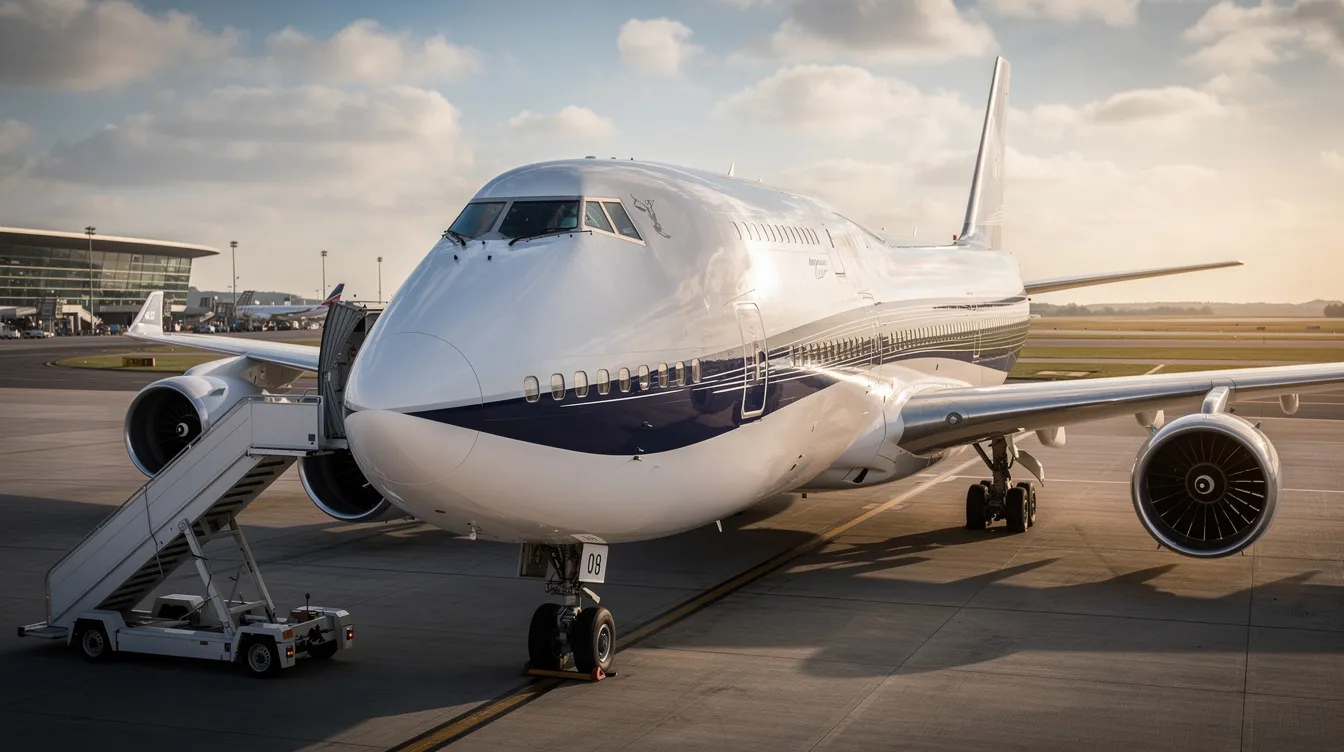
What Is a Boeing Business Jet 747 (BBJ 747-8)?
The BBJ 747-8 represents the VIP variant of the Boeing 747-8 Intercontinental, introduced in 2008 as the final generation of the storied 747 family. The 747-8 platform was first introduced by Boeing in 2008 as the final variant of the 747 family, with production retiring in 2023.
Boeing Business Jets (BBJ) operates as a dedicated division taking airliner platforms—the 737 MAX, 787, 777X, and 747-8—and adapting them into long-range business jets with bespoke interiors. For the 747-8, this means delivering a “green” aircraft (stripped interior) to completion centers where the transformation into a flying palace begins. Owners work closely with specialized completion centers such as Greenpoint Technologies and AMAC Aerospace to install master bedrooms, private cinemas, large galleys, and other bespoke features, tailoring the cabin for residential, corporate, or recreational use. This process creates a 'private terminal in the sky' experience.
Key specifications define why this aircraft stands alone:
The list price for a new Boeing 747-8 was around $418.4 million in 2019
Range up to 8,000 nautical miles at a cruising speed of Mach 0.855
The Boeing 747-8 has a total length of 250 feet 2 inches (76.25 m), making it the world’s longest currently-operational passenger airliner
Cabin space of approximately 5,179 square feet across two decks—roughly twice the width of two Gulfstream G650 cabins combined
The BBJ 747-8 features a dual-deck design that allows for private master suites or exclusive lounges separated by grand spiral staircases, offering significant onboard flexibility with multiple custom layouts that enhance privacy and security for travelers. Its fully customizable interior can include multiple zones such as passenger seating, boardrooms, lounges, staff areas, and bedrooms, each meticulously designed to the owner's specifications.
The 747-8 competes directly with Airbus models such as the A380 and A350, with Airbus often leading in high-capacity and long-range aircraft segments. The rivalry between Boeing and Airbus in this market has shaped the evolution of widebody jets, with each manufacturer offering unique advantages in terms of size, efficiency, and passenger experience.
The BBJ 747-8 is the largest bizliner in service, offering unprecedented space for those who require true luxury at 40,000 feet. By the mid-2020s, the final Boeing 747-8F was unveiled on December 6, 2022, marking the conclusion of more than five decades of 747 production. Any BBJ 747 is now a rare, legacy flagship rather than a current-production option.
Performance & Capabilities of the Private 747
The BBJ 747-8’s ability to link almost any two major cities nonstop makes it the preferred aircraft for global missions requiring both range and passenger capacity. When your requirement includes moving an entire executive team plus staff and security across continents without stopping, no other plane compares.
The 747-8 features a maximum range of 8,000 nautical miles (15,000 km) at a cruising speed of Mach 0.855. This enables nonstop routes like Sydney–New York, London–Adelaide, and London–Los Angeles in roughly 9.5 hours. The General Electric GEnx engines on the 747-8 provide improved fuel efficiency and reduced noise compared to previous versions, aided by fly-by-wire technology and flight systems derived from the 787 Dreamliner, resulting in a 30% noise reduction and better fuel economy. The 747-8 BBJ incorporates improved aerodynamics and more fuel-efficient systems relative to earlier models, further enhancing long-range performance.
The Boeing 747-8 has a maximum takeoff weight of 975,000 pounds (442,253 kg), making it the heaviest aircraft manufactured in the U.S. The 747-8’s wing design includes a wingspan of 224 feet 7 inches (68.4 m) and is made of carbon-fiber composites to improve fuel efficiency—a new wing and new design element that distinguishes this model from earlier 747 variants.
Operationally, the 747 requires specialized airport infrastructure, including runways of at least 7,500 to 10,000 feet, and maintenance at major airports equipped to handle its size. Variants like the 747-8 VIP benefit from established maintenance ecosystems and global support networks, ensuring reliability and safety for demanding missions.
The BBJ 747-8 can carry between 25 and 100 VIP passengers, depending on configuration, allowing as many passengers as an entire executive team plus support staff; in many cases, organizations instead evaluate charter plane options and costs for 100 passengers. However, limitations exist:
Factor | BBJ 747-8 | Ultra-Long-Range Business Jet |
|---|
Minimum Runway | 7,500-10,000 ft | 5,500-6,500 ft |
Airport Access | Major hubs only | Wide airport network |
Operating Cost | ~$23,000/hour | ~$10,000-15,000/hour |
Passenger Capacity | 25-100 | 8-19 |
Compared to smaller long-range jets like the Global 7500 or Gulfstream G650, the 747 trades flexibility and airport access for space and prestige. Most travelers find that ultra-long-range private jets deliver the range they need with far greater operational flexibility.
Inside the Flying Palace: Cabin Design & Layout
Step aboard a VIP-configured Boeing 747 and you enter a dual-level cabin of more than 5,000 square feet—an aircraft often described as a flying palace with zones for work, rest, and entertainment that rival the world’s finest hotels.
Boeing delivers the 747-8i as an empty fuselage, then specialized completion centers such as Greenpoint Technologies in Seattle or AMAC Aerospace in Switzerland design and install the VIP cabin over 12 to 24 months. These facilities pioneered the transformation of airliners into private residences, with some projects requiring 2,500+ man-hours for hand-crafted wood veneers alone.
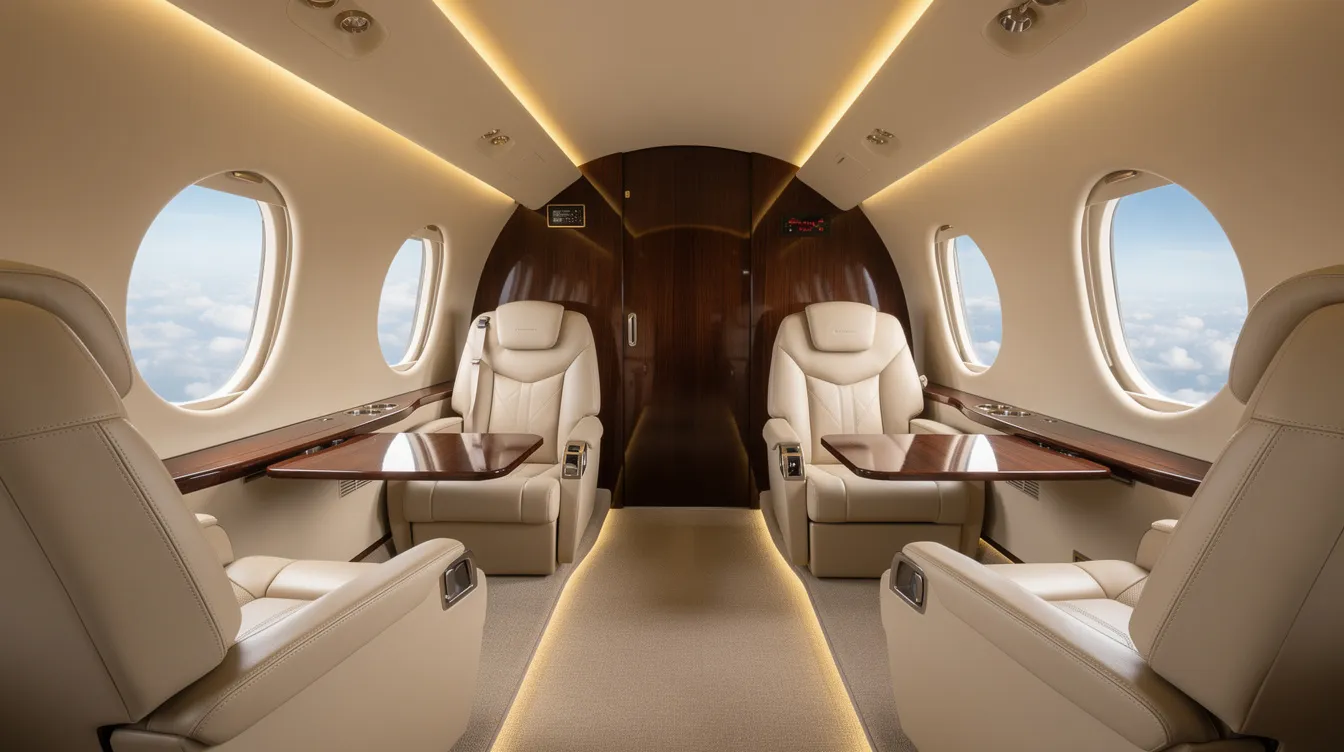
Iconic interior design firms like Cabinet Alberto Pinto have created palace-like décor for royal clients—majlis-style lounges with gold accents, hand-inlaid wood, and bespoke LED mood lighting that transforms cabin atmosphere at the touch of a button.
The Boeing 747-8 features a fully customizable interior, allowing for multiple zones that can include passenger seating, boardrooms, lounges, staff areas, and bedrooms, each designed to the owner’s specifications.
Typical layouts include:
Grand entry lobby with spiral staircase or lift to upper deck
Reception lounge with vaulted ceilings
Formal dining room seating 14
Corporate boardroom with secure communications and 100-inch screens
Private offices for working on a flight
Multiple bedroom suites with king-sized beds and ensuite bathrooms
Dedicated crew rest areas
The interior of a Boeing 747 private jet can include luxurious amenities such as full-size King beds, private washrooms, and large kitchen spaces for preparing gourmet meals, mirroring the opulence seen in Saudi princes' private plane luxury. Lifestyle features extend to full galleys for fine dining, showers and spa-style bathrooms, cinema rooms, prayer rooms or meditation areas, and advanced soundproofing. The Boeing 747-8 is equipped with advanced entertainment systems, including high-speed internet and satellite TV, allowing passengers to enjoy a premium in-flight experience across long-haul flights.
Who Actually Owns a Private Boeing 747?
Private 747s are almost exclusively the domain of governments, royal families, and the rarest tier of billionaires. The cost, scale, and operational complexity place these aircraft beyond typical private aviation.
By around 2018–2025, only about 11 BBJ 747-8 aircraft had been delivered, with operators including Qatar Amiri Flight, Kuwait, Oman, and other Middle Eastern and North African states. These aircraft were originally built as airliners before conversion or ordered directly as VIP platforms. Classic 747-400 models have also been converted for VIP use, with some featuring gold fixtures and majlis-style lounges befitting royal travel.
The United States Air Force operates heavily modified 747-200B and 747-8 aircraft as Air Force One and Survivable Airborne Operations Center platforms, designed to function as mobile command posts during national emergencies. These aircraft receive military-specification communications, defense systems, and capabilities far beyond standard VIP configurations.
Owning a private jumbo jet creates unmatched “ramp presence”—when a BBJ 747 parks next to a fleet of Gulfstreams, the statement is unmistakable. This symbolism drives acquisition for some, but for most high-net-worth individuals, the aircraft’s complexity outweighs the prestige.
Most ultra-wealthy travelers opt for ownership of smaller business jets with manageable crew requirements, or utilize access models like BlackJet’s Jet Card instead of managing what amounts to a private airline's operation for one aircraft, often consulting guides to understand private jet sizes to right-size their choice.
The Economics of a Private Boeing 747
Beyond the $418.4 million acquisition price for a new airframe, the real story of 747 ownership lies in long-term operating costs, customization expenses, and crew requirements that rival those of small airlines.
Customizing the interior of a Boeing Business Jet 747 can add an additional $25 million to $50 million to the overall cost. Clients often exercise carte blanche when designing their flying palaces, with completion centers executing visions that include hand-stitched leather, custom artwork, and security features. Some completed aircraft have topped $600 million in total investment.
Operating costs for a Boeing 747-8 can reach up to $23,000 per flight hour, primarily due to fuel expenses from four GEnx engines burning 10-12 tons per hour. For perspective, the average hourly rental rate of the Boeing 747-400 is around $30,950 per hour on the limited charter market. The average purchase price of a pre-owned Boeing 747-400 is approximately $16,000,000, more accessible, but with higher per-hour operating economics due to older engines.
The annual ownership burden includes:
Cost Category | Annual Estimate |
|---|
Fixed Costs (hangar, crew salaries, training) | $10-20 million |
Variable Costs (200 flight hours) | $4-5 million |
Insurance | $1-2 million |
Depreciation | 5-7% annually |
A full-time flight department requires multiple pilots, engineers, cabin crew, dispatchers, and security teams, plus dedicated hangar space and ongoing regulatory compliance. For 200 flight hours annually, total costs approach $30-50 million per year.
BlackJet’s prepaid Jet Card model offers a stark contrast: predictable hourly rates locked by cabin class, no asset risk, no depreciation, and no crew management. Clients access large-cabin jets for transatlantic routes at a fraction of the lifecycle cost of operating one aircraft at this scale, and resources that explain jet card cost and membership pricing help clarify the value proposition.
Long-Haul Flight Experience vs. Conventional Business Jets
Consider two scenarios: a BlackJet Jet Card member flying New York–London overnight in an ultra-long-range jet, and a head-of-state crossing continents on a BBJ 747-8 with a delegation of 40.
The 747 allows separate zones for diplomatic teams, security details, and family members—each group in their own cabin section—while preserving a private presidential suite and secure conference room at the nose. On a six-hour London crossing, passengers can dine in the formal room, work in the office, and retire to private suites before arrival.

Comfort advantages on long-haul flights extend beyond space. The 747-8 features approximately 3dB lower cabin noise than previous versions, walk-around areas for exercise and stretching, and multiple private seats across both the main deck and upper deck. Arriving rested across time zones becomes achievable even on 15-hour legs.
Yet for the majority of private travelers—those flying with 4-14 passengers rather than 40—a well-chosen large-cabin jet delivers 90% of the comfort and 100% of the time savings, and groups closer to 15 passengers can select among the best private jets for 15 travelers. Modern ultra-long-range jets feature lie-flat beds, quiet cabins outfitted with premium materials, and service levels matching five-star hotels. BlackJet clients access these aircraft without the complexity of managing a jumbo operation.
Safety, Technology, and Air Force–Level Security
VIP Boeing 747s blend commercial airliner safety standards with head-of-state security protocols, creating some of the most secure airborne environments in the skies.
The 747-8 platform benefits from decades of Boeing engineering, with over 1.5 million test flight hours across the 747 program and ETOPS-370 certification demonstrating reliability over oceanic routes. The airframe’s robustness made it the preferred choice for critical government missions, including its use as a Survivable Airborne Operations Center platform by the Air Force.
Typical onboard technologies in VIP 747s include:
Encrypted Ka-band satellite communications
Secure data links for classified operations
Triple-redundant avionics systems
Advanced weather radar and terrain awareness
In-flight connectivity exceeding commercial airline standards
Some configurations add missile defense systems, NBC (nuclear, biological, chemical) protection, and ground-independent power systems. The Air Force’s presidential aircraft program invested $3.2 billion per plane for military-specification security.
While BlackJet does not operate private 747s, we apply airline-style safety oversight across our partner fleet. Every aircraft undergoes independent third-party audits through ARGUS and Wyvern certification programs, ensuring Jet Card members fly with consistently high safety standards.
Sustainability and the Future of Jumbo Private Jets
Operating a four-engine jumbo jet as a private aircraft creates a significant environmental impact in an era focused on sustainable aviation. This reality shapes the future of ultra-large private flight.
The 747-8’s four GEnx engines burn approximately twice the fuel of modern twin-engine business jets of similar range—12 tons per hour versus 5 tons. Many BBJ 747 operators offset emissions or invest in sustainable aviation fuel (SAF) initiatives, but the inherent fuel consumption remains higher than efficient alternatives.
BlackJet takes a different approach: every flight is carbon-neutral through verified carbon offset programs, with a preference for newer, fuel-efficient aircraft types in our partner network. This model aligns with modern expectations around environmental responsibility without requiring clients to manage offset programs themselves, especially when paired with more economical private aircraft options that reduce fuel burn from the outset.
The industry trend moves away from four-engine giants toward efficient twin-engine widebodies like the Boeing 787 and 777X, suggesting future flying palaces may be built on greener platforms. For clients seeking true luxury and sustainability together, access programs deliver both without the environmental overhead of jumbo jet ownership.
How BlackJet Delivers Jumbo-Jet Level Access Without Ownership
BlackJet represents the practical alternative to 747 ownership: access to the right jet for each mission—from light jets to long-range aircraft—via flexible 25+ hour Jet Card membership.
A Jet Card works simply: clients prepay for 25-50+ hours, lock in transparent hourly rates by cabin class, then request flights on demand through our digital platform or 24/7 support team. Understanding jet card pricing structures and benefits helps frequent flyers decide how many hours to commit. No acquisition cost, no crew management, no hangar concerns.

Real use cases demonstrate the flexibility that ownership cannot match for travelers selecting the best jet cards for frequent flyers:
CEO, New York–London: Overnight flight on a large-cabin jet, departing after dinner, arriving for morning meetings. Cost predictable, aircraft selected for the mission.
Family, Los Angeles–Honolulu: Weekend getaway on a super-midsize jet, departing from Van Nuys rather than LAX. No TSA lines, no connections.
Executive team, intra-Europe: Four-city tour on midsize jets, repositioning as the schedule demands. Each leg uses the optimal aircraft for the route.
BlackJet’s partner aircraft are safety-certified through rigorous third-party audits, maintained to standards exceeding Part 135 requirements, and every flight operates carbon-neutral. For those not ready for full membership, it’s also possible to buy a single seat on a private jet through select shared and semi-private options. This system delivers what matters—time, privacy, control—without ever requiring the purchase of one aircraft at $400 million.
Elevate your travel—effortlessly. Explore BlackJet’s Jet Card programs and discover how refined, meaningful travel becomes your new standard.
FAQ: Private Jet Boeing 747
These frequently asked questions address common inquiries about private Boeing 747s and how they compare with more accessible private aviation options. For most travelers, understanding the realities of jumbo jet ownership clarifies why access models have become the preferred path to premium flight.
How many private Boeing 747s exist in the world?
Only around 11 BBJ 747-8 aircraft were delivered in VIP configuration during production, with perhaps 20 additional classic 747-400 models converted for VIP or head-of-state use. This makes them extraordinarily rare compared to the thousands of Gulfstream and Bombardier business jets in operation, many of which are also available through established programs such as NetJets jet card memberships.
Most of these aircraft serve governments, royal families, or state flight departments—not individual private owners, even when other large-group missions can be met by private jets for up to 50 passengers. The end of 747 production in December 2022 means no new private 747s will be built, further limiting their numbers and increasing the legacy value of existing aircraft.
Can an individual charter a private Boeing 747 for a single trip?
While technically possible to charter a 747—particularly ex-airline 747-400s configured for large group movements—VIP-configured BBJ 747-8s rarely appear on the open charter market. When they do, pricing reflects both the $30,950+ hourly operating costs and specialized crew requirements, far above the levels discussed for the cheapest private jet and entry-level options.
Charters typically serve governments, corporate roadshows, sports teams, or large event movements rather than individual travelers, who more often look at private jet solutions for 20 passengers or fewer. BlackJet focuses on right-sized aircraft that optimize comfort, cost, and availability—matching the mission rather than flying excess capacity.
Is a private Boeing 747 more comfortable than a typical business jet?
In terms of raw square footage, multiple rooms, and capacity to create a true flying residence, the BBJ 747-8 offers unmatched space. For large entourages or very long flights requiring separate zones for work, rest, and delegation, nothing compares.
However, for small groups of 4-14 passengers, modern long-range business jets already deliver lie-flat beds, exceptionally low cabin noise, and service levels matching five-star hotels, with some of the top 16-seat private jet options offering remarkable comfort and flexibility. The practical comfort difference shrinks considerably when you’re not traveling with a 40-person delegation. BlackJet clients achieve world-class comfort and privacy without the overhead of managing a jumbo operation.
What is the difference between Air Force One and a typical private Boeing 747?
Air Force One—currently based on specialized 747 variants operated by the Air Force—includes extensive military communications, defense systems, and mission-specific modifications not present on typical VIP 747s. The aircraft functions as a Survivable Airborne Operations Center with classified capabilities, including secure nuclear communications and aerial refueling capacity.
While both share the core 747 model and fuselage, Air Force One receives modifications costing billions of dollars. Head-of-state BBJ 747s for other countries may include similar but usually less extensive security features compared to the U.S. presidential aircraft.
What’s the most practical way to access long-range private flights if I’m not buying a 747?
A Jet Card or on-demand charter approach delivers the strategic advantages of private flight without ownership burden. BlackJet’s Jet Card programs provide prepaid access to a curated fleet of light, midsize, and long-range jets worldwide, with options ranging from focused 100-hour jet card solutions to more modest hour blocks.
Clients select cabin class for each trip: large-cabin jets for transatlantic routes, super-midsize for transcontinental domestic, and smaller aircraft for regional travel, often starting with a 50-hour jet card program as a testing ground for frequent use. This flexibility—impossible with a single-owned aircraft—matches each mission to optimal equipment. BlackJet adds carbon-neutral operations, stringent safety oversight, and digital booking tools, making premium private aviation accessible without ever managing or affording a 747.
Conclusion: The Pinnacle of Private Jet Travel
The private Boeing 747 stands as the ultimate symbol of prestige, power, and unparalleled luxury in private aviation. Its unmatched range, spaciousness, and customization options make it the preferred choice for heads of state, royal families, and elite corporate leaders who demand more than just transportation—they require a flying palace that serves as a strategic asset. However, the immense costs and operational complexities place ownership beyond the reach of most travelers.
For discerning individuals seeking the benefits of large-cabin, long-range private jets without the burdens of ownership, BlackJet offers an exclusive solution. Through BlackJet’s Jet Card programs, travelers gain seamless, on-demand access to a curated fleet of premium aircraft, combining rigorous safety standards, carbon-neutral operations, and cutting-edge technology. This approach delivers the strategic advantages of private aviation—privacy, flexibility, and efficiency—while eliminating the complexities of managing a jumbo jet.
Elevate your travel effortlessly with BlackJet. Discover how their tailored Jet Card memberships can transform your flying experience, granting you access to the world’s most prestigious aircraft and destinations on your terms. Explore premium private jet access today at blackjet.com and redefine what it means to fly in luxury and style.


 Sign up with google
 Sign up with Apple


