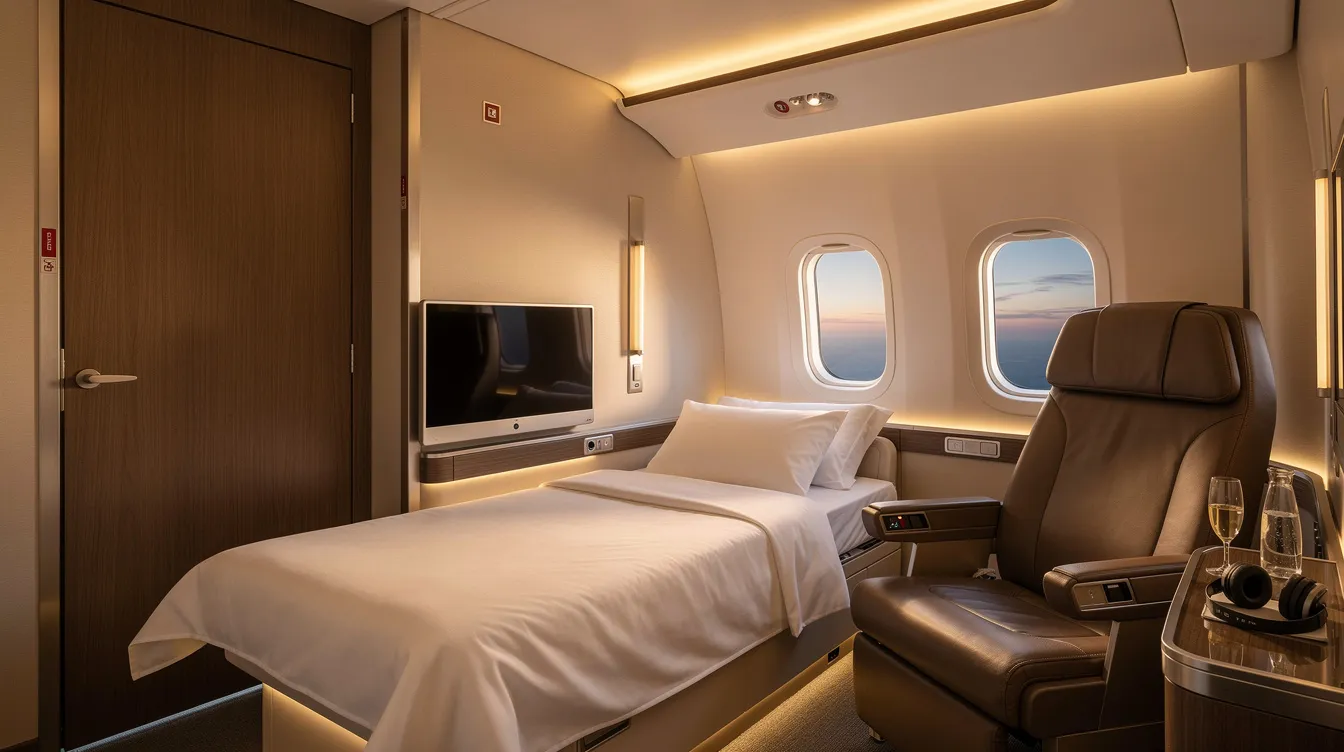
Commercial first class remains the gold standard of airline travel — but for a growing number of executives and high-net-worth travelers, it is no longer the ceiling. Here is what first class actually delivers in 2026, and when going private makes more strategic sense.
Introduction: Why First Class Matters for Serious Travelers
Picture two travelers flying Newark to LAX on the same day in 2025. One sits in coach: 31 inches of seat pitch, a 45-minute security line, middle-seat odds, and spotty sleep across five and a half hours. The other departs from a dedicated check-in zone, clears an expedited lane, settles into a lie-flat suite, and lands rested enough to take a meeting by noon. That is the core answer to the perks of flying first class: more space, priority airport handling, lounge access, premium dining, personalized service, and amenities built to protect your time, comfort, and productivity.
For executives, high-net-worth leisure travelers, and frequent flyers weighing first class against private aviation, the difference is not subtle. On flagship routes with carriers like United Airlines, that top cabin class sets a baseline expectation: priority boarding lets first-class passengers settle in early without the crowd, first-class fares usually include two or more checked bags with priority handling, and the ground-to-gate experience is designed to reduce friction. During peak periods in 2024, average TSA wait times at major U.S. airports often exceeded 45 to 60 minutes. Understanding those tradeoffs helps travelers decide when a first-class upgrade improves comfort and efficiency, and when it still falls short on flexibility, privacy, or total time saved.
That is where BlackJet enters the picture. As a private aviation company offering Jet Card programs with prepaid access to vetted aircraft, BlackJet helps travelers move beyond commercial first class when airline schedules are too rigid, airports too crowded, or privacy too important. The sections below compare first-class products across airlines, the ground and in-flight benefits they deliver, how they stack up against private jet travel on safety, technology, and sustainability, and the point at which private aviation outperforms every airline seat.
What "First Class" Really Buys You on Major Airlines like United Airlines
Understanding first class in 2026 starts with recognizing that the term covers vastly different products. On U.S. domestic routes, "first class" on a narrowbody plane typically means a wider seat at roughly 38 to 40 inches of pitch — comfortable, but not a lie-flat bed. On international long-haul routes, true first class is a different idea entirely. On some long-haul international flights, first-class seats can fully recline into horizontal beds, and flagship products like Emirates A380 First Class Suites offer 86-inch pitch, 23-inch width, fully enclosed privacy doors, and onboard shower spas. First-class seats provide more legroom and can convert into fully flat beds on long-haul flights, a point that separates them from even the best business class options.
First-class dining includes multi-course meals designed by renowned chefs served on real china with silverware — think à la carte ordering, Dom Pérignon or Krug by the glass, and high-quality espresso on demand. First-class travel provides a higher crew-to-passenger ratio for personalized and attentive service, sometimes one attendant for every two or three guests. Travelers in first class may receive designer amenity kits stocked with luxury items from brands like Byredo or Bvlgari, and first-class passengers enjoy luxury amenities like high-end skincare products and plush pajamas on ultra-long-haul flights.
What does all this cost? For a New York to London round trip, economy runs roughly $1,000 to $1,500, business class sits around $3,000 to $4,000, and first class averages approximately $5,900 — with good deals occasionally dipping to $5,200 one way. Points and miles can offset those numbers, with award space sometimes available for 120,000 to 160,000 miles on select carriers. For travelers who find that spend worth it, the experience is clear: you pay for things that directly affect how you feel and perform at your destination.
Ground Experience: From Priority Check-In to Exclusive Lounges
Consider a traveler flying first class on United Airlines from Chicago O'Hare to Tokyo in early 2026. Priority services include dedicated check-in and expedited security screening for first-class passengers, which means bypassing the main terminal queues and reaching the lounge within minutes of arriving at the airport. First-class tickets often include access to exclusive airport lounges before boarding, where à la carte dining, premium spirits, showers, and nap rooms are standard. At select hubs like Frankfurt or Doha, chauffeur transfers take you directly from the lounge to the aircraft door. First-class travel enhances overall convenience with quicker deplaning and less waiting time on the other end.
Now contrast that with the private jet FBO experience. BlackJet members drive up to a private terminal, skip every public line, and board their aircraft in under 15 minutes. Private jets offer direct access to over 5,000 airports, which means flying out of Teterboro instead of Newark or Van Nuys instead of LAX — landing closer to your final destination and cutting ground transit by an hour or more, provided you match your mission to the right private jet size for your journey and understand how high a private jet flies compared with commercial aircraft. The length of time you spend before and after the flight often matters as much as what happens on the plane.
In-Flight Comfort: First Class Seats, Space, and Personalized Service
The physical perks of first class cabins are hard to overstate. International suites typically offer 78 to 82 inches of pitch in 1-1-1 or 1-2-1 layouts with direct aisle access, privacy doors, and turndown service with upgraded bedding. First-class cabins are typically quieter with fewer passengers for a more serene travel experience. Amenities may include premium headphones and blankets to enhance in-flight comfort, and frequent travelers benefit from the comfort of first-class seating and personalized service that makes long flights feel shorter.
Here is a use case that fits lots of executive schedules: a red-eye first-class flight from Los Angeles to New York, boarding at 10 p.m. and arriving by 6 a.m. Sleep in a fully flat bed, skip the jet lag, and stay sharp for an 8:00 a.m. board meeting. The life-and-productivity benefit is real — good sleep quality mitigates circadian rhythm disruption and lets you show up ready to perform.
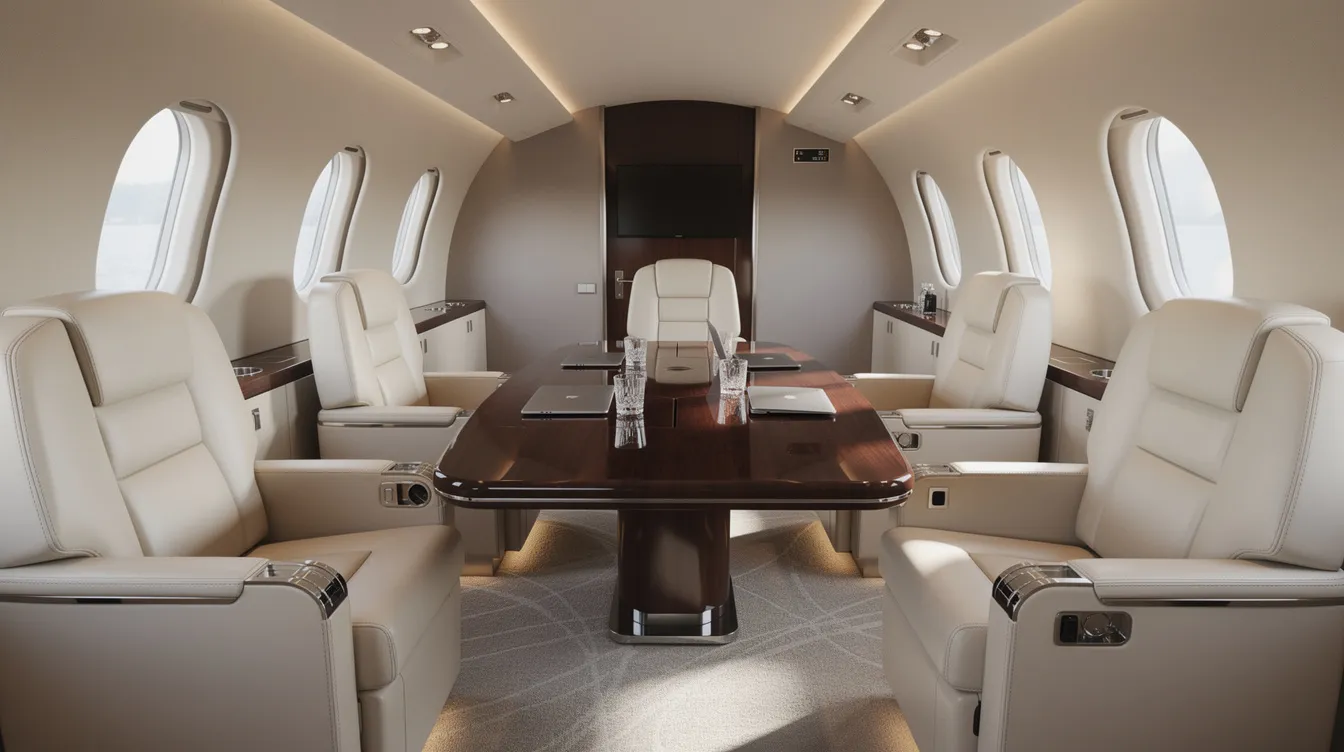
BlackJet's private jet cabins take customization further. Select the aircraft category that fits the mission: light jets typically seat 4 to 8 passengers for short hops, midsize jets can accommodate 6 to 8 passengers comfortably for regional routes, and heavy jets often seat 8 to 16 passengers with more amenities for transcontinental or international travel, drawing on a wide range of private jet types for every traveler and small private jets for flexible luxury travel. Configure the cabin layout — club four, divans, or conference-style tables — and pre-select catering, cabin temperature, and onboard amenities through BlackJet's digital platform. With premium private jet cards and Jet Card programs, there are no seatmates unless you want them.
Working in the Sky: Connectivity, Privacy, and Control
Modern first class cabins support work with upgraded satellite Wi-Fi, large tray tables for laptops, power outlets at every seat, and relative quiet compared with economy. You can find enough bandwidth for video calls and live document editing on most transatlantic routes. But privacy has limits: conversations can be overheard, cabin announcements interrupt focus, and reviewing sensitive financial documents next to a stranger carries risk.
Flying private can enhance productivity with onboard workspaces where passengers enjoy complete privacy and personalized service. A BlackJet member might hold live deal negotiations between New York and Miami, or review M&A documents between London and Zurich without a single interruption. Private jets can accommodate last-minute travel plans easily, which means a schedule change at noon does not require rebooking a commercial flight for the next morning.
Consider this example: an executive using a 25-hour Jet Card block for quarterly site visits across three U.S. cities in a single day. Jet Card programs and their costs provide prepaid access to private jets, so the air time is already budgeted, and a dedicated guide to 25-hour Jet Card features and pricing helps clarify the total commitment. For travelers who do not yet need a full program, understanding whether chartering a private jet is worth it helps frame the upgrade from first class. Direct routing eliminates layovers, the cabin serves as a mobile office, and every hour in the air produces measurable output. That is an experience commercial first class simply cannot replicate.
How First Class Compares to Private Jet Access with BlackJet
First class on airlines like United Airlines is ideal for fixed, long-haul routes—a solo traveler on a predictable New York to London schedule booked months ahead gets tremendous value. But BlackJet excels in scenarios that airlines cannot serve well: multi-city itineraries, late-notice departures, or access to airports commercial carriers do not fly into, especially when you compare Jet Card costs across 25-, 50-, and 100-hour programs and use a broader guide to jet card pricing, costs, and benefits to benchmark different providers.
The differences in schedule flexibility and routing are important. Super midsize jets offer a range of 2,500 to 3,500 nautical miles, covering most transcontinental and transatlantic missions nonstop, and advanced tools like a private jet flight time calculator for accurate planning make it easier to map complex itineraries. Turboprop aircraft are ideal for short regional flights where commercial options require inconvenient connections and can be among the cheapest private aircraft options for cost-conscious flyers. BlackJet's Jet Card model — available in 25-hour and 50-hour programs — offers all-inclusive hourly rates that make budgeting predictable throughout the year compared with fluctuating first-class fares, similar in structure to many 50-hour Jet Card pricing models, and complements more traditional on-demand options outlined in guides to how much it costs to rent a private jet. For frequent travelers, the best jet cards for flexibility and value ensure hours never expire, and guaranteed availability windows mean you are not competing for upgrade status or award space.
Imagine a Dallas-based executive traveling to Aspen for a half-day meeting, then onward to LA in the evening. With a BlackJet 25+ Hour Jet Card, they fly a light jet directly into Aspen's regional airport, then a midsize jet to LA — no hub connections, no fixed airline schedule, departure times tailored to the day, even when evaluating costs and options for 12-seater private jets for larger teams. Mobile booking platforms offer 24/7 digital booking tools, and real-time support services enhance user experience on every leg. That case makes the cost worth every dollar.
Safety, Sustainability, and Technology: Beyond the Seat
Commercial airlines operate under strict FAA and EASA oversight, and first-class passengers benefit from modern, fuel-efficient aircraft like the 787 and A350. But those safety and sustainability advantages are shared across all cabin classes — they are not exclusive to the front of the plane.
BlackJet's safety framework sets a higher bar for private aviation. Private jets undergo rigorous safety inspections regularly. Many private aviation companies hold FAA Part 135 certification, and BlackJet requires operators to meet or exceed ARGUS Platinum and Wyvern Wingman standards through independent third-party audits. Private jets often have advanced safety technology onboard, and pilots in private aviation must complete extensive training that matches or surpasses commercial airline requirements, reinforcing that private jets are safe when you understand the real risks and safeguards.
On sustainability, BlackJet flights are carbon neutral by default — verified offsets aligned with Gold Standard and VCS are included at no extra cost to members. Select hubs will offer Sustainable Aviation Fuel in 2026 for deeper emissions reductions. For decision-makers comparing options, an overview of private jet prices and access models is essential, alongside a detailed look at Jet Card cost per hour and key pricing drivers, and a practical guide to how much it costs to charter a small plane. On the technology side, BlackJet's platform lets members share trip history, select aircraft options, and manage bookings via email or mobile app—a level of control that airline apps for managing first class upgrades cannot match.
Is First Class Enough - Or Is It Time to Go Private?
Let us summarize: the perks of flying first class are real. Superior comfort, lie-flat beds, elevated dining, exclusive lounges, and the ability to arrive rested for the most important moments in your professional and personal life. For a solo traveler on a predictable transatlantic route, first class remains an outstanding option — and you can learn more about who has the best first class flights to find the right fit.
Is first class worth it in 2026? In specific cases, absolutely — especially on long-haul routes with true suite products. But as business class continues to level up and close the gap, many frequent travelers find the logical progression runs from economy to business, then first class, then private aviation. When you need to visit three cities in 24 hours, travel with a small team, reach a regional airport, or simply guarantee privacy, a BlackJet Jet Card delivers what no commercial seat can, whether you charter the whole aircraft or buy a seat on a private jet through shared and semi-private options.
If you have reached the point where first class feels like a compromise rather than an upgrade, it may be time to explore what comes next. Discover how BlackJet Jet Cards can redefine your idea of first class — with transparent safety, carbon-neutral flights, and the flexibility to travel on your terms, or evaluate whether unlimited private jet flight memberships make more sense for your travel pattern. Comment or reach out to our advisory team to start the conversation.
Frequently Asked Questions About Flying First Class and Private Jet Travel
What are the main perks of flying first class?
Flying first class offers enhanced comfort with more spacious seats that often recline fully, premium dining options, priority boarding and baggage handling, access to exclusive lounges, personalized service, and amenities such as luxury skincare products and designer amenity kits. It also includes expedited check-in and security screening, making the overall travel experience more seamless, though the very top tier of comfort now comes from the best private jets in the world for luxury and performance.
How does private jet travel compare to flying first class?
Private jet travel provides unmatched flexibility with access to over 5,000 airports, the ability to customize flights and onboard amenities, complete privacy, and significantly reduced total travel time. Unlike first class on commercial airlines, private jets accommodate last-minute travel plans and multi-city itineraries without the constraints of fixed schedules, and you can choose from the best small private aircraft for each specific mission.
Are private jets safe compared to commercial flights?
Yes. Private jets undergo rigorous safety inspections, comply with FAA Part 135 certification, and operators often meet or exceed ARGUS Platinum and Wyvern Wingman standards. Pilots complete extensive training, and private jets often feature advanced safety technology, especially in the newest generation of private jets that blend innovation and luxury.
What types of aircraft are available with private jet programs?
Private jet categories include light jets (4-8 passengers), midsize jets (6-8 passengers), heavy jets (8-16 passengers), super midsize jets with longer ranges, and turboprops ideal for short regional flights. Each category suits different travel needs and distances, and travelers focused on budget can look at the cheapest private jet options and entry-level aircraft to right-size their spend.
How can I book a private jet with BlackJet?
BlackJet offers Jet Card programs with prepaid access to private jets and a 24/7 digital booking platform. Members can manage bookings via mobile app or email and receive real-time support to ensure a seamless travel experience, whether they are booking a light jet for a short hop or chartering a small plane for a custom itinerary.
Is flying first class worth the cost?
For many travelers, especially on long-haul international routes, first class offers significant comfort and productivity benefits that justify the higher price. However, for those needing greater flexibility, privacy, or multi-leg itineraries, private jet travel may offer better value despite a higher cost, particularly when you understand whether chartering a private jet is worth it compared with first class.
How does BlackJet ensure sustainability in private aviation?
BlackJet includes verified carbon offsets aligned with Gold Standard and VCS for all flights at no extra cost. They also plan to offer Sustainable Aviation Fuel at select hubs to further reduce emissions, and many of the most affordable private jet options emphasize efficient, lower-consumption aircraft that help minimize environmental impact.
Can I use frequent flyer miles to upgrade to first class?
Many airlines allow upgrades using miles or points, but availability varies. Using miles for first-class tickets can provide high value, especially on international routes with true suite products. Travelers weighing whether to keep investing in miles or shift toward ownership or access programs may also evaluate 10 million dollar private jet options and access models as their travel demand grows.
What is a Jet Card and how does it work?
A Jet Card is a prepaid program that gives members access to a fleet of private jets at fixed hourly rates. It simplifies budgeting and guarantees availability without the responsibilities of jet ownership, and a detailed guide to jet card pricing, costs, and structures can help you compare programs before committing.
How does first class boarding compare to private jet boarding?
First class passengers enjoy priority boarding to settle in early, but still board with other passengers. Private jet travelers bypass all lines, check in at private terminals, and board within minutes, significantly reducing total travel time.
Conclusion: Elevate Your Travel Experience Beyond First Class
Flying first class offers undeniable perks—luxury seating, premium dining, exclusive lounges, and priority services—that transform commercial air travel into a seamless, restful experience. For many, especially on predictable long-haul routes, these benefits justify the investment and enhance productivity and comfort.
However, for discerning travelers who demand ultimate flexibility, privacy, and time efficiency, private jet access through BlackJet’s Jet Card programs represents the next evolution. With direct access to thousands of airports, bespoke cabin configurations, carbon-neutral flights, and a proprietary safety certification framework, private aviation redefines what it means to fly first class.
Whether you prioritize the elevated amenities of commercial first class or the tailored freedom of private jets, understanding your travel needs and mission profile is key. For travelers testing private aviation for the first time, affordable private plane rideshare options can be a smart bridge between premium cabins and full-aircraft charter. Explore how BlackJet can unlock new possibilities in air travel—where luxury meets strategic advantage, and every journey is a seamless extension of your lifestyle and business goals. Discover the future of first class with BlackJet and elevate your travel to unparalleled heights.


 Sign up with google
 Sign up with Apple