Introduction: From Supersonic Flight to Hypersonic Records
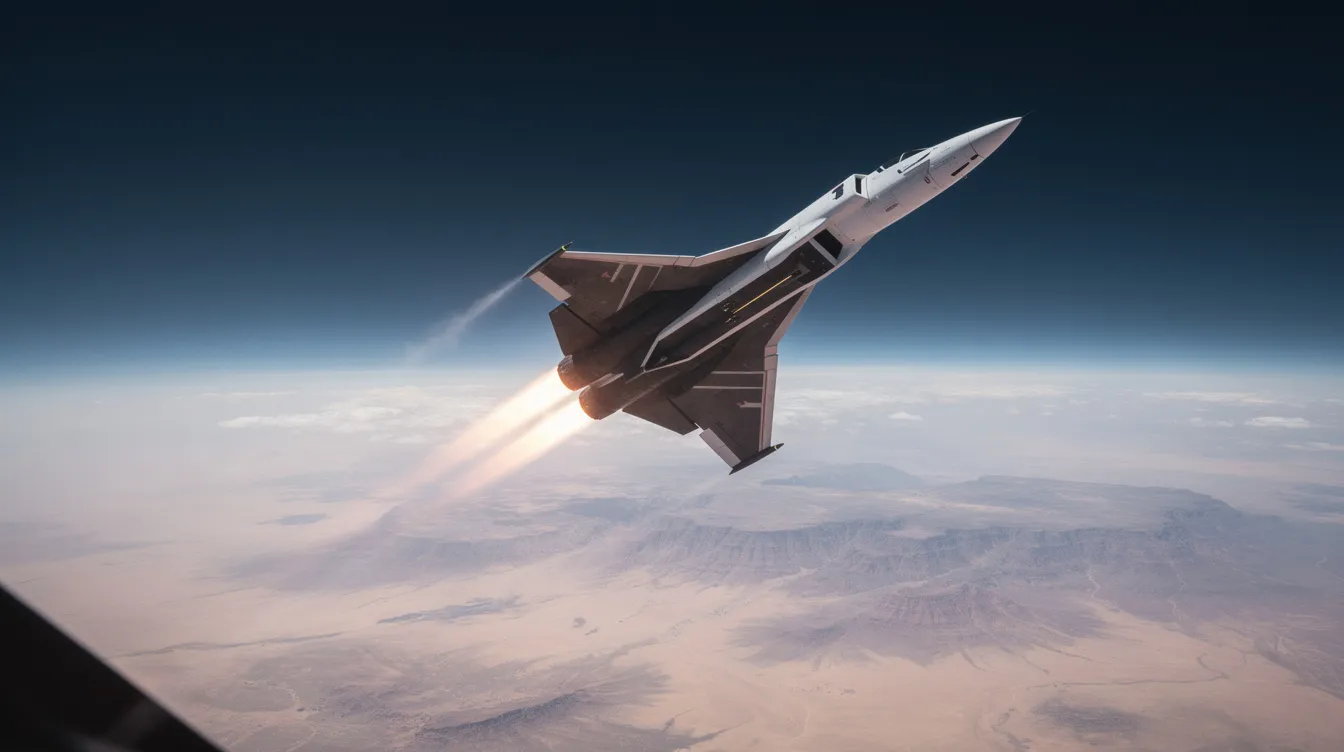
More than half a century after its final mission, the North American X-15 remains the fastest piloted aircraft ever flown. On October 3, 1967, this rocket-powered research aircraft reached Mach 6.7-approximately 4,520 miles per hour-setting a record that no crewed, powered, winged vehicle has surpassed. That speed is not a rounding error above other fast planes; it occupies an entirely different category of flight.
For perspective, commercial airliners cruise at roughly Mach 0.8, or about 550 mph. The legendary SR-71 Blackbird topped out near Mach 3.2. The X-15 more than doubled the Blackbird's maximum speed, entering the hypersonic domain where air behaves less like a fluid and more like a blowtorch against every exposed surface. The aircraft bridged the gap between conventional aviation and spaceflight, producing data that shaped the Mercury, Gemini, Apollo, and Space Shuttle programs.
That heritage of precision engineering, rigorous safety protocols, and relentless performance improvement echoes through every tier of aviation today-including the standards discerning travelers expect from premium private flight providers like BlackJet.
North American X-15 Top Speed Record Explained
The absolute speed record belongs to USAF pilot William "Pete" Knight, who flew the modified X-15A-2 to Mach 6.7 on 3 October 1967. Knight flew that mission over the Nevada and California test ranges, reaching approximately 4,520 mph (7,274 km/h) at an altitude of around 102,700 feet. The flight lasted roughly eight minutes and seventeen seconds from release to touchdown-yet the powered phase consumed less than two and a half minutes of that window.
The flight profile followed a carefully rehearsed sequence. The X-15 was released from a B-52 at roughly 45,000 feet and about 500 mph. Knight ignited the rocket engine, climbed steeply under full thrust using both internal and external propellant tanks, reached peak speed, then shut down the engine and glided unpowered to a dry lakebed landing at Edwards Air Force Base.
To appreciate how extreme Mach 6.7 truly is: the speed of sound at altitude sits between roughly 660 and 760 mph depending on temperature and air density. A typical airliner covers ground at about Mach 0.85. The SR-71 Blackbird managed around Mach 3.2. Knight's record more than doubled the Blackbird and exceeded airliner speed by a factor of nearly eight. This record applies specifically to piloted, powered, winged aircraft-distinct from unpiloted missiles or spacecraft re-entry vehicles-and it remains unbroken.
Designing the X-15 for Hypersonic Flight
North American Aviation won the contract on 5 October 1954 to build a hypersonic research aircraft for NACA (the precursor to NASA) and the U.S. Air Force. From the outset, engineers understood they were designing a vehicle that would operate in flight regimes no piloted aircraft had survived before.
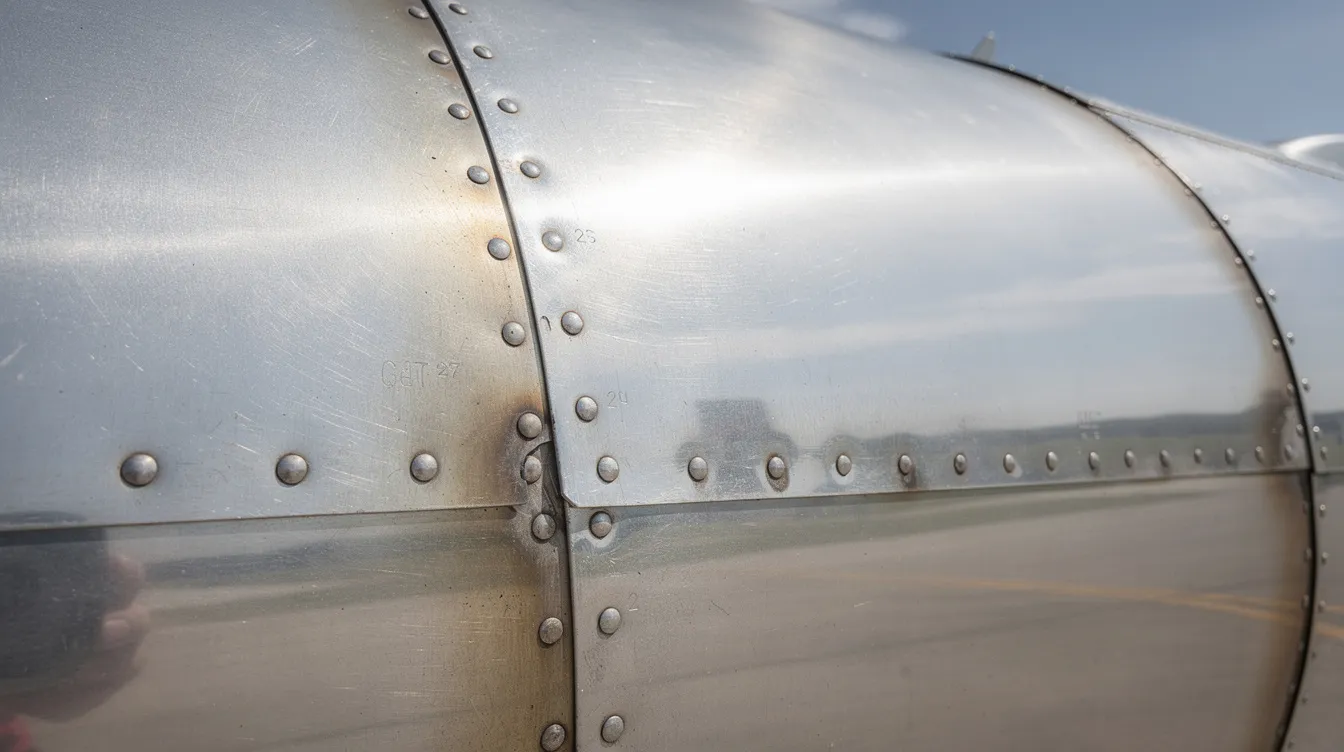
The X-15's fuselage was long and cylindrical, constructed primarily from Inconel X, a nickel-chromium alloy capable of withstanding skin temperatures exceeding 1,200 °F. Internally, titanium-manganese spars and ring frames provided structural integrity under severe thermal stress and shock loads. The aircraft used heat-resistant Inconel-X 750 alloy across its most exposed surfaces-a material choice driven by the reality that at hypersonic speeds, aerodynamic heating dominates every engineering decision.
Rather than conventional wings optimized for lift, the X-15 featured small, stubby wing surfaces designed for high-speed stability. It had a thick wedge tail for hypersonic stability and directional control in thin atmosphere where conventional tail shapes would be ineffective. The entire vehicle was built around its powerful rocket engine rather than a traditional turbojet, with internal volume dominated by propellant tanks, cooling circuits, and thermal management systems. Engineers anticipated extreme aerodynamic heating, shock waves, and thermal expansion-challenges that demanded solutions far beyond anything seen in conventional piloted aircraft of the era.
Rocket Engine Power: XLR11 to XLR99
The X-15's propulsion system was the single most critical enabler of its record-setting performance. Unlike turbojet or turbofan engines that breathe atmospheric air, the X-15's rocket engine carried both fuel and oxidizer internally, allowing it to produce thrust at altitudes where air-breathing engines would starve and flame out.
Early flights used the Reaction Motors XLR11, a four-chamber engine derived from the same family that powered the Bell X-1 during the first flight past Mach 1. The XLR11 delivered approximately 6,000 pounds of thrust-sufficient for initial envelope expansion and pilot familiarization, but far short of what hypersonic speeds demanded. The first powered flight of the X-15 occurred on 17 September 1959 using this interim engine.
The definitive powerplant was the Reaction Motors XLR99, which entered service around 1960. This throttleable engine produced up to 57,000 pounds of thrust at altitude, burning liquid oxygen and anhydrous ammonia. Its turbopump was driven by decomposed hydrogen peroxide, and cooling was regenerative-propellant circulated through tubing around the combustion chamber, which reached internal temperatures near 5,000 °F.
Burn duration directly governed maximum speed. With internal tanks alone, full-thrust burns lasted roughly 80 to 90 seconds. The modified X-15A-2 added external drop tanks that extended total burn time to approximately 150 seconds, giving Knight the extra energy needed to push past Mach 6. Every additional second of thrust translated into hundreds of miles per hour-but also meant hundreds of additional degrees of structural heating.
Breaking and Redefining the Sound Barrier
The X-15's achievements only make full sense when placed in the arc of aviation history. In 1947, Chuck Yeager broke the sound barrier in the Bell X-1. By the mid-1950s, aircraft like the Lockheed F-104 Starfighter were reaching routine Mach 2 speeds in military service. But each step higher on the Mach scale introduced compounding challenges: shock waves, drag rise, heating, and control degradation.
Breaking the sound barrier involves punching through a region of rapidly increasing drag and pressure disturbance. Supersonic flight (Mach 1 to roughly Mach 5) brings shock-wave management and moderate heating into the design conversation. Hypersonic flight-generally defined as Mach 5 and above-changes the physics entirely. At hypersonic speeds, aerodynamic heating becomes the dominant structural threat, control surfaces lose effectiveness in rarefied atmosphere, and real gas effects alter how air flows over surfaces.
The X-15 pushed progressively deeper into these regimes: Mach 4.43 in March 1961, Mach 5.27 by June 1961, Mach 6.04 in November 1961, and finally Mach 6.70 in October 1967. The program advanced the understanding of hypersonic flight in ways that ground-based wind tunnels simply could not replicate. Data on aerodynamic heating behavior, control-surface authority transitions, and high-altitude reaction control directly defined engineering standards for later vehicles including the Space Shuttle orbiter.
Operational Profile: How X-15 Flights Reached Top Speed
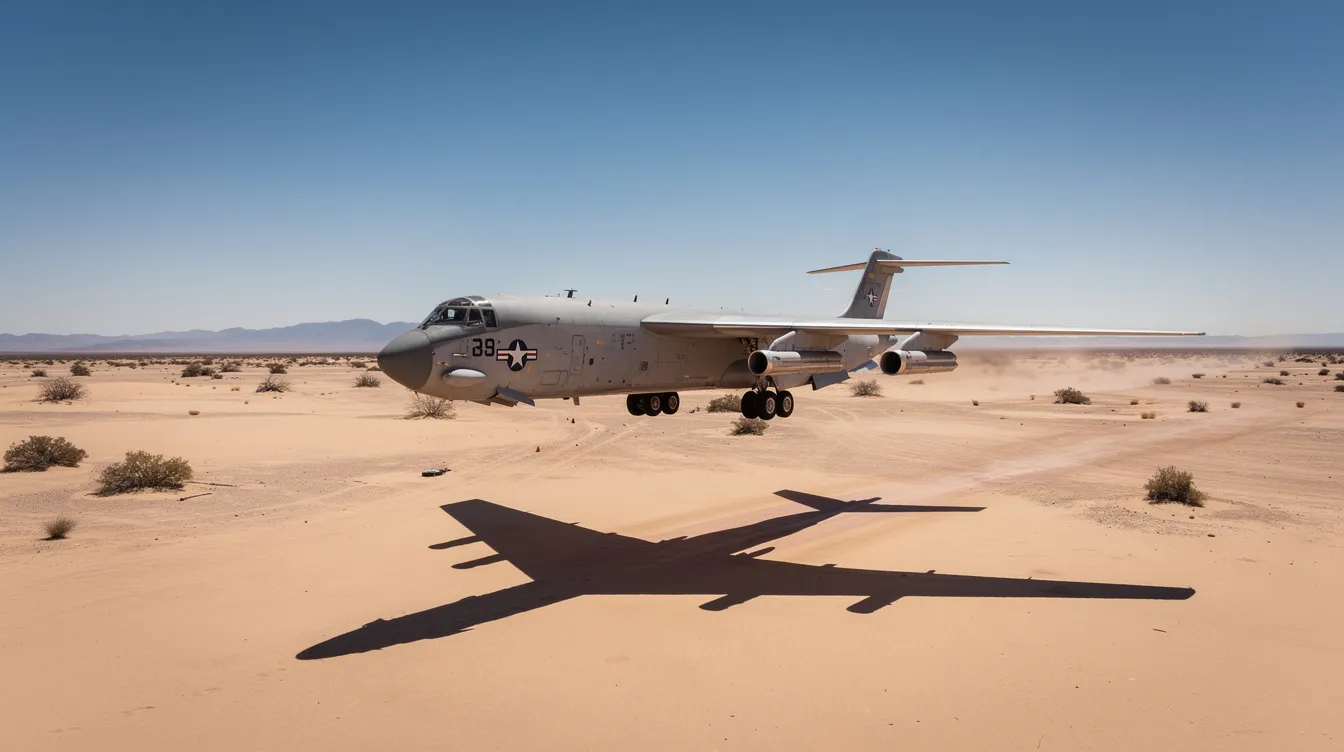
A typical X-15 mission began not on a runway but under the wing of a modified Boeing B-52 Stratofortress. The aircraft was carried aloft to approximately 45,000 feet and about Mach 0.8 before being released. This air launch approach was essential: it saved precious rocket propellant that would otherwise be consumed climbing from sea level and allowed the vehicle to begin its powered run in thinner air where drag was significantly lower.
After release, the pilot ignited the rocket engine and entered a steep climb-and-acceleration profile. Typical flights lasted roughly ten to twelve minutes from drop to touchdown, with the powered phase often consuming less than two minutes. During high-speed runs, pilot workload was extreme-every second of burn time had to be managed against speed, altitude, structural temperature, and the rapidly approaching limits of propellant supply.
The program operated jointly by NASA and the U.S. Air Force and completed 199 test flights by 1968. The last X-15 flight took place on 24 October 1968. Three airframes were built: the X-15-1, X-15-2, and X-15-3. The X-15A-2 was the most heavily modified, with an 18-inch fuselage stretch, external drop tanks, and ablative coatings on high-heat areas-modifications specifically engineered to extend burn time and boost the vehicle to its record-setting maximum speed. All flights ended with unpowered glide landings on dry lakebeds in California, a technique that later informed Space Shuttle approach-and-landing procedures.
Pilots, Astronaut Wings, and Human Performance at Hypersonic Speed
Twelve test pilots flew the X-15 during its program, drawn from NASA, the U.S. Air Force, the Navy, and North American Aviation itself. Several went on to become defining figures in aerospace history. Neil Armstrong, later the first man to walk on the moon, flew the X-15 seven times. Joe Engle, another X-15 veteran, commanded Space Shuttle missions. These were not just pilots-they were engineers, data collectors, and test subjects simultaneously.
Eight pilots earned their astronaut wings through the program. The U.S. Air Force awarded astronaut wings for flights exceeding 50 miles altitude, and 13 X-15 flights crossed that threshold. Joe Walker exceeded 100 km altitude in July 1963, surpassing the Kármán line recognized by the Fédération Aéronautique Internationale as the boundary of space. The X-15's highest altitude was 354,200 feet, roughly 67 miles above Earth, reached by Walker on a separate mission. The aircraft operated at altitudes above 30,500 meters routinely during high-altitude profiles.
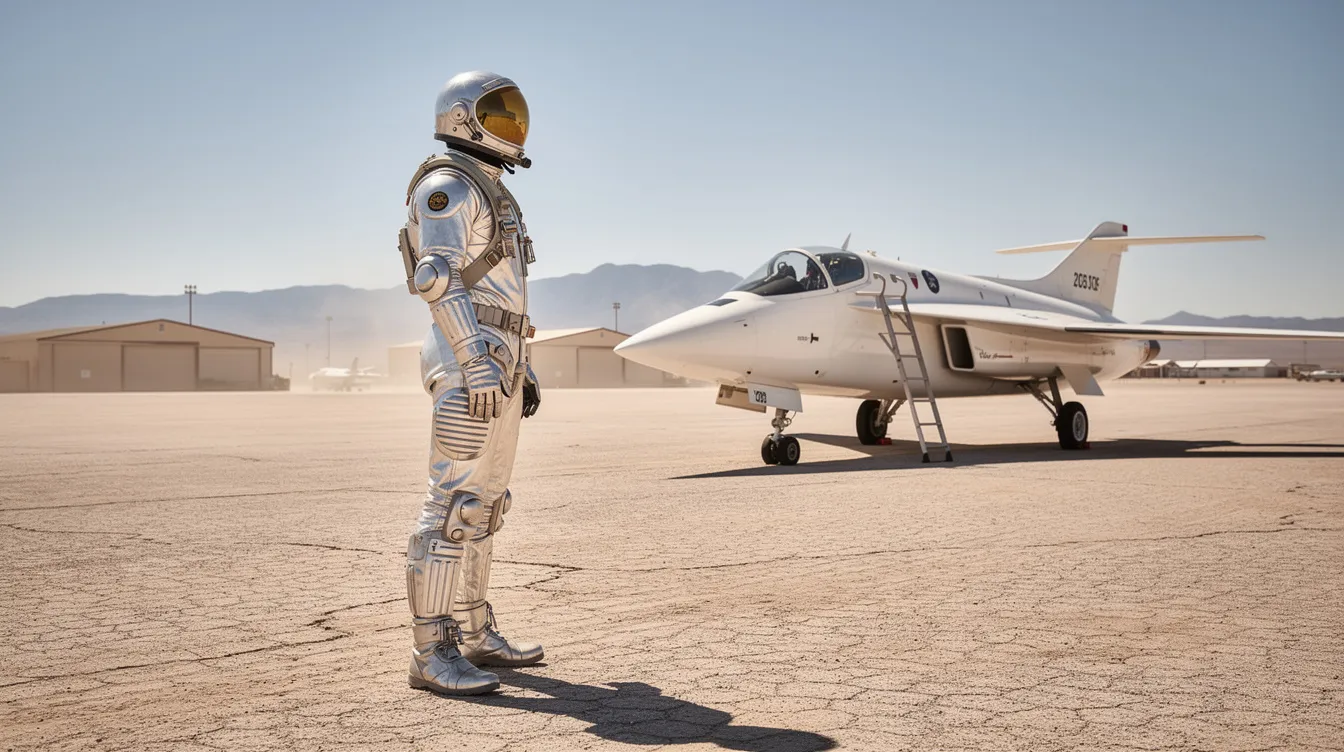
Human factors at these extremes were severe. Pilots wore pressure suits and operated in a cockpit pressurized to 3.5 psi above 35,000 feet. Acceleration during powered flight imposed significant G-forces, while rapid transitions from dense lower atmosphere to near-vacuum demanded constant attention. The ejection seat was rated to approximately Mach 4 and 120,000 feet. During a record-setting run, a pilot like Knight flew through a compressed sequence of tasks: monitoring engine performance and burn time, managing energy state, switching from aerodynamic control surfaces to the reaction control system as air thinned, and setting up for a precise dead-stick landing with zero opportunity for a go-around.
Heat, Materials, and Stability at Mach 6.7
At Mach 6 and above, the air compressed against leading edges and the nose heats surfaces to approximately 1,200–1,350 °F. This is not a momentary spike; heat soaks progressively into internal structures, threatening to weaken metals, warp aerodynamic shapes, and compromise structural integrity. The X-15 provided pioneering data on aerodynamic heating that no wind tunnel could fully replicate.
Inconel X served as the primary thermal armor. This nickel-chromium alloy maintained its strength at temperatures where conventional aluminum airframes would soften and fail. On the X-15A-2, engineers added ablative coatings to the highest-heat regions, sacrificial layers that absorbed thermal energy by charring and eroding rather than transmitting heat inward. These were precursors to the thermal protection systems later used on the Space Shuttle.
The thick wedge-shaped tail surfaces provided directional stability at hypersonic speeds but introduced considerable base drag at lower velocities-a deliberate trade-off accepted because maintaining control near Mach 6.7 was non-negotiable. The X-15 had a reaction control system for maneuvering at altitudes where conventional aerodynamic surfaces became ineffective. Small rocket thrusters in the nose and wingtips allowed the pilot to control roll, pitch, and yaw in near-vacuum conditions, functioning identically to spacecraft attitude-control systems.
Legacy: From X-15 to the Space Shuttle and Modern Hypersonics
The X-15's research influenced NASA's Mercury, Gemini, and Apollo programs by providing real-world data on re-entry heating, pilot workload at the edge of space, and reaction-control-system behavior. Data from the X-15's glide landings informed the Space Shuttle's design, particularly its unpowered approach and landing profile. The program produced approximately 700 technical documents that remain primary references in hypersonic research.
The X-15 never became an operational military vehicle. Its legacy instead lives in reusable spacecraft concepts, modern hypersonic weapons development, and advanced thermal protection research. The program laid groundwork for future aviation and spacecraft endeavors in ways its designers could scarcely have predicted. One X-15 is displayed at the Smithsonian National Air and Space Museum in the Boeing Milestones of Flight Hall; the X-15A-2 sits at the National Museum of the U.S. Air Force-both accessible to the public as enduring icons of national air research and human ambition.
The pioneering spirit that drove the X-15 project forward-meticulous planning, verified data, and an unwillingness to compromise on safety-mirrors what discerning travelers now expect from premium aviation. Those principles translate directly into how modern operators certify aircraft, train crews, and manage risk.
Why the X-15 Still Matters for Modern Aviation and Private Flight Expectations
The X-15 program conducted 199 test flights, each planned with exhaustive attention to aerodynamic, thermal, structural, and human risk factors. Redundant control systems, backup procedures, and verified data at every stage of operations set a template that high-performance aviation still follows today.
Key lessons from the program remain directly relevant:
Verified, transparent data drives safe operations at the limits of performance
Comprehensive pilot training for unusual or demanding flight regimes is non-negotiable
Redundancy in control systems, life-support equipment, and mission planning protects against the unexpected
These principles map precisely onto what high-net-worth and business travelers expect from private jet safety: certified operators, audited maintenance standards like Wyvern Wingman ratings, advanced avionics technology, and disciplined operational oversight. A company like BlackJet applies these same values-robust safety frameworks, cutting-edge digital booking technology, and real-time flight support-to deliver a seamless travel experience, even if today's private jets operate well below Mach 6.7.
From Experimental High Speed to Effortless Private Travel with BlackJet
The X-15's missions lasted ten minutes, demanded pressure suits, and ended with unpowered landings on desert lakebeds. Today's private travelers expect something different: comfort, efficiency, and sustainability on routes like New York to Los Angeles or London to Geneva-without sacrificing the precision and safety that aviation history has painstakingly earned.
BlackJet's Jet Card programs offer prepaid blocks of flight time-25-hour or 50-hour options-providing access to multiple cabin classes and aircraft categories for regional and transcontinental missions. Every flight is backed by rigorous operator certification, 24/7 digital and human support, and carbon-neutral performance through verified offset programs. It is the kind of responsible innovation that the X-15's engineers would recognize: push boundaries, but never at the expense of safety or accountability.
Elevate your travel-effortlessly. If you appreciate the legacy of an aircraft that redefined the limits of human flight, explore how BlackJet can reshape your own journeys with safety, sustainability, and flexibility built into every mile. Discover our Jet Card programs and experience what refined, purposeful private aviation looks like today.


 Sign up with google
 Sign up with Apple