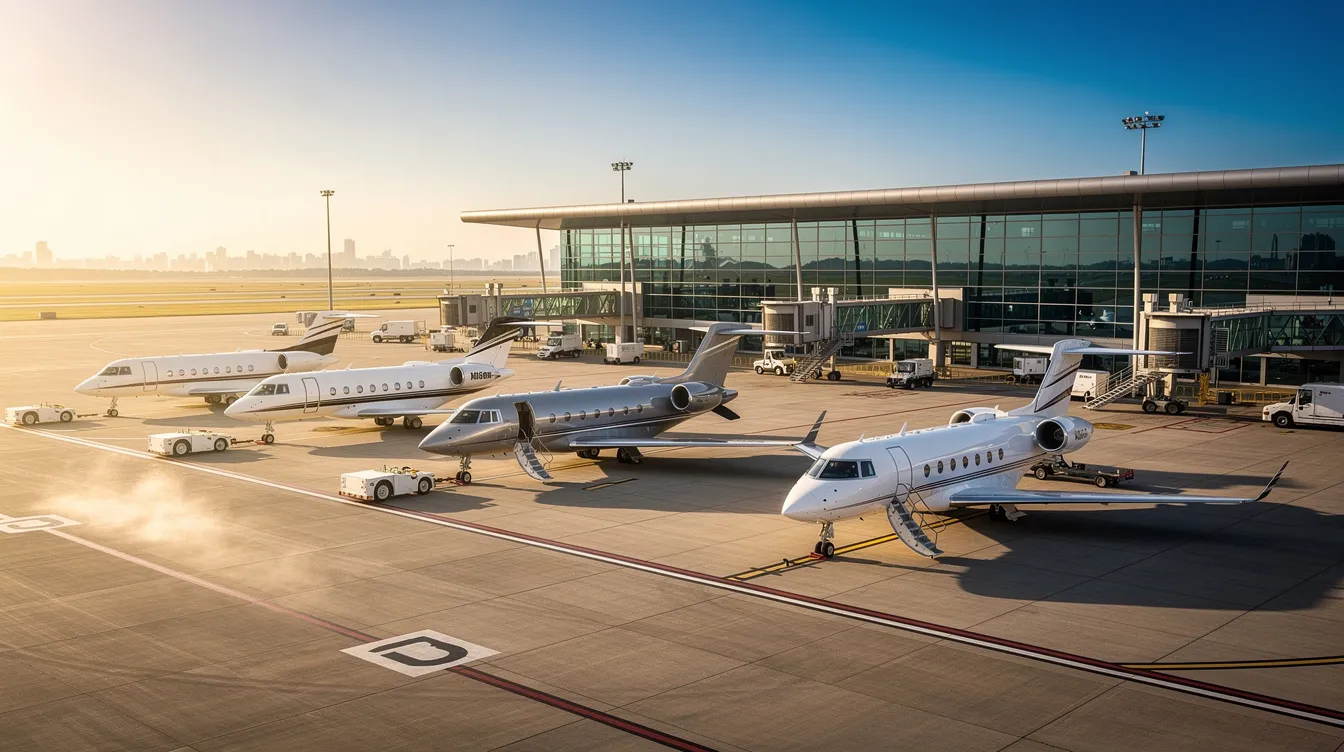
Private aviation is no longer a luxury reserved for the select few - it is a strategic advantage. As of March 2026, NetJets' fleet size stands at more than 845 aircraft across its U.S. and European operations, making it the largest private jet fleet in the world, with projections pushing that total toward 860 to 880 jets by late 2026. For executives and high-net-worth leisure travelers who fly regionally or internationally multiple times a year, that scale shapes what matters most in private aviation: guaranteed access, flight availability, operational flexibility, and confidence in the service behind each trip.
This article looks at how NetJets built and manages that fleet, what aircraft categories and programs support it, and how its size compares with alternatives such as BlackJet and other competitors. You will also see how fleet growth, global reach, flight frequency, safety standards, sustainability efforts, and options like jet cards and fractional ownership affect the decision to choose the private aviation solution that best fits your travel needs.
NetJets Fleet Size at a Glance in 2026
As of March 2026, NetJets operated 845 private jets, making it the operator behind the world's largest fleet of private aircraft. NetJets Inc combines its U.S. operations - headquartered in Columbus, Ohio - with NetJets Europe under a single global umbrella. The company operates more than 800 private jets globally across both divisions, and that number continues to climb with active deliveries throughout the year.
Here are the key figures that define the scale of NetJets aviation today:
Total fleet: 845+ aircraft across the U.S. and Europe, with projections pushing toward 860–880 by late 2026
Daily flights: approximately 1,400 worldwide movements every day
Annual flights: over 300,000 flights per year, including tens of thousands of international legs
Shareholders: more than 7,000 fractional owners relying on guaranteed access
Jet classes: five cabin categories - light, midsize, super-midsize, large, and long-range jets
This single-operator fleet size dwarfs fragmented on-demand charter providers and rivals some commercial airlines in daily movements. Such scale supports fractional ownership, leases, and jet card programs, while brands like BlackJet offer a different model: asset-light jet card access across multiple operators rather than owning the aircraft.
How NetJets Built the World's Largest Private Jet Fleet
NetJets has experienced significant growth since its founding in 1964 as Executive Jet Aviation, originally a small executive jet airways operation serving corporate clients. The private aviation history of what became the industry's dominant player unfolded in distinct phases:
1964–1986: Founded by key people, including Richard Santulli, who would later transform the company. Executive jet operations remained modest, serving a niche corporate market.
1987: NetJets pioneered fractional aircraft ownership, allowing clients to purchase shares - starting at one-eighth of an aircraft - and access a pool of jets rather than bearing the full cost of whole aircraft sales.
1998: NetJets was acquired by Berkshire Hathaway, providing the substantial financial backing needed for long-term aircraft orders and rapid fleet expansion. This capital infusion remains central to the company's growth strategy today.
2000s–2010: Launch of NetJets Europe in the late 1990s extended global access across the Atlantic. In 2010, the acquisition of Marquis Jet Partners brought the Marquis Jet card model in-house, broadening the company's offerings to include prepaid flight time programs.
2015–present: Massive fleet orders with Textron Aviation, Embraer, and Bombardier — including contracts for up to 1,500 jets over multiple years — cemented the company's fleet as the industry benchmark. NetJets has orders for nearly 2,000 new private jets across these partnerships.
The fractional model let NetJets order aircraft in large blocks, building a unified private jet fleet rather than ad hoc charter inventory. BlackJet, by contrast, focuses on premium private jet cards and digital access across partner fleets, freeing clients from asset risk while maintaining similar reach.
Current NetJets Fleet Size by Manufacturer (OEM)
The NetJets fleet is best understood through its OEM composition. The company's fleet includes over 120 different aircraft types, sourced from three primary manufacturers. NetJets coordinates fleet growth with aircraft manufacturers to address supply chain constraints, ensuring steady delivery pipelines.
Textron Aviation (Cessna/Citation): Represents just over half the fleet with roughly 420–430 jets, including the Textron Aviation Citation XLS, Citation Latitude, Citation Longitude, Sovereign, and the new Citation Ascend. This dominance reflects a long-term supply agreement spanning 15 years.
Embraer: The second-largest contributor with 160+ Embraer Phenom 300 light jets and a growing Praetor 500 super-midsize presence.
Bombardier: Approximately 230–240 aircraft, including Challenger 350/3500, Challenger 650, and the Global family (5500, 6000, 7500) - the fleet's intercontinental backbone.
NetJets expects to add roughly 80 new jets in 2026 alone, with deliveries split across all three OEMs. NetJets aims to take delivery of 80 to 100 new jets annually, reflecting its aggressive growth strategy.
Biggest NetJets Fleets by Aircraft Type
Fleet size also means understanding which NetJets aircraft dominate daily operations. Certain models form the workhorses of the entire operation:
Citation Latitude: ~253–260 aircraft - the single largest type in the fleet, handling cross-country and mid-range North American missions
Embraer Phenom 300: ~154–165 light jets, the backbone of short-haul business and leisure trips (think Las Vegas weekends or regional hops)
Citation Longitude: ~86–95 aircraft bridging midsize and super-midsize roles, including transcontinental U.S. routes
Challenger 350/3500: ~87 super-midsize jets prized for cabin comfort and range
Challenger 650: ~58 larger jets serving high-demand corridors
Global 5500/6000/7500: Smaller in unit count (19, 37, and 18, respectively) but strategic for intercontinental missions - these are the larger jets that connect continents
NetJets' inventory spans five jet classes, enabling fractional owners and cardholders to find flights by aircraft type that match their mission profile precisely, much like BlackJet clients choosing among the best small private aircraft for different missions.
NetJets Fleet Changes in 2025–2026: Growth, Retirements, and the Citation Ascend
NetJets' fleet is continually modernized by adding new models and retiring older ones. Fleet changes are driven by customer demand for flexibility and access to various aircraft types.
Retiring aircraft:
The Citation Excel/XLS fleet fell to roughly 50 U.S.-registered aircraft by late 2025. NetJets announced it would stop selling XLS jet cards in December 2025, with 15 units phased out since early 2024
Sovereign numbers have edged into the low 20s as newer midsize options absorb demand
Growing fleets:
Challenger 3500, Praetor 500, and Citation Longitude deliveries continue to expand super-midsize capacity
Global 7500 and 8000 deliveries strengthen long-range capability
New types:
The Citation Ascend - NetJets' next-generation midsize platform - saw its first three deliveries in May 2026. The Ascend replaces the XLS with a flat-floor cabin, improved fuel efficiency, and quieter engines
NetJets expects approximately 80 net additions in 2026 after retirements and disposals via QS Partners
This renewal focuses on quieter, more fuel-efficient aircraft, reducing the company's environmental footprint while expanding capacity, in parallel with broader industry trends showcased by the newest private jet models combining innovation and luxury.
NetJets Europe and Global Reach of the Fleet
NetJets Europe, launched in the late 1990s and regulated under EASA from its base in Portugal, operates the European arm of the global fleet. As of mid-2026, NetJets Europe flies approximately 41 actively serviced aircraft with an average age of 8.1 years, including Phenom 300s, Citation Latitudes, Challengers, and select Global models tailored to European and transatlantic missions.
NetJets serves over 3,000 airports worldwide, often bypassing congested commercial airline hubs entirely
Popular European hubs include Lisbon, London, Paris, Geneva, Munich, and Milan Linate
In June 2026, NetJets Europe logged over 6,500 flights, commanding roughly 12% of the European business aviation market share
The company coordinates repositioning between the U.S. and European fleets to maintain availability during peak demand, a capability that helps cement its status among the top private jet companies for global travelers
BlackJet's approach differs: rather than a single branded fleet, BlackJet Jet Card clients access a vetted network of charter operators across Europe and the U.S., delivering similar global access without proprietary fleet overhead.
Executive Jet Management, Aircraft Management, and Charter Within the NetJets Ecosystem
Executive Jet Management (EJM) operates as NetJets' aircraft management and jet charter arm, serving whole owners who are not fractional shareowners.
Aircraft management: EJM handles crew hiring, pilot logbooks and training, maintenance oversight, insurance, and Part 135 regulatory compliance for 100+ managed aircraft
Charter: EJM's charter operations supplement the core NetJets fleet during peak demand, effectively increasing available aircraft beyond the company's fleet count. This on-demand charter capacity ensures that even during holidays or major events, availability remains strong for everything from small groups to large private jet charters for around 20 passengers
QS Partners and QS Security Services: QS Partners manages aircraft sales and disposals, cycling older jets out and bringing newer types into the NetJets program. This directly shapes fleet size and average fleet age year over year
BlackJet similarly leverages a broad network of managed and charter aircraft through its jet card platform, delivering personalized service and access without owning or managing aircraft directly.
Fleet Size, Jet Cards, and Access: How NetJets Uses Its Aircraft vs BlackJet
The extensive fleet behind NetJets underpins its ability to offer guaranteed access within 24–48-hour notice windows at fixed hourly rates. NetJets offers Jet Card programs allowing prepaid access to private jets across multiple cabin types, with jet cards starting from $100,000 per year, a level where many flyers begin evaluating the full cost structure of a 100-hour jet card. The company also offers leasing without equity ownership for clients who want dedicated aircraft without buying a share. NetJets provides 24/7 digital booking tools and real-time support for its customers, ensuring seamless scheduling.
NetJets must maintain minimum fleet depth in each cabin category — which is why it operates so many Phenom 300s, Latitudes, and Challengers. For potential customers who fly fewer hours, however, the capital intensity of flying NetJets may not align with their needs, making it more relevant to understand how 50-hour jet card pricing compares across providers.
Use case: A CEO flying from New York to Dallas twice monthly and from New York to London quarterly needs roughly 80–100 annual flight hours. Under the NetJets jet card, they'd access the branded fleet at predictable pricing tied to cabin class. With a BlackJet 25-hour Jet Card, they'd access equivalent cabin categories across multiple vetted operators - often at lower capital commitment and without a monthly management fee tied to fractional ownership.
Safety, Certification, and Sustainability in a Large Private Aviation Fleet
Operating the world's largest private jet fleet demands safety systems rivaling those of major commercial airlines. Flying NetJets means every flight uses dual-pilot crews with recurrent simulator training.
Safety and certification: NetJets holds third-party ratings including ARGUS Platinum and Wyvern Wingman. Pilots undergo standardized training across the fleet, and the company maintains IS-BAO registration
Fleet standardization: A larger fleet enables consistent cabins, avionics, and procedures — reducing maintenance costs, improving safety, and delivering a uniform experience across aircraft types
Sustainability: NetJets' fleet supports carbon-neutral flights and sustainable aviation initiatives. Newer types like the Citation Ascend, Praetor 500, and Global 5500 burn less sustainable aviation fuel per nautical mile. Carbon offset programs are integrated into the NetJets program, aligning with broader moves to make even the cheapest private jet options more sustainable and efficient
BlackJet similarly emphasizes safety by partnering only with audited, certified operators and commits to carbon-neutral flights through integrated offsetting — at no extra cost to cardholders.
NetJets Fleet Size vs Commercial Airlines and Other Private Aviation Models
NetJets' 845+ aircraft rivals mid-sized commercial airline fleets in sheer numbers, but the comparison ends there. Private travel means arriving 15–20 minutes before departure, flying point-to-point into thousands of smaller airports, and eliminating connections entirely. Demand for private aviation surged post-pandemic due to preferences for privacy, safety, and point-to-point travel — a trend that has not reversed and that has spurred more interest in options to buy just a seat on a private jet instead of a whole aircraft.
Time advantage: A cross-country flight from Teterboro to Van Nuys saves 3–4 hours door-to-door versus commercial first class through LAX
Predictability vs charter: Compare NetJets' guaranteed fleet with the uncertainty of on-demand charter pricing and availability
Capital commitment: Discerning travelers flying 100–200+ hours annually may favor the NetJets program and fractional ownership. Those flying 25–75 hours often find greater value in jet card programs like BlackJet's, where luxury travel meets flexibility without asset risk — especially once they understand the broader private jet price list and access options availableand where a clear view of overall jet card membership costs and pricing models helps shape the right decision
FAQ: Key Questions About the NetJets Fleet and Private Aviation Access
How many aircraft are currently in the NetJets fleet worldwide?
As of March 2026, NetJets operates 845 private jets across the U.S. and Europe. Including managed aircraft under Executive Jet Management, the total operational footprint reaches approximately 860–880 jets. NetJets operates more than 800 private jets globally on a sustained basis.
What are the most common aircraft types in the NetJets fleet?
The Citation Latitude leads with roughly 253 aircraft, followed by the Embraer Phenom 300 at approximately 154, the Challenger 350/3500 at 87, and the Citation Longitude at 86.
How does NetJets' fleet size affect my ability to get a jet on short notice?
Depth in each cabin category — particularly light and midsize — means NetJets can honor 24–48-hour access windows reliably. The fleet operates around 1,400 flights per day across the world.
Is flying on the NetJets fleet as safe as flying commercial airlines?
NetJets maintains dual-pilot crews, recurrent simulator training, and third-party safety certifications comparable to scheduled carriers, mirroring the standards found on many of the best private jets in the world. Every aircraft operates under rigorous FAA or EASA oversight.
What is the difference between NetJets fleet access and a BlackJet Jet Card?
NetJets cards grant access to the company's own branded fleet at fixed rates by cabin class, illustrating many of the core benefits outlined in comprehensive guides to the best jet cards for frequent flyers. A BlackJet Jet Card provides similar guaranteed hours and predictable pricing across a vetted network of operators — without tying clients to a single fleet or ownership structure — and can be paired with more economical private aircraft options for budget-conscious flyers.
Does NetJets' fleet use sustainable aviation fuel or carbon offsets?
Yes. NetJets has committed to sustainability through newer, fuel-efficient aircraft types and carbon offset programs. SAF adoption is growing but not yet fleet-wide.
Conclusion: The Strategic Advantage of NetJets' Fleet Size in Private Aviation
NetJets' fleet size of over 845 aircraft in 2026 is more than a number—it represents a strategic advantage that redefines private aviation for the modern traveler. This scale ensures unparalleled access, operational flexibility, and a consistent luxury experience across multiple cabin classes, supporting everything from short regional hops to intercontinental journeys. Backed by Berkshire Hathaway's capital strength and a commitment to safety, certification, and sustainability, NetJets offers a premier private aviation solution that meets the demands of high-net-worth individuals and corporate executives alike.
However, the landscape of private aviation continues to evolve. While NetJets excels in guaranteed availability and a unified fleet, alternatives like BlackJet provide asset-light jet card access with similar safety and sustainability standards, appealing to travelers seeking flexibility without ownership commitments — whether they are weighing 10 million dollar private jet options versus access models. Ultimately, choosing between NetJets and other private jet options depends on your travel frequency, budget, and preference for ownership versus access, especially if you are comparing what a 15 million dollar private jet offers against jet card flexibility.
For discerning travelers seeking effortless, premier private jet access combined with cutting-edge technology and a commitment to carbon-neutral flights, exploring how BlackJet can reshape your private travel experience is a compelling next step — including for those evaluating 20-million-dollar private jet features alongside alternative access models.
Discover how BlackJet can elevate your private aviation journey.


 Sign up with google
 Sign up with Apple