The most popular private planes are the aircraft that combine the strongest charter demand with proven safety certifications, cabin comfort, operational flexibility, and consistent availability through private charter and jet card programs—models such as the Gulfstream G650ER, Citation Latitude, HondaJet Elite S, Falcon 7X, Citation CJ4, Global 6000, and Phenom 300E. Private aviation is not a luxury for its own sake-it is a strategic instrument, especially for frequent business executives, high-net-worth travelers, and corporate teams who need reliable, efficient, and comfortable lift for regional and international trips.
While commercial travelers spend most of their time in security queues and layover lounges, discerning fliers reclaim entire days by stepping onto the correct aircraft for their mission. This article examines the most popular private planes dominating charter demand, breaks down their strengths and limitations, compares aircraft categories, cabin configurations, safety standards, sustainability considerations, and booking availability, and helps you choose the right private jet for your travel patterns, budget, and priorities.
Key Takeaways
The most popular private planes are chosen for their blend of safety, comfort, range, and operational flexibility, meeting the highest standards demanded by elite travelers.
Ultra-long-range jets like the Gulfstream G650ER and Falcon 7X enable nonstop intercontinental flights, ideal for executives with global itineraries.
Super-midsize and light jets such as the Citation Latitude and HondaJet Elite S offer cost-effective, efficient solutions for regional travel without compromising luxury.
Sustainability and fuel efficiency are increasingly critical factors, with many popular models supporting Sustainable Aviation Fuel (SAF) and carbon-neutral operations.
Jet card programs provide seamless, prepaid access to these popular aircraft, combining convenience with premium service and safety certifications.
Understanding your travel patterns—range, passenger count, and airport access—is essential to selecting the optimal private plane for your needs.
How We Selected the Most Popular Private Aircraft Using the Definite Article
Before we assembled this list, a note on what "most popular" actually means in practice. In English, the word "most" functions as a superlative determiner in the superlative degree-a form rooted in Middle English that can modify both adjectives and a noun phrase to indicate the greatest degree, typically across three or more cases, or the greatest amount of something. In a linguistic sense, it can serve as an adverb, a pronoun, or even stand alone as a noun. Students of grammar will note that the suffix "-est" and the plural forms of superlative adjectives follow specific rules, while the cognate construction in other languages uses synonyms like "le plus" in French. For example, saying a midsize jet is the "most popular" means it is requested more often than the other aircraft in the comparison. Whether spoken in formal or informal contexts, the answer remains: when a sentence states that an aircraft is "most popular," the meaning is practical-it reflects the greatest number of charter bookings, the greatest extent of fleet operations, and the greatest amount of demand confirmed by the majority of travelers. In that sense, popularity here is measured by quantity, not just preference.
Our selection criteria covered six dimensions:
Charter demand and booking frequency across global broker platforms
Safety certifications, including ARGUS Platinum, Wyvern Wingman, and IS-BAO compliance
Cabin comfort, range, and operational flexibility for real-world missions
Sustainability features such as SAF compatibility and carbon efficiency
Proven performance for both business and leisure travel
Availability across major jet card programs and charter networks
Industry-leading jets are tailored for specific missions in business aviation-and our seven picks reflect the aircraft most people actually request when money is on the line.
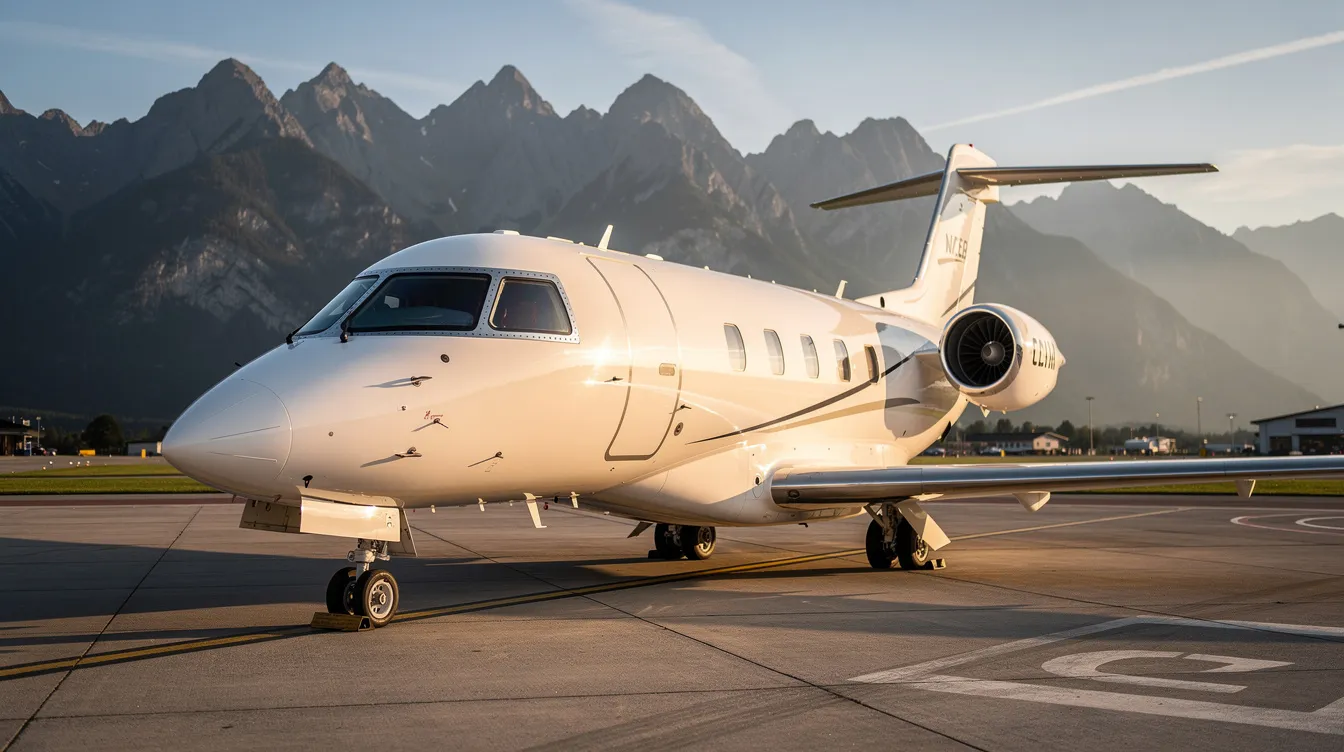
Top 7 Most Popular Private Planes for Elite Travel: A Superlative Degree Comparison
1. Gulfstream G650ER
The Gulfstream G650ER is a premier ultra-long-range jet known for its luxurious cabin and continent-spanning reach. Without a doubt, the Gulfstream G650 is a top-selling private jet, and the ER variant extends that legacy with unmatched range. Its newer sibling, the Gulfstream G700, is recognized for its spacious cabin and high cruise speed, but the G650ER remains the benchmark most charter clients request.
Why It Stands Out
The Gulfstream G650ER has a range of 7,500 nautical miles and top speeds of Mach 0.925-enough to fly nonstop from New York over the Hudson River to Dubai or from London to Los Angeles. Advanced Symmetry Flight Deck avionics and Enhanced Vision Systems provide cockpit automation that reduces pilot workload and increases safety margins.
Best For
Global executives who need intercontinental reach, VIP delegations, and travelers who refuse fuel stops. Optimal routes include York-based departures to the Middle East or LA to Singapore without compromise.
Key Strengths
7,500 nm range enabling non-stop transcontinental flights
Cabin altitude of approximately 3,300–4,000 ft at cruise, dramatically reducing jet lag
Cabin volume of ~2,421 cu ft with up to four living zones and room to stand at 6 ft 5 in
Proven collision avoidance and safety systems
Possible Limitations
Operating costs can reach $13,000–$18,000/hr in charter, roughly double a midsize alternative
Limited availability during peak seasons
Some old-school travelers might argue that repositioning fees add up quickly
2. Citation Latitude
The Cessna Citation Latitude is known for its spacious and comfortable cabin-the defining verb most people use to describe it is "roomy." It dominates the super-midsize charter market for corporate teams on regional routes.
Why It Stands Out
A flat-floor cabin design with stand-up height (~6 ft) delivers comfort that rivals larger aircraft at half the operating cost. Connectivity suites keep executives productive in the air.
Best For
Corporate teams on 3–5-hour regional routes and frequent business travelers who need consistent day-in, day-out availability.
Key Strengths
~2,700 nm range covering most North American and European city pairs
Flat-floor cabin construction maximizing passenger comfort
Charter rates of approximately $4,500–$6,000/hr
Strong fuel efficiency
Possible Limitations
3. HondaJet Elite S
The HondaJet Elite S redefines entry-level luxury aviation with its revolutionary over-the-wing engine mount design. In the light jet category, it continues to win with travelers who want efficiency without sacrificing comfort.
Why It Stands Out
The over-the-wing configuration delivers superior fuel economy and advanced noise reduction for quieter operations. Alongside models like the Cirrus Vision Jet G2 Plus, known for its innovative safety features, the HondaJet represents a new school of thought in light jet engineering.
Best For
Regional business travel within a 1,400 nm radius. High-net-worth individuals seeking cost-effective light jet charter access.
Key Strengths
Industry-leading fuel efficiency in the light jet category
Spacious cabin relative to aircraft size
Lower environmental impact with reduced carbon emissions
Possible Limitations
4. Falcon 7X
Dassault's Falcon 7X features advanced fly-by-wire technology-a force multiplier for safety on demanding international itineraries. Its tri-engine layout is uncommon and deliberate.
Why It Stands Out
Three Pratt & Whitney Canada PW307A engines provide exceptional safety margins and short-field performance. The Dassault Falcon 10X features advanced flight controls and strong efficiency as its successor, but the 7X remains the proven workhorse. These engines sing at altitude, delivering reliable thrust even into challenging airports.
Best For
International business travelers requiring maximum safety assurance and complex multi-stop itineraries. Operations into shorter or higher-elevation runways where twin-engine jets struggle.
Key Strengths
5,950 nm range enabling most global city pairs
Superior short-field performance accessing smaller airports
Proven dispatch reliability and maintenance network
Possible Limitations
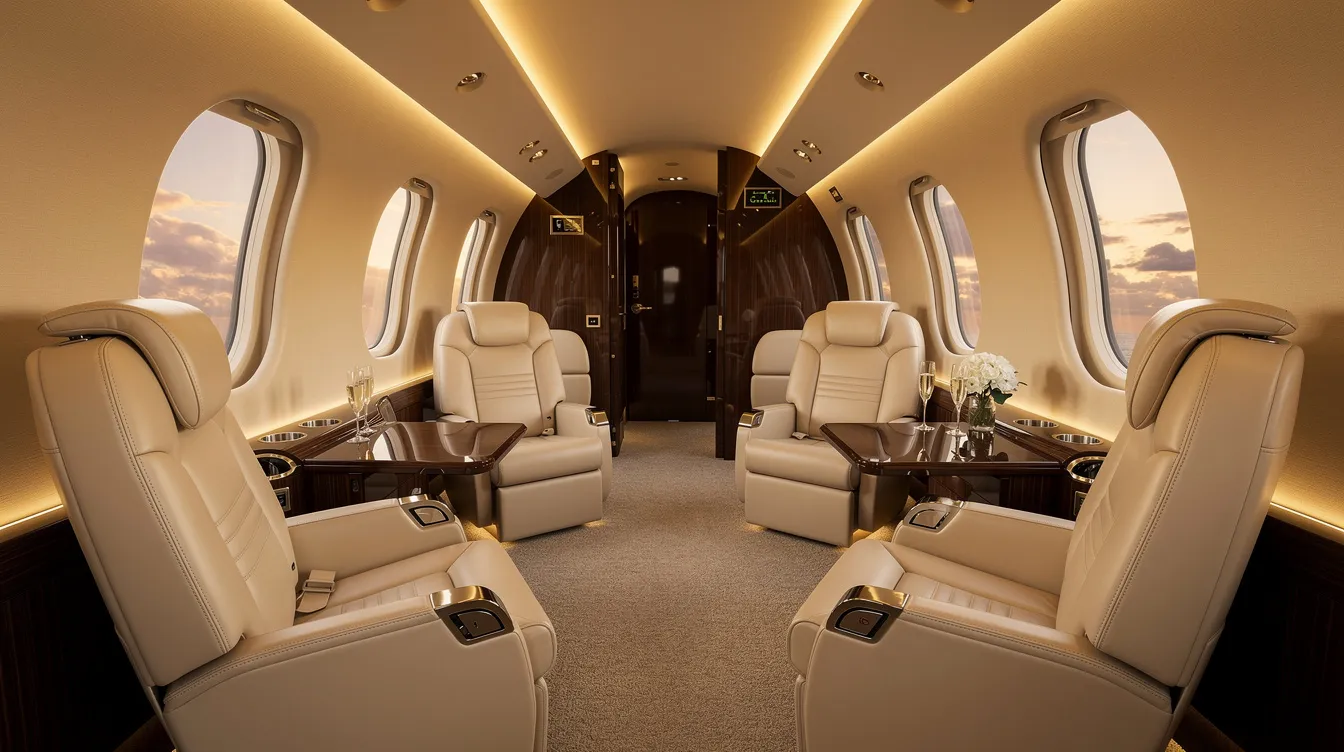
5. Citation CJ4
The CJ4 is the kind of aircraft that doesn't need to sing its own praises-its booking numbers do the work. Within the Cessna family, the Cessna Citation X+ is known for its speed, reaching Mach 0.935, but the CJ4 optimizes for a different mission: versatile, efficient regional travel.
Why It Stands Out
Single-pilot certification reduces operational costs significantly. Simplified maintenance requirements and cockpit automation keep the aircraft available and reliable.
Best For
Business executives with regular regional travel patterns. Corporate flight departments seeking reliable, cost-effective operations.
Key Strengths
2,165 nm range covering extensive regional networks
Single-pilot certification reduces crew costs
Excellent short-field capability accessing diverse airports
Possible Limitations
6. Global 6000
Bombardier's Global 6000 can house up to 16 passengers in a cabin that some argue is the most comfortable in its class. It sits within a formidable family: the Bombardier Global 7500 offers a range of 7,700 nautical miles, and the Bombardier Global 8000 is among the longest-range and fastest jets currently available. The 6000 remains the value play.
Why It Stands Out
At approximately 7 ft 11 in wide and 6 ft 2 in tall, the cabin provides room for formal meetings, audio and video conferencing, and genuine rest. The Bombardier Challenger 350 is favored for its reliability and strong resale value as a super-mid alternative, but the Global 6000 steps up for longer-haul missions.
Best For
Large corporate teams requiring spacious meeting capabilities. Luxury leisure travelers on extended international journeys-don't put all your eggs in one basket when you can paste together an itinerary covering multiple continents.
Key Strengths
6,000 nm range enabling global connectivity
Widest cabin in its class, maximizing passenger space
Advanced cabin management and entertainment systems
Possible Limitations
7. Phenom 300E
The Embraer Phenom 300 is popular for its efficiency and comfort, and the 300E variant leads as the most delivered light jet globally. At the time of writing, it remains the number-one requested light jet on charter platforms.
Why It Stands Out
Market-leading delivery numbers demonstrate widespread adoption. Advanced avionics enhance safety and operational efficiency across every place it flies.
Best For
Business travelers require reliable regional connectivity. Charter operators seeking versatile, in-demand aircraft.
Key Strengths
~2,010 nm range covering major regional routes
Spacious cabin with flat-floor design
Proven reliability and extensive global support network
Possible Limitations
Quick Comparison of Popular Private Aircraft: A Noun Phrase Overview
Most private jets have a cruising speed of 400–600 knots, while typical range for private jets is 1,500 to 6,000 nautical miles, but there are also specialized 30-passenger private jets and 50-passenger private jet options that trade some speed or range for large-group capacity. Private jets can accommodate 4 to 20 passengers comfortably, and understanding private jet sizes helps you match cabin height, range, and budget effectively. High cruise speeds and long ranges enhance aircraft utility across every mission profile. When comparing apples to apples, here is a comparison of our top seven, while larger groups should also look at private jets for 20 passengers when mission requirements go beyond the typical 4–10 travelers:
Aircraft | Category | Range (nm) | Cruise Speed | Passengers | Cabin Height | Charter Rate |
|---|
G650ER | Ultra-Long Heavy | ~7,500 | Mach 0.90 | 14–19 | 6 ft 5 in | $13,000–18,000/hr |
Citation Latitude | Super-Midsize | ~2,700 | Mach 0.77 | 8–9 | ~6 ft | $4,500–6,000/hr |
HondaJet Elite S | Light | ~1,400 | ~400 ktas | 5–6 | ~4 ft 10 in | $2,500–3,500/hr |
Falcon 7X | Ultra-Long Heavy | ~5,950 | Mach 0.85 | ~14 | 6 ft 2 in | $8,000–12,000/hr |
Citation CJ4 | Light | ~2,165 | ~450 ktas | 7–9 | ~4 ft 9 in | $3,000–4,500/hr |
Global 6000 | Long-Range Heavy | ~6,000 | Mach 0.85 | 12–16 | 6 ft 2 in | $10,000–14,000/hr |
Phenom 300E | Light | ~2,010 | Mach 0.78 | 6–7 | ~4 ft 11 in | $3,000–3,600/hr |
How Most People Choose the Right Private Aircraft for Their Needs
Private aircraft vary based on range, cabin size, and runway capabilities. The rules of thumb below help you modify your search based on what matters most.
Choose Based on Range Requirements
Seek nonstop capability between major business centers if you frequently fly coast-to-coast or transatlantic; super-mid or heavy jets are ideal for these routes.
For regional hops, opt for a light jet to save money without sacrificing the experience.
Focus on the cheapest private aircraft options that still meet your safety and comfort standards.
Remember that fuel stops add 45–90 minutes per stop.
Choose Based on Passenger Capacity and Comfort
Evaluate your typical group size: a couple traveling for leisure has different needs than a corporate team of twelve.
For larger groups, compare the best private jets for 15 passengers to secure the right cabin layout and range.
Consider if you need a cabin with room to work, rest, or hold a formal meeting—larger groups should look at top 16-seat private jet options with stand-up cabins and conference configurations.
Modern and customizable designs with high-end amenities enhance cabin comfort, as seen in many of the top 10 private jets in the world.
Choose Based on Airport Access and Operational Flexibility
Consider aircraft like the Pilatus PC-24 for operations from short or unpaved runways.
Check if your preferred airports can handle heavier jets at maximum takeoff weight.
For missions into specific markets, such as private jet charters in Karachi, ensure your aircraft choice matches airport capabilities.
The extent of your airport flexibility directly shapes which aircraft category you should explore.
Choose Based on Sustainability and Environmental Impact
Compare fuel efficiency and maintenance costs across aircraft models.
Evaluate SAF compatibility and prioritize providers that offer carbon-neutral flights at no extra cost.
Consider the cheapest private jet options that still deliver acceptable performance and lower environmental impact.
BlackJet includes carbon neutrality as a standard feature.
Frequently Asked Questions About the Most Popular Private Planes
What factors make a private plane the most popular among travelers?
Popularity is driven by charter demand, safety certifications, cabin comfort, operational flexibility, range, and availability through jet card programs. Travelers prioritize aircraft that save the most time, offer luxurious comfort, and support seamless booking and scheduling.
How does cabin height affect passenger comfort on private jets?
Cabin height significantly impacts comfort, especially on longer flights. Most popular private jets feature cabin heights ranging from approximately 4 feet 10 inches in light jets to over 6 feet 5 inches in ultra-long-range jets, allowing passengers to stand and move freely, reducing fatigue and jet lag.
Why is sustainability becoming important in private aviation?
Sustainability matters as travelers and operators seek to reduce environmental impact. Many popular private planes now support Sustainable Aviation Fuel (SAF) compatibility and carbon-neutral flight options, helping reduce the carbon footprint without compromising luxury or performance.
How do jet card programs enhance access to the most popular private planes?
Jet card programs offer prepaid access to fleets of popular private jets, ensuring availability, transparent pricing, and simplified booking. This approach provides the most time-saving convenience and operational flexibility for frequent travelers without the responsibilities of ownership.
Can I book the most popular private planes for short regional trips?
Yes. Many popular models, such as the Citation Latitude and HondaJet Elite S, excel on regional routes with efficient range and lower operating costs, making them ideal for short trips that still demand comfort and reliability.
Which Aircraft Category Is Best for You?
The answer depends entirely on your travel patterns. If you fly regionally a number of times per month, a light 25+ hour jet card delivers cost-effective travel. BlackJet value, especially when you apply frameworks for choosing the best jet cards for frequent flyers to your own travel profile. If your schedule demands intercontinental reach, ultra-long-range heavy jets are the only option that makes sense. For those in between, super-midsize aircraft offer the greatest balance of comfort, range, and cost, and understanding jet card cost and membership pricing helps you budget for that flexibility.
BlackJet's premium private jet card programs provide access across multiple aircraft categories from light jets to ultra-long-range heavies, with never-expiring hours, proprietary safety vetting, and carbon neutrality included at no extra cost.
Elevating Your Private Aviation Experience
Choosing from the most popular private planes is not about prestige alone-it is about matching the right aircraft to every mission you fly. Safety, reliability, and sustainability are not optional extras; they are the foundation of every seamless journey. The common thread among all seven aircraft above is proven demand, engineering excellence, and availability within the world's leading charter and jet card networks, whether you are simply buying a seat on a private jet for a single leg or exploring icons at the level of the most expensive private jets.
Discover how BlackJet can reshape your private travel. Explore our Jet Card programs and access the aircraft that elevate every flight from routine to remarkable.


 Sign up with google
 Sign up with Apple