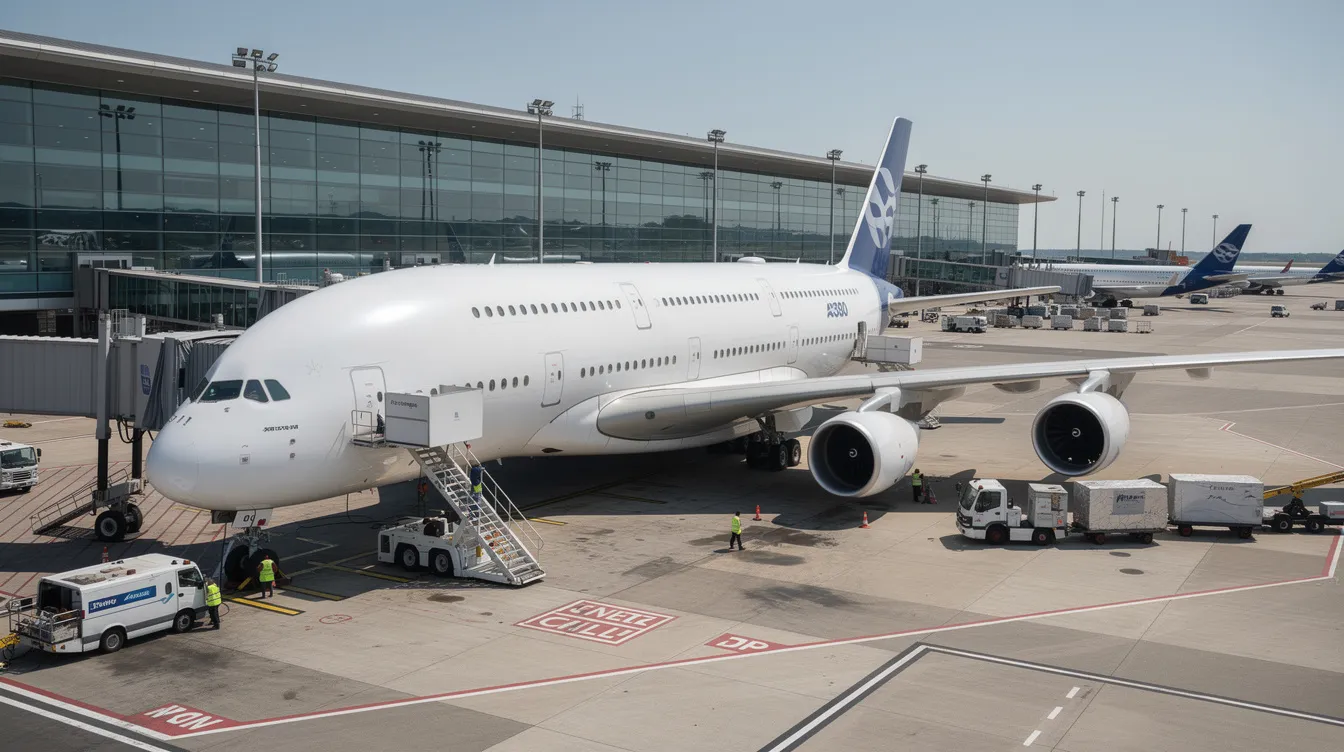
Few aircraft command attention on the runway quite like a double-decker. Lufthansa's Airbus A380, the world's largest passenger airliner, is an engineering statement — 73 meters of fuselage, two full-length passenger decks, and room for over 500 passengers across four classes. Whether you are an aviation enthusiast tracking fleet movements or a premium traveler weighing your seating options for a long-haul flight, the Lufthansa A380 remains one of the most compelling ways to cross continents.
This overview covers every angle of the Lufthansa double-decker plane: its fleet history and strategy, what each cabin class offers, the routes where you can actually fly it, and how the experience compares to both smaller commercial widebodies and the tailored world of private aviation.
Quick Answer: What Is Lufthansa's Double Decker Plane?
Lufthansa's double-decker plane is the Airbus A380-800, the world's largest passenger airliner currently in scheduled service. It matters to premium travelers because it features two full-length passenger decks, four Rolls-Royce engines, and a four-class layout with just eight first-class seats at the nose — a level of exclusivity that smaller widebodies simply cannot replicate at this scale.
The A380 is purpose-built for long-haul routes and high-capacity hubs. Its massive size makes it ideal for moving large numbers of passengers on a single frequency, which is particularly valuable at slot-constrained airports. Lufthansa received its first A380 in May 2010 and grew the fleet to 14 aircraft by 2015. When the pandemic collapsed long-haul demand, many were placed into deep storage. From summer 2023, Lufthansa returned eight A380s to service as premium travel demand surged and delivery of replacement aircraft was delayed.
Today, Lufthansa operates the Airbus A380 primarily out of Munich Airport, deploying it on routes to destinations across North America and Asia. The A380 represents the pinnacle of commercial capacity. On the other end of the spectrum, private aviation — through models like BlackJet's premium Jet Card programs - offers something the biggest planes in the world never can: total schedule control, privacy, and door-to-door flexibility.
Key Facts at a Glance
Seats: 509 in four-class configuration (8 First / 68 Business / 52 Premium Economy / 371 Economy)
Range: ~12,400 km (~7,710 miles)
Size: 73 meters long, 24 meters high, wingspan ~79.75 m
Maximum takeoff weight: 560 tons
Engines: 4 × Rolls-Royce Trent 970 generating 70,000 lbs of thrust each
Current base: Munich (MUC)
The Airbus A380: The World's Largest Passenger Airliner
The Airbus A380 is the largest commercial aircraft ever to carry passengers on scheduled flights. What sets it apart from every other plane in the skies is its two full-length passenger decks, stacked atop each other inside a distinctive oval fuselage that is unmistakable from any airport observation deck.
The numbers behind the A380 communicate its scale immediately:
Wingspan of approximately 79.75 meters — wider than the aircraft is long
Length of 73 meters, height of 24 meters
Maximum takeoff weight of 560 tons
Four Rolls-Royce Trent 970-series engines, each generating 70,000 lbs of thrust
The A380's cabin has 550 square meters of usable floor space, distributed across its two decks
The A380 typically seats 525 passengers in three classes across its global operator base. In an all-economy layout, it can carry a maximum of 853 passengers — though no airline currently configures it that way. The aircraft is known for having remarkably spacious cabins, with wider aisles and more room per passenger than virtually any competitor.
Why did Airbus build it?
To directly challenge Boeing's long-standing 747 dominance in the widebody market
To serve hub-and-spoke networks at congested airports where runway slots are scarce - moving 500+ passengers per takeoff instead of 300
To give airlines enough floor area to create truly differentiated premium cabins that smaller aircraft could never accommodate
The A380's wings also incorporate wingtip fences, large vertical surfaces at each wingtip that reduce aerodynamic drag and improve fuel efficiency — an important design feature for an aircraft of this weight class.
Lufthansa and the A380: Fleet History and Strategy
Lufthansa's relationship with the A380 has been anything but straightforward. The German airline bet early on the superjumbo as a flagship for its highest-demand long-haul routes, but the catch was how quickly that strategy could become a liability if demand shifted, only to see the plan upended by a global pandemic and then revived by an unexpected surge in premium travel.
Here is the complete timeline:
May 2010: Lufthansa received its first A380, placing it on routes from Frankfurt to destinations like Tokyo and Johannesburg
2010–2015: The fleet grew steadily, reaching a peak of 14 aircraft. Munich joined Frankfurt as an A380 base as the hub matured
2019: Fleet rationalization discussions began as the airline industry shifted toward smaller, more efficient twin-engine widebodies
2020–2021: The pandemic grounded long-haul travel. Lufthansa placed its A380s into deep storage and announced plans to retire the type entirely. Six aircraft were sold back to Airbus
2022: With post-pandemic demand outstripping available capacity — and delays in delivery of new A350s, 787s, and Boeing 777X aircraft — Lufthansa reversed course and announced reactivation
Summer 2023: Lufthansa returned eight A380s to service, with initial flights from Munich to Boston (June) and Munich to New York JFK (July)
It is worth noting that Lufthansa is also the world's largest operator of the passenger Boeing 747-8, giving it unique expertise in managing very large aircraft fleets. The A380 fleet, now exclusively based at Munich, serves as a capacity tool for specific high-demand corridors where the economics of 500+ seats per departure make sense, especially when alliance and commercial partners help feed traffic onto those routes – a very different use case from evaluating the best $10 million private jets for individual ownership.
Cabin Layout: Two Decks, Four Classes, 500+ Seats
Lufthansa configures its Airbus A380 for approximately 509 passengers spread across four cabins: First, Business, Premium Economy, and Economy. Each class occupies a specific zone across the aircraft's two decks, and the layout is designed to balance exclusivity at the front with density at the back.
The approximate seat breakdown:
First Class: 8 seats - located at the nose of the upper deck, offering a boutique atmosphere for passengers who want maximum privacy
Business Class: 68 seats (after retrofit) - occupying the majority of the upper deck behind First
Premium Economy: 52 seats - positioned at the front of the lower deck (main deck)
Economy: 371 seats - filling the remainder of the main deck, with a smaller 35-seat economy section in the rear of the upper deck
Upper-deck cabins on the A380 provide a boutique atmosphere for passengers, feeling more intimate and quieter than the main deck. The total cabin floor area spans roughly 550 square meters, which gives Lufthansa room for wider aisles, larger galleys, more lavatories, and multiple staircases between decks. This is noticeably more space than any single-deck widebody can offer, and it directly improves service logistics and passenger comfort on flights that can last 10 to 13 hours.
Lufthansa First Class on the A380: The Flagship Experience
Only eight first class seats exist on the entire aircraft, all positioned in the nose of the upper deck. This is not merely a premium cabin — it is a deliberately scarce product designed around privacy, quietness, and tailored service.
Each suite offers a fully flat bed with generous pitch (approximately 83 inches) and width, personal wardrobe storage, fine linens, and enhanced sound insulation. The forward position on the upper deck places passengers as far as possible from the engines, making it one of the quieter spots on any commercial aircraft in the world.
The dining experience matches the setting: multi-course menus curated for the route, caviar service, a selection of fine wines and Champagne, and courses timed to the passenger's preference rather than a rigid schedule. On sectors like Munich to Los Angeles or Munich to New York, this level of service unfolds over 10+ hours — enough time for a complete fine-dining experience, rest, and arrival preparation.
Ground services complete the picture. First class passengers access dedicated check-in counters, Lufthansa's First Class Lounges in Munich and Frankfurt, and on select itineraries, limousine transfers to and from the aircraft. For those evaluating the best first class flights globally, Lufthansa's A380 product consistently ranks among Europe's strongest offerings, especially when contrasted with the ultra-exclusive world of private Airbus A380 ownership and charters.
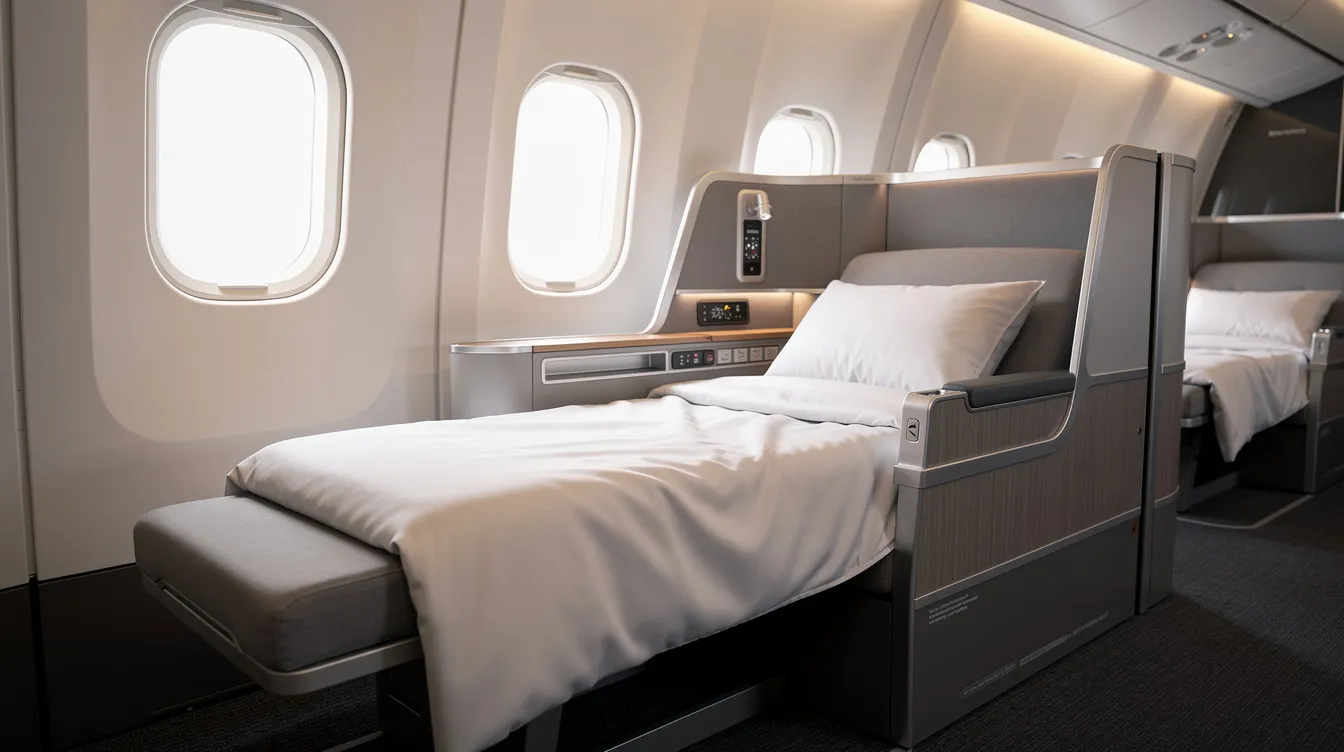
Upgraded Business Class: Lufthansa's New A380 Lie-Flat Suite
Lufthansa debuted an upgraded business class on its Airbus A380 on flight LH452 from Munich to Los Angeles, marking a significant step forward in its premium cabin strategy. The retrofit represents the most substantial change to the A380 cabin since the aircraft arrived in the fleet.
Key changes from the old to new configuration:
Layout: The older 2-2-2 arrangement has been replaced by a new 1-2-1 configuration using Thompson Vantage XL seats. Every business class passenger now has direct aisle access for the first time on Lufthansa's A380
Seat count: Business seats drop from 78 to 68, freeing space for larger individual suites with improved privacy
Bed: Fully lie-flat, with a bed length of at least 2 meters and seat width of approximately 58 cm
Entertainment: 18-inch Panasonic HD screens, Bluetooth audio connectivity for personal headphones, wireless device pairing, interactive 3D maps, and external flight cameras
Privacy: Flexible partitions between center seats allow couples to open the divider or solo travelers to close it completely
Lufthansa plans to upgrade all eight A380s by mid-2027, progressively rolling out the new configuration as each aircraft cycles through the retrofit schedule. This positions Lufthansa strongly against competitors on the routes where you can fly Lufthansa's flagship — particularly the North Atlantic and Southeast Asian corridors where business class demand is highest, even among travelers weighing premium cabins against options like a 100-hour private jet card for frequent trips.
Premium Economy: Extra Space on the Double Decker
Premium economy occupies a dedicated cabin at the front of the main (lower) deck, with 52 seats arranged in a 2-4-2 layout. It sits in a clear middle ground between economy and business, designed for travelers who want meaningful comfort upgrades without the price jump to a lie-flat cabin.
Compared to standard economy, premium economy delivers:
Greater legroom and recline, with seat pitch around 38 inches
Wider seats with adjustable headrests and leg rests
Upgraded dining with welcome drinks, better meal presentation, and more menu choices
A quieter, less crowded cabin environment than the main economy section
This cabin appeals to both leisure travelers on long sectors like Munich to Bangkok or Munich to San Francisco and corporate passengers whose travel policy doesn't always cover business class on every trip. For those routes, premium economy on the A380 is a strong deal — a genuine step up in comfort over economy without requiring premium cabin spend, and for travelers still seeking more privacy, there are options like buying a single seat on certain private jet services.
Economy Class: Capacity and Comfort on Long-Haul Routes
Economy is the largest cabin on the A380, with roughly 371 seats that benefit from the aircraft's advanced technology and double-deck architecture. Despite the density, Lufthansa's A380 economy is a noticeably different experience from economy on older widebodies.
The main deck economy seats are arranged in a 3-4-3 layout, while a smaller upper deck economy section uses a 2-4-2 configuration — a quieter, less crowded space often favored by families. Economy seats on the A380 can be up to 48 cm wide in a 10-abreast configuration, with a typical seat pitch of about 31 inches.
Features across the economy cabin include:
Personal IFE screens with on-demand content
USB-A and USB-C power ports on refitted aircraft
Adjustable headrests with side wings
Higher cabin humidity and improved air quality compared to older aircraft types
The double-decker design also allows wider aisles and extra lavatories compared to single-deck widebodies, reducing congestion during meal service and improving movement on flights that can stretch to 13 hours. Families and groups often favor the side blocks of two or three seats for a degree of privacy within the economy cabin.
Onboard Technology, Quietness, and the Passenger Experience
The A380 was designed from the ground up with advanced technology aimed at reducing fatigue and improving the long-haul experience. Two features stand out above all others: its noise profile and its cabin environment.
The A380 produces half the noise of the Boeing 747-200, a dramatic improvement that passengers notice immediately on takeoff and landing. Internal cabin noise is also reduced by approximately 50% compared to older aircraft, thanks to extensive sound insulation, engine placement further from the fuselage, and the structural damping properties of the double-deck design. This is especially noticeable in the upper deck first class and business class cabins, where the distance from the engines creates an almost serene atmosphere.
The A380 is celebrated for its smooth ride and superior turbulence handling, partly due to its sheer mass and partly due to active damping systems in the wings. The Airbus A380's cabin offers high-frequency air renewal every 2 to 3 minutes, maintaining fresher air quality than many older aircraft. Combined with higher cabin pressure equivalents (lower effective altitude) and improved humidity levels, these systems reduce the dehydration, headaches, and general malaise that long-haul travelers associate with older planes – characteristics that also define many of the largest private jets for ultra-long-range travel.
Entertainment systems on refitted aircraft include large HD screens in all cabins, Bluetooth headphone pairing, 3D flight maps, and external camera views. Wi-Fi is available on most long-haul flights, keeping passengers connected across continents.
Key Lufthansa A380 Routes and Where You Can Fly It
Lufthansa deploys its Airbus A380 fleet on high-demand intercontinental routes from Munich to major global cities. Double-decker aircraft can support high-demand routes with increased passenger capacity, and Lufthansa's scheduling reflects exactly that logic — placing the A380 where 500+ seats per flight can be consistently filled.
Current and scheduled A380 routes from Munich include:
MUC ↔ Bangkok (BKK) - daily in winter schedule
MUC ↔ Delhi (DEL) - daily, year-round
MUC ↔ Los Angeles (LAX) - daily
MUC ↔ San Francisco (SFO) - 3x weekly, increasing seasonally
MUC ↔ Washington Dulles (IAD) - daily during selected periods
MUC ↔ Boston (BOS) - daily in summer
MUC ↔ Denver (DEN) - daily in summer months
MUC ↔ Mumbai (BOM) - new as of July 2026, daily in core summer season
These routes connect Munich's hub with key destinations across North America and Asia, supporting Lufthansa's hub-and-spoke strategy by moving large numbers of connecting passengers on a single frequency.
To make this tangible: imagine a business traveler based in Germany flying the new business class from Munich to Los Angeles. They board the upper deck, settle into a 1-2-1 suite with direct aisle access, enjoy a lie-flat bed for the 12-hour overnight flight, and arrive at LAX rested enough for a morning meeting. That is the scheduled A380 experience at its best.
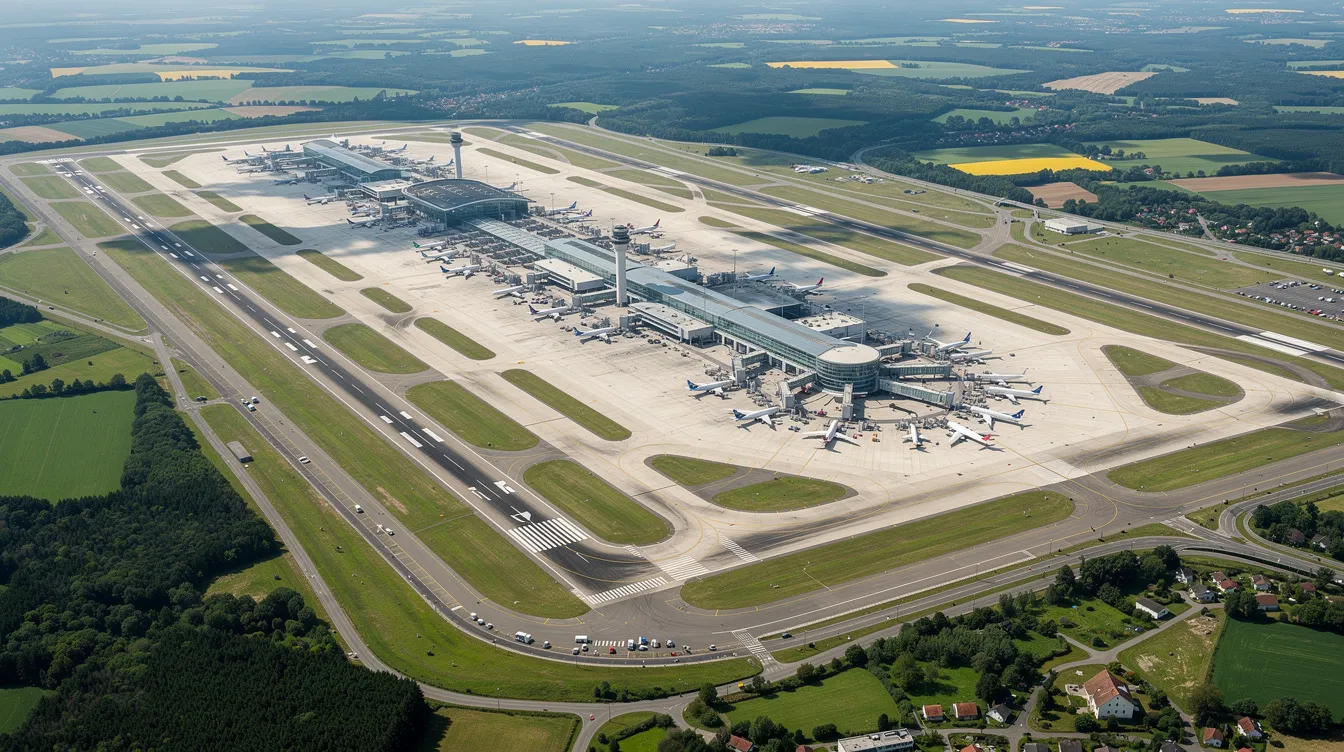
Why Airlines Choose the A380: Capacity and Economics
Airlines like Lufthansa chose the A380 for a specific reason: when airport slots are scarce and premium demand is strong, moving 500+ passengers on a single departure is more efficient than operating two smaller widebodies.
The economic logic centers on per-seat cost. The A380 burns 20% less fuel per seat-mile than the 747-400, making it competitive on densely loaded routes. Airbus originally marketed this efficiency advantage as a core selling point, and on corridors where load factors consistently exceed 80%, the math works in the A380's favor.
But the A380 is not universally efficient. Its four engines, heavy airframe, and high absolute fuel consumption mean that when flights are not nearly full, the per-seat economics deteriorate rapidly. This is why it only makes sense on the busiest routes — it cannot compensate for low demand the way a smaller twin-engine aircraft can by simply flying a more right-sized plane.
The competitive landscape has also shifted. Newer twin-engine widebodies like the Airbus A350, Boeing 787, and the expected Boeing 777X offer better fuel efficiency on a per-trip basis and can serve thinner routes profitably. Jet fuel prices, changing travel patterns, and environmental scrutiny all push airlines toward these smaller, more flexible alternatives. For a deeper look at how fuel considerations shape aviation economics, the calculus applies across both commercial and private fleets, including more economical entry-level and budget-conscious private jet options.
Why Some Lufthansa A380s Were Retired - and Then Came Back
The story of Lufthansa's A380 fleet is one of the more dramatic reversals in modern aviation. By 2019, even before the pandemic, the airline was questioning the long-term viability of its superjumbo fleet as newer, more efficient aircraft entered service.
When COVID-19 collapsed long-haul demand in 2020, the decision seemed final. Lufthansa placed its entire A380 fleet into deep storage and announced plans to phase the type out entirely. Six aircraft were sold back to Airbus, and the remaining eight sat idle in hangars from February 2020 through much of 2022.
Then the market shifted. Post-pandemic recovery on the North Atlantic and key Asian routes came faster and stronger than expected — particularly in premium cabins. Business class and first class demand surged while delivery of replacement aircraft (A350s, 787s) was delayed by supply chain issues. Lufthansa needed capacity, and the A380s sitting in storage were the fastest path to getting it.
By summer 2023, Lufthansa returned eight A380s to service from Munich, deploying them on routes where high passenger volumes and strong premium demand made the economics work again. It was a pragmatic decision driven by market forces rather than sentiment — though the aircraft's popularity with passengers certainly did not hurt, particularly when compared with premium private options like NetJets’ jet card programs and pricing.
Comparing the A380 to Smaller Widebodies for Long-Haul Travel
The Airbus A380 and aircraft like the A350 or Boeing 787 serve fundamentally different roles, even though they all fly similar distances.
A380 strengths:
Unmatched seat capacity - roughly 509 seats in Lufthansa's layout versus the Boeing 747-8, which accommodates roughly 364 passengers across four classes
Quieter, more spacious cabins with more room for premium products
Ability to move 500+ passengers per slot at congested airports
The Boeing 747-8 features a partial upper-deck design, while the A380 offers two complete decks — a meaningful difference in usable premium space
A380 limitations:
Not all airports have gates and taxiways sized for the A380's wingspan
Higher absolute trip cost, even if per-seat cost is competitive
Less flexibility to scale capacity up or down seasonally
Both the Airbus A380 and Boeing 747-8 offer quieter cabin experiences than standard aircraft, but the A380 takes this further with its more modern airframe and extensive sound insulation. The Boeing 747-8 offers a unique upper deck that carries business class, but it is a partial deck — the A380's full-length double deck provides a categorically different amount of space.
From a passenger experience perspective, the A380 delivers a broader, more open feel. Smaller twin-engine jets may have excellent individual products (the A350's business class cabins, for example, are superb), but the overall environment is more compressed. For travelers who value space, the A380 remains the king of widebody aircraft.
Sustainability and Noise: How the A380 Fits into Modern Aviation
The A380's sustainability profile is nuanced. On a per-seat basis, when fully loaded, it is one of the more efficient ways to move large numbers of passengers across long distances. The A380's fuel consumption is 2.4 liters per 100 passenger kilometers at high load factors — a figure that competes well with smaller aircraft on dense routes.
Historically, the A380 played an early role in alternative fuel development. In 2008, the A380 flew using synthetic liquid fuel for the first time, demonstrating the aircraft's compatibility with non-petroleum-based fuels years before sustainable aviation fuel (SAF) became a mainstream industry conversation.
Lufthansa mitigates the A380's environmental impact through several channels, while private aviation pursues its own strategies to fly private more affordably and sustainably:
Deploying the A380 only on routes where high load factors are expected, maximizing per-seat efficiency
Investing in fleet modernization with A350-900s and 787s for routes where a smaller aircraft is more appropriate
Participating in SAF initiatives and carbon offset programs that help compensate for emissions across its operations
On noise, the A380 meets strict international standards and is significantly quieter on takeoff and landing than early 747 generations. Its four modern Rolls-Royce engines, combined with the wingtip fences that improve aerodynamic efficiency, produce measurably less community noise than older quad-jets — an important factor at airports with tight noise limits.
From Commercial Giants to Private Jets: Different Ways to Fly in Luxury
Flying Lufthansa's double-decker A380 in first class or the upgraded business class delivers an exceptional experience: lie-flat beds, refined dining, advanced technology, and the prestige of the world's largest passenger airliner. For a fixed-schedule flight between major hubs, it is hard to beat.
But the experience has boundaries. You fly when Lufthansa flies. You transit through large commercial airports. You share the terminal with thousands of other passengers. Your itinerary bends to the airline's network, not the other way around.
Private aviation changes every one of those variables. Through a provider like BlackJet, travelers access private terminals (FBOs), choose departure times that fit their schedule, fly point-to-point without hub connections, and board an aircraft where they are the only passengers. For travelers comparing ownership, charter, and membership, understanding the broader private jet price list and access models is as important as knowing how private jets work in practice – the model is straightforward: you buy access to aircraft time and use it when and where you need it.
Consider two scenarios:
Scenario 1: A solo executive flying Munich to Los Angeles for a board meeting. The A380 business class is an excellent choice — a lie-flat suite, 12 hours of productivity or rest, arriving at LAX's international terminal. Total travel time, door to door: roughly 16-18 hours.
Scenario 2: A C-suite team of four needs to reach a meeting in Santa Barbara, then fly to Denver by the next morning. No direct scheduled flights connect these points efficiently. A long-range private jet, often one of the top 16-seat private jet options for group travel, departs from a nearby FBO, lands at Santa Barbara Airport, then repositions to Denver overnight. Total itineraries completed: two cities in 24 hours, with no commercial connections.
The A380 is ideal for the first scenario. The second requires a fundamentally different model.
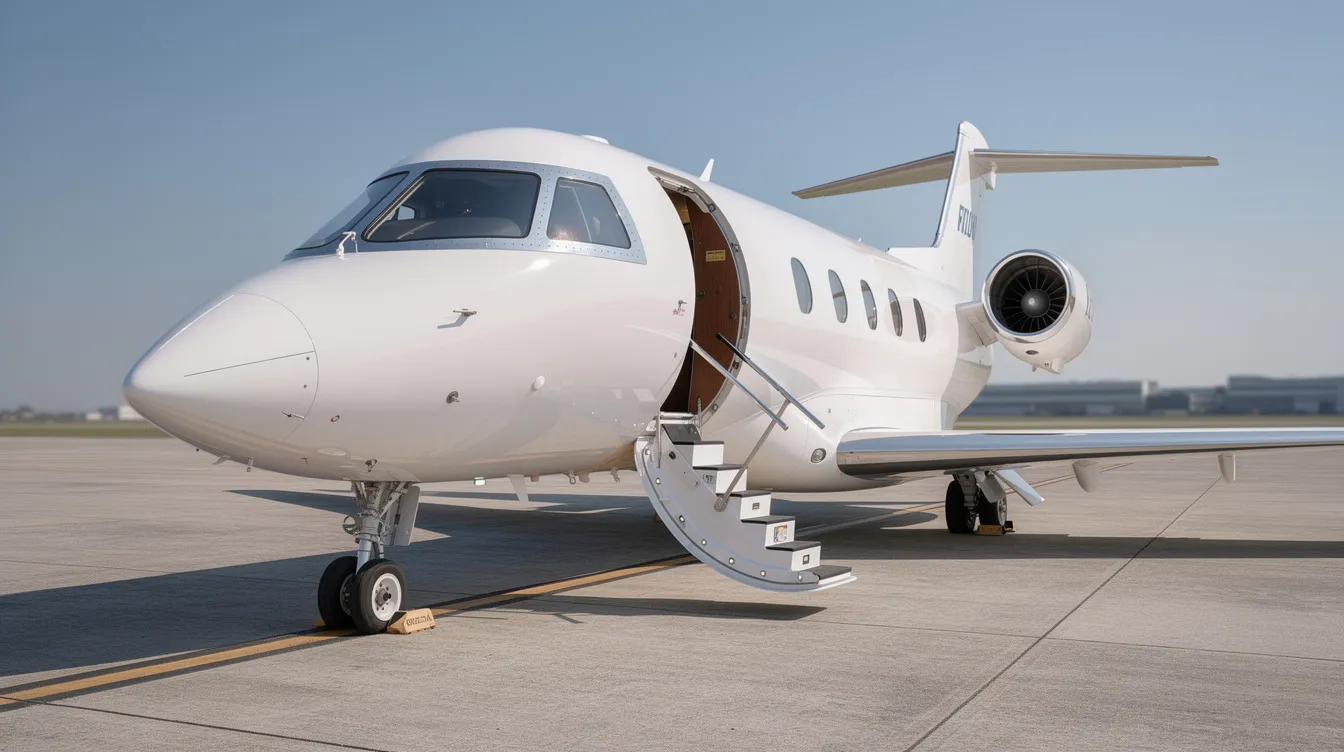
How Jet Cards Like BlackJet's Differ from Flying Lufthansa A380 Premium Cabins
A Jet Card is prepaid access to private jets: you purchase a block of flight hours (commonly 25 or 50 hours), and in return receive guaranteed availability, predictable hourly rates, and the ability to fly on your terms. For a complete breakdown of what this involves, see this guide to jet card costs alongside a broader overview of jet card pricing structures and benefits.
Here is how the two models compare – and for travelers considering committing to 25, 50, or more hours of private flying, understanding a dedicated 50-hour jet card cost breakdown makes these differences even clearer:
Factor | Lufthansa A380 Premium | BlackJet Jet Card |
|---|
Schedule | Fixed airline timetable | You choose departure time |
Airports | Major hubs only (Munich, LAX, JFK) | 5,000+ airports including FBOs |
Cabin | Shared (8 First, 68 Business) | Fully private |
Booking | Online, advance planning | 24/7 digital tools, short notice |
Sustainability | Airline SAF programs | Carbon-neutral flights included |
Safety | EASA/FAA airline certification | ARGUS / Wyvern approved operators |
The cabin experience is the starkest difference. On the A380, even in first class, you share the aircraft with 500 other passengers. On a private jet, the entire cabin is yours — for meetings, family travel, or uninterrupted rest. BlackJet's Jet Card also provides 24/7 real-time support and digital booking tools that allow members to adjust itineraries, specify catering preferences, and coordinate ground transport, all from a single platform.
Safety Standards: Commercial Flagships vs. Private Aviation
Both Lufthansa's A380 operations and reputable private jet providers operate under stringent safety regulations, though the frameworks differ in structure.
The A380 has no hull-loss accidents to date across all operators worldwide. It underwent rigorous certification testing — including full-aircraft evacuation trials, wing stress tests, and engine reliability programs — before entering service. Lufthansa maintains its fleet under EASA oversight with standardized procedures across large crews and maintenance facilities in Germany.
In private aviation, safety depends on the operator network. BlackJet addresses this by working exclusively with operators that hold top-tier safety certifications, including ARGUS Platinum and Wyvern Wingman ratings. Pilot experience minimums, aircraft maintenance standards, and operational audits are enforced before any operator enters the approved network.
The difference is one of scale and structure: airlines rely on standardized fleets and large operational teams, while private aviation providers curate networks of certified operators. For frequent flyers comparing options, understanding the best jet cards for safety, value, and flexibility helps frame how these models stack up. Both aim for the same outcome — extremely low incident rates and a travel experience where safety is never in question.
Technology and Digital Experience: Booking A380 Tickets vs. Private Jet Flights
Both major airlines and private jet providers use advanced technology to streamline the journey, but the emphasis differs.
For Lufthansa, the digital experience centers on flight booking: online search and purchase, seat selection across the A380's four cabins, Miles & More loyalty account management, and mobile boarding passes. The system is built for scale, handling millions of passengers per year across a global network, in contrast to emerging private jet rideshare platforms and digital tools for sourcing large private jets for sale or charter.
For BlackJet, technology goes beyond ticketing. Members access a digital booking platform that allows them to request flights, view available aircraft categories, confirm availability, and adjust itineraries in real time — including last-minute changes to departure time, airport, or passenger count. Catering preferences, ground transport coordination, and FBO selection are handled within the same system, especially for members using products like the BlackJet 25+ Hour Jet Card.
The distinction is clear: airline technology manages your place within a fixed system. Private aviation technology adapts the system to you.
Choosing Between Lufthansa A380 Business Class and a Private Jet
The right choice depends entirely on the trip.
When Lufthansa A380 Business Class makes sense:
Solo traveler with a fixed meeting date at the destination
Flying between major hubs that the A380 serves (Munich to Los Angeles, Delhi, Bangkok)
Prioritizing the in-flight product experience - the new 1-2-1 suite is genuinely excellent
Schedule aligns with Lufthansa's published timetable
When a private jet or Jet Card is the smarter move:
Multi-city itinerary compressed into a short timeframe
Destination airports not served by the A380 or requiring connections
Need for privacy - confidential discussions, family travel, or uninterrupted rest
Group travel where per-seat cost of a private jet approaches or undercuts multiple premium commercial fares
Last-minute schedule changes are expected or likely
Consider the scenario comparison: a single Munich-to-LAX roundtrip for one executive is hard to beat on the A380 in business class. But a C-suite team doing Munich to LAX, then LAX to a meeting in Napa Valley, then onward to Denver for a September conference, faces a fundamentally different equation. The commercial route involves multiple connections, layovers, and schedule compromises. A Jet Card eliminates all of it.
For travelers who frequently fly long-haul in premium cabins and increasingly find that their time is worth more than the fare difference, exploring how to book a private jet and the underlying costs of renting a private jet is a logical next step.
Future of the Lufthansa A380 and Very Large Aircraft
Airbus ended A380 production in 2021, with the final delivery going to Emirates in December of that year. No new A380s will ever be built, making existing fleets finite assets that airlines must manage strategically.
Lufthansa's medium-term plan is clear: operate its reduced A380 fleet on select high-demand routes from Munich while growing its fleet of newer twin-engine aircraft like the A350-900 and Boeing 787 for the majority of long-haul missions. The A380 is expected to remain in Lufthansa service through the late 2020s and potentially into the early 2030s, depending on demand patterns and the arrival of replacement aircraft.
The broader industry trend points away from very large aircraft. Airlines increasingly favor point-to-point routing over hub-and-spoke concentration, and the economics of modern twin-engine widebodies are difficult to argue against on most routes. Whether future large jets will be developed remains uncertain — the capital required, environmental pressure, and risk make it unlikely in the near term.
For travelers, the analysis is straightforward. The A380 will remain a spectacular way to fly across continents for as long as it operates. But for those who value time, flexibility, and complete control over their travel, the future belongs to solutions that adapt to the traveler — not the other way around. Private jet access through programs like BlackJet's Jet Card is not a replacement for the A380; it is a complement for those whose travel demands exceed what any scheduled flight, however impressive, can deliver.
FAQ: Lufthansa's Double Decker Plane and Private Jet Alternatives
Which routes does Lufthansa operate the Airbus A380 on?
Lufthansa currently flies its A380s exclusively from Munich to eight major global destinations: Bangkok, Delhi, Los Angeles, San Francisco, Washington D.C., Boston, Denver (summer), and Mumbai (new in 2026). Route assignments vary seasonally, and some comments from aviation trackers suggest additional destinations may be considered as the retrofit program completes. Terms apply to seasonal scheduling — always verify current timetables before booking.
What is the difference between A380 First Class and Business Class?
First class offers just 8 private suites in the nose of the upper deck, with exceptional space, enhanced sound insulation, and a level of personalized service that business class cannot match. Lufthansa's A380 business class has 68 seats in a 1-2-1 configuration after the retrofit, giving every passenger direct aisle access and a fully lie-flat bed. Both cabins are premium, but first class is a deliberately scarce, ultra-exclusive product while business class serves a broader premium audience.
Is the Airbus A380 really the world's largest passenger airliner?
Yes. The A380 remains the largest passenger aircraft in regular commercial service anywhere in the world. No other scheduled aircraft matches its two full-length passenger decks, its 550 square meters of cabin floor space, or its capacity of 509 passengers in Lufthansa's four-class layout. Additionally, the Points Guy and other aviation commentators consistently rank it among the most iconic aircraft ever built.
How comfortable is Economy on Lufthansa's A380 for long flights?
Economy on the A380 benefits from the aircraft's double-deck design in ways that may surprise passengers. The cabin is quieter than on older widebodies, with higher humidity and better air quality that reduce fatigue on 10-13 hour sectors. Economy seats can be up to 48 cm wide, and USB power ports, personal IFE screens, and wider aisles all contribute to a more tolerable long-haul experience. More comments from frequent flyers consistently note that the upper deck rear economy section is especially quiet and uncrowded.
When does it make sense to choose a private jet instead of flying Lufthansa Business Class?
If your itinerary requires flexibility outside fixed flight schedules, time savings are critical, you need to reach smaller airports without hub connections, or you are traveling with a group where dividing private charter cost may approach commercial premium fares, a private jet is the more efficient choice – particularly when considering large private jets tailored for 20 passengers. The Lufthansa A380 is outstanding for fixed-schedule, hub-to-hub travel; private aviation excels when the trip itself is the variable.
Can Lufthansa's A380 fleet grow again?
No. With Airbus having ended A380 production, Lufthansa cannot order new aircraft. The airline's current plan covers its eight remaining A380s, all of which are scheduled for the business class retrofit by mid-2027. Any future capacity growth will come from newer aircraft types like the A350 and 787.
How does a Jet Card with BlackJet complement flying commercial airlines like Lufthansa?
A Jet Card provides prepaid hours of private jet access, giving you schedule flexibility, departure time choice, airport flexibility, fully private cabins, and consistent safety and sustainability standards — including carbon-neutral flights at no extra cost. It does not replace the A380 for high-volume, fixed-schedule routes, but for travelers who fly at the level where Lufthansa first class or business class is routine, a Jet Card offers something no commercial airline can: complete control over when, where, and how you fly, especially once you understand typical jet card cost per flight hour. Explore how BlackJet's Jet Card programs can reshape your travel.
Conclusion: The Lufthansa A380 and the Future of Premium Air Travel
Lufthansa's Airbus A380 stands as a symbol of aviation ambition — a double-decker giant that combines scale, technology, and luxury to serve the world's busiest long-haul routes. For premium travelers, it offers an unparalleled blend of space, comfort, and service across its four-class cabin, with standout features like the exclusive first class and the newly upgraded business class suites.
Yet, the A380's story also reflects the evolving dynamics of global air travel. While its massive capacity and efficiency shine on slot-constrained high-demand routes, changing market preferences, environmental considerations, and technological advances favor more flexible twin-engine aircraft for many missions. Lufthansa's strategic pivot to maintain a smaller A380 fleet alongside newer widebodies exemplifies this balance.
For discerning travelers, the choice between flying Lufthansa's A380 and accessing private jet services like BlackJet's Jet Card programs comes down to priorities: fixed schedules and hub-to-hub service versus ultimate flexibility, privacy, and bespoke itineraries. Both represent the pinnacle of luxury travel in their own right.
As the era of very large aircraft production ends, the A380 will remain a prestigious way to cross continents for years to come. Meanwhile, private aviation continues to redefine luxury by putting the traveler in full control. Together, they shape a future where premium air travel is not just about the journey, but about elevating every moment of it.
Explore how Lufthansa's A380 and BlackJet's private jet offerings can each elevate your next trip — whether you seek the grandeur of the world's largest passenger airliner or the freedom of your own private sky. Learn more about the upgraded business class on Lufthansa's A380, discover premium economy benefits, compare private jet safety standards, and understand the economics of very large aircraft.


 Sign up with google
 Sign up with Apple