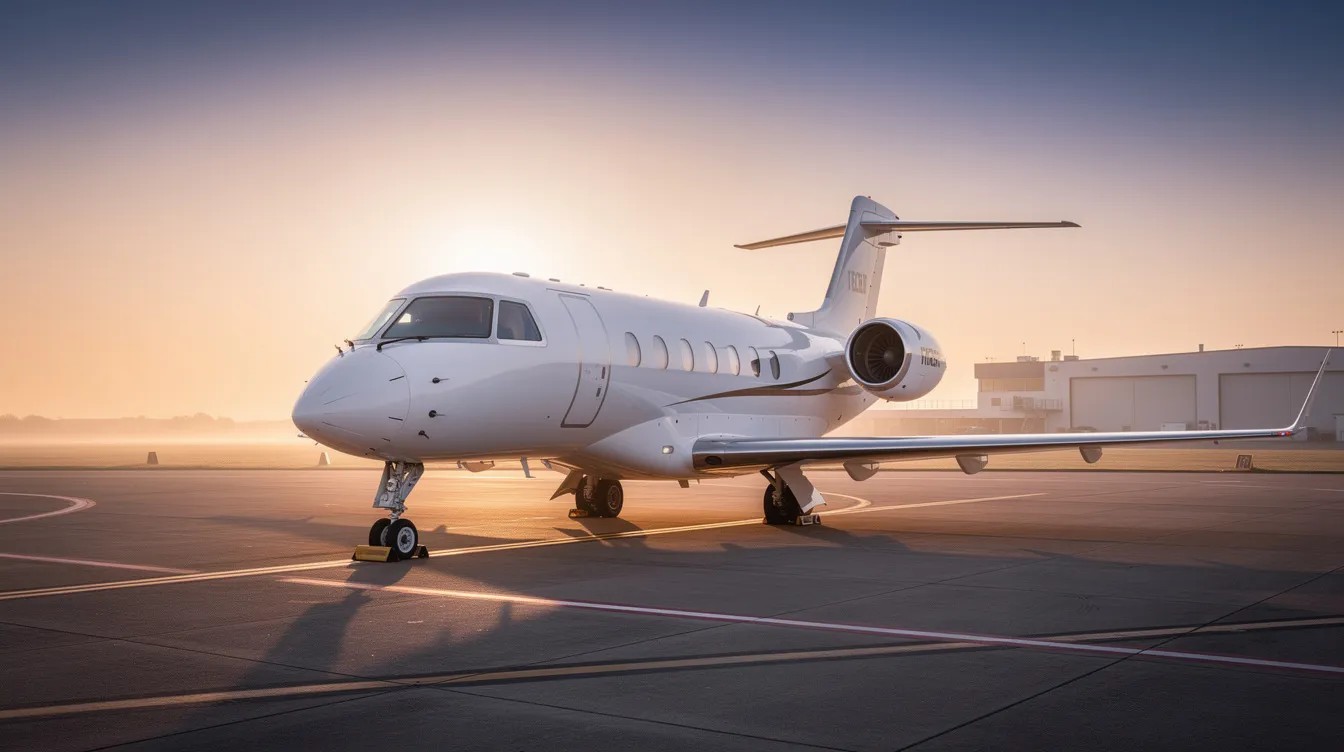
A Learjet is more than a symbol of success. For business travelers and discerning families, it is a strategic private jet tool: faster departures, private terminals, flexible schedules, and fewer wasted hours than commercial flights. This guide is designed for business travelers, families, and anyone considering private jet charter or jet card membership. Understanding Learjet options helps travelers maximize efficiency, comfort, and value in private aviation.
Why Learjet Still Matters for Serious Private Flyers
The Learjet is considered the pioneer of modern private aviation, adapting military-grade engineering for corporate travel. Learjet aircraft cruise around Mach 0.78–0.81, close to commercial airliners, but without hub connections, long security lines, or crowded terminals. On New York–Chicago or Los Angeles–Dallas, that can turn a full travel day into a same-day meeting and return.
Although Learjet production ended in 2022, more than 2,000 Learjet aircraft remain in service from over 3,000 built, according to fleet history from JETNET. Many are refurbished for charter, jet card, and corporate service.
BlackJet gives members access to Learjet charter, where available, alongside other aircraft in light and midsize jet categories through our premium private jet card programs. Our 25-hour and 50-hour Jet Card programs combine private aviation speed with carbon-neutral flights, third-party safety screening, and app-based booking.
From Bill Lear’s Vision to the End of Learjet Production
The Learjet aircraft family spans nearly six decades of business aviation, evolving from fighter-jet-inspired designs to advanced models managed by Bombardier. The Learjet is considered the pioneer of modern private aviation, adapting military-grade engineering for corporate travel.
Learjet began when Bill Lear founded Swiss American Aviation Corporation in 1960. Inspired by the Swiss FFA P-16, Lear wanted a small, fast business jet that could rival airline speed.
In 1962, work moved to Wichita, Kansas, where Learjet Corporation was formed near Wichita's airport. Assembly of the first Learjet, the Model 23, began in February 1963.
The Learjet 23, which took its maiden flight on October 7, 1963, was revolutionary for its time, offering speeds comparable to commercial airliners and setting the standard for business jets. It used GE CJ610-1 engines, carried six to eight passengers, and reached about 903 km/h.
Early models of Learjets quickly became status symbols, utilized by high-profile celebrities and corporations for rapid transport. The Learjet 24, Model 25, and later Learjet line improved range, cabin comfort, and avionics.
In 1967, Gates Rubber acquired the company, creating Gates Learjet Corporation. The Gates Aviation era brought Garrett TFE731 engines, better fuel economy, and winglets on the Learjet 28. In 1990, Bombardier Aerospace acquired the Learjet Corporation, which led to the development of new models like the Learjet 60 and Learjet 45, expanding Learjet's market presence.
Bombardier announced the end of production in 2021. The final Learjet, a Model 75, was delivered on March 28, 2022, marking the end of 60 years of production during which over 3,000 aircraft were built, with more than 2,000 still in service today.
Year | Milestone |
|---|
1960 | Swiss American Aviation Corporation was founded |
1963 | Learjet 23 first flight |
1967 | Gates Learjet Corporation formed |
1990 | Bombardier Aerospace Acquisition |
2022 | Production ceased with the final Learjet 75 |
Core Learjet Aircraft Families and Key Models
The Bombardier Learjet family includes classic 20-series jets, 30/50-series workhorses, and Bombardier Learjet models such as the 45XR, 60XR, 70, and Learjet 75. The first true "Stand-Up Cabin" Learjet was the Learjet 55, which addressed criticisms of cramped passenger spaces.
The Learjet 35A remains heavily utilized for medevac missions and military operations due to its robust airframe and reliability. The Learjet 31A introduced "Delta Fins," which significantly improved aerodynamic stability and stall characteristics.
model | passengers | range | speed | |
|---|
35A | 6–8 | 1,900–2,300 nm | Mach ~0.78 | |
31A | 7–8 | 1,800–2,000 nm | high-speed | a cruise capable |
learjet 45XR | 7–8 | 1,900–2,100 nm | Mach ~0.79 | |
60XR | 7–8 | 2,400–2,600 nm | Mach ~0.79 | |
learjet 75 | 6–9 | ~2,040 nm | Mach 0.81 | |
BlackJet generally places Learjet models in light and midsize categories, comparing them with Citation CJ, Hawker, Phenom, and Legacy options so members get the right aircraft for each mission within the broader context of types of private jets for every traveler.
Spotlight on the Learjet 45, Learjet 60 & Learjet 75
Learjet 45 & Learjet 45XR
The Learjet 45 arrived in 1998; the 45XR followed in 2004 with new engines, higher weights, stronger climb, and low operating costs for its class. The Learjet 45/45XR features a flat-floor cabin design, which is unique among its competitors, allowing for more legroom and accommodating up to eight passengers.
Key points: range near 1,900–2,100 nm, cruise near Mach 0.79–0.81, two club sections, and cockpit technology including Honeywell Primus 1000 EFIS, dual FMS, and upgraded WAAS/LPV on many aircraft. A BlackJet member might use a 25-hour jet card for quarterly East Coast board trips without overbuying aircraft.
Learjet 60 & 60XR
The Learjet 60 is renowned for its impressive climb performance and can comfortably handle transcontinental flights with a range of about 2,400 nautical miles, fitting well into a 50-hour jet card structure for frequent coast-to-coast travelers. The 60XR adds refinement, connectivity options, and a stand-up cabin for 7–8 passengers.
Expect a strong climb, Mach 0.78–0.79 cruise, generous baggage, and refurbished interiors with LED lighting and modern leather. For Los Angeles–Las Vegas–Phoenix or New York–Dallas, it offers more cabin comfort than smaller light jets without stepping into large-cabin operating costs.
Learjet 75 and 75 Liberty
The Learjet 75 stands as the fastest business aircraft in its category, boasting a range of 2,040 nautical miles (3,778 kilometers) and a high-speed cruise capability of Mach 0.81 (860 km/h). The Learjet lineage has set 111 world speed records, including those achieved by the Learjet 75 during a round-trip flight between New York and Los Angeles in September 2015.
Modern Learjet models, such as the Learjet 70 and 75, feature advanced Garmin G5000 avionics, enhancing safety and situational awareness for pilots. The Bombardier Vision cockpit adds synthetic vision, weather radar, touchscreen controls, and reduced pilot workload.
Cabins may offer two distinct floor plans: a six-seat layout with more legroom or 8–9 seats in double-club form. Canted winglets improve efficiency, reduce drag, and help burn less fuel per mile. For a Toronto-based BlackJet member, a 100-hour jet card or 50-hour card can cover Toronto–Vancouver, New York–Miami, and Chicago–Scottsdale trips throughout the year.
Inside a Learjet Private Jet Cabin
A modern Learjet private jet is practical rather than theatrical: leather seating, veneer cabinetry, fold-out tables, LED lighting, power outlets, and cabin-management systems for temperature, lighting, and entertainment, while modern environmental control systems help keep cabin noise levels low enough for conversation and work.
Most charterable Learjets seat between six and nine passengers, depending on the model and interior configuration, placing them firmly in the category of small private jets for luxury travel. Common distinct floor plans include double-club seating, an occasional side-facing seat, and a belted lavatory.
Baggage planning matters. Golf clubs, ski gear, and production cases can change the ideal aircraft, so BlackJet flight support checks luggage before confirming the trip.

Performance, Airports & Operating Economics
The typical range for Learjet models on charter flights is approximately 1,900 to 2,800 nautical miles, depending on the specific model, which aligns closely with what travelers see when chartering a small plane across popular business and leisure routes. Real-world range changes with passengers, fuel, wind, routing, and weather.
Chartering Learjets grants access to private terminals, allowing travelers to avoid the typical delays and crowds of commercial airports, thereby enhancing convenience and saving valuable time. Airports such as Teterboro, Van Nuys, Dallas Love Field, and London Luton can reduce travel time dramatically.
Operating costs for the Learjet 75 typically range between $2,200 and $2,600 per flight hour, making it competitive with other light jets such as the Citation CJ4 and Phenom 30,0 and comparable to many jet card cost per hour benchmarks in the market. The operating costs for the Learjet 40XR run approximately $1,900 to $2,300 per flight hour, while the larger Learjet 60XR reaches $2,600 to $3,100 per hour.
BlackJet converts complex per-flight hour economics into clear Jet Card access, helping members choose when Learjet is ideal and when another aircraft class is smarter by applying a transparent view of overall jet card cost.
Chartering a Learjet with BlackJet: Jet Cards vs On-Demand
Chartering a Learjet can be done on demand, allowing travelers to avoid the burdens of ownership, maintenance, and crew management, whether flying regionally, comparing the overall cost to charter a small plane, or arranging private jet charters in Karachi. You select route, timing, passengers, baggage, and preferred cabin; BlackJet verifies aircraft, crew, safety, and service standards.
Jet Cards differ by adding prepaid hours, priority access, predictable hourly pricing, and a consistent cabin class, all driven by a clearly defined jet card pricing structure. Compared with owning, there is no hangar, insurance, maintenance department, or crew payroll.
Through the BlackJet app or web portal, members can request a Learjet or comparable midsize jet, review flight estimates, see carbon-neutral status, and coordinate multi-segment travel with one support team under flexible BlackJet 25+ Hour Jet Card solutions.
Safety, Certification & Sustainability on Learjet Flights
Learjet charter operations are typically flown under commercial rules such as FAA Part 135, with operator certification, maintenance programs, crew duty limits, and two-pilot standards.
BlackJet screens for operators with recognized safety credentials such as ARGUS, Wyvern, or IS-BAO, where available, a key factor for many travelers comparing the best jet cards for frequent flyers. Safety features may include redundant systems, TCAS, EGPWS/TAWS, radar, advanced avionics, and precision-approach upgrades.
Carbon-neutral performance is built in. BlackJet measures flight emissions, purchases high-quality offsets, and coordinates sustainable aviation fuel options where available, with no extra effort required from the member.
When a Learjet Private Jet Is the Best Choice
Popular use cases for Learjet charters include business trips between major cities, family travel, and urgent medical flights. A CEO can fly New York–Chicago and return that evening; a family of six can fly Toronto–Palm Beach through private terminals; a medical-related relocation can use a reliable, fast Learjet aircraft when timing matters, while other travelers may opt for the cheapest private jet options when budget is the primary concern.
Sports and entertainment teams often value the same flexibility: late departures, secondary airports, and quick turns, and larger groups may occasionally upgrade to the best private jet for 50 passengers when entourage size or event logistics demand it. BlackJet advisors evaluate passengers, runway length, weather, range, and baggage before recommending a Learjet or other aircraft, whether a short regional hop or an international private jet charter from Lahore.
Market Reality: Learjet Values & Long-Term Support
Annual fixed expenses for owning a Learjet can add between $750,000 and $1.4 million, depending on the model, before flying. That is before variable fuel, maintenance reserves, upgrades, and crew travel.
Currently, around 40 Learjet aircraft are available for sale, with an average listing price of $2,800,500, reflecting steady buyer interest in the market, similar to ongoing demand explored in analyses of NetJets jet card cost and other access programs. Current listings of Learjet aircraft for sale range from $595,000 to $6,050,000, reflecting market adjustments to the aircraft's orphan status after production ceased.
Learjet values will likely depreciate faster than continuing-production competitors, but acquisition discounts can justify ownership for operators prioritizing performance and speed over maximum residual value protection, especially when evaluated alongside leasing a private jet or other access models. For charter customers, the more relevant issue is whether the operator maintains engines, avionics, records, and support programs properly.
The Learjet 75 remains a supportable model because of its relatively young fleet age, compared with older classics, modern avionics, and Bombardier's support network, even when compared with the latest long-range private jets for sale in the broader market.

FAQ: Learjet Private Jet Charter & BlackJet Jet Cards
How many passengers can a Learjet carry?
Most charterable Learjets seat six to nine passengers. Layout depends on model, cabin, lavatory seating, and baggage needs.
How far can a Learjet fly without stopping?
Typical charter range is about 1,900–2,800 nautical miles. Winds, payload, routing, and reserves affect every flight.
How does a BlackJet Jet Card differ from an on-demand Learjet charter?
On-demand charter prices each trip individually. A Jet Card prepays hours, simplifies budgeting, and gives priority access within program terms.
Are Learjet flights with BlackJet carbon neutral?
Yes. BlackJet offsets program flights to net-zero and integrates SAF where available.
What safety standards apply?
We screen for commercial certification, experienced crews, maintenance tracking, and third-party audit credentials where available.
Can I bring my pet?
Many operators are pet-friendly. BlackJet coordinates crate, cleaning, and documentation requirements before confirmation.
How far ahead should I book?
Several days’ notice is ideal. Urgent trips may be arranged within hours, subject to aircraft availability.
Conclusion: Is a Learjet Right for Your Next BlackJet Flight?
A Learjet is best when speed, privacy, runway access, and efficiency matter more than maximum cabin size. It remains one of business aviation’s most recognizable examples of innovation, technological prowess, and practical performance.
With BlackJet, members access Learjet private jets and comparable ones


 Sign up with google
 Sign up with Apple