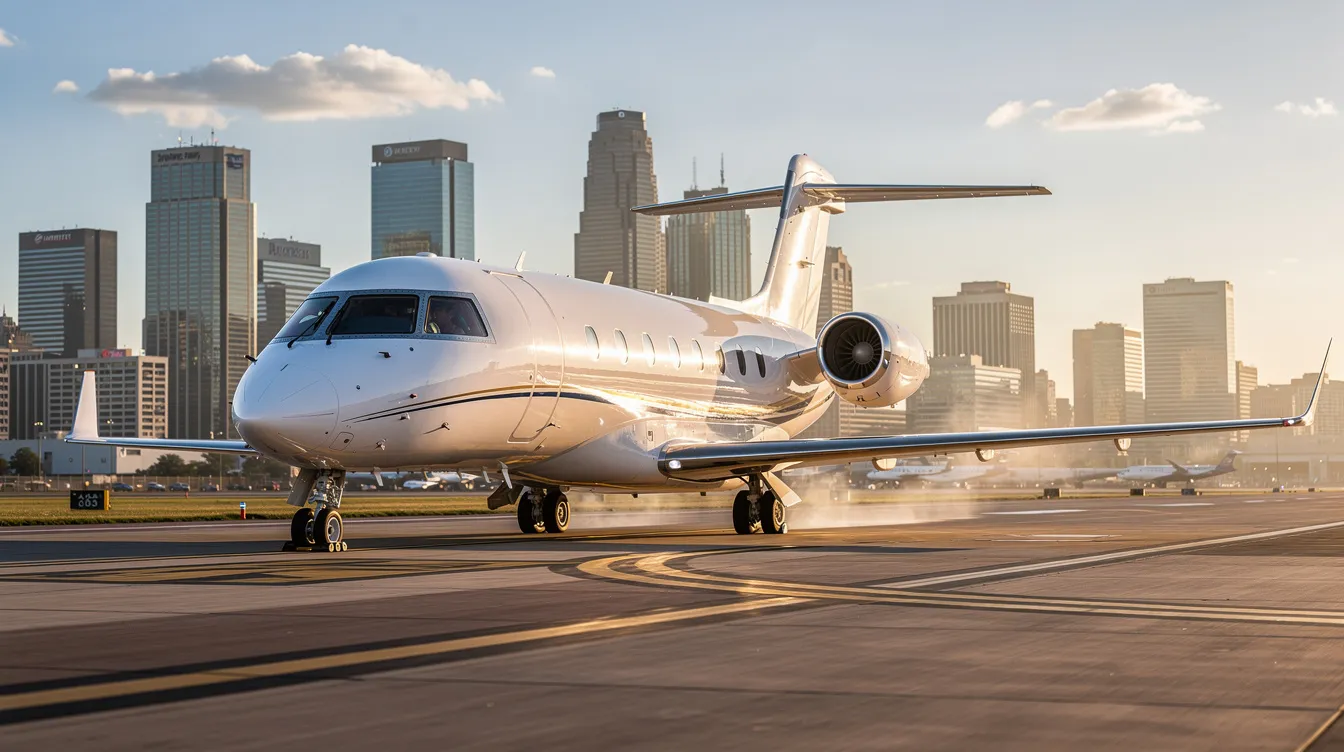
Choosing a large cabin jet card for long-range nonstop travel usually comes down to a question the brochures skip: will the aircraft still fly your route nonstop once you count passengers, bags, winds, and required fuel reserves? A large cabin jet card is a prepaid block of flight time that provides access to large-cabin private jets, typically seating 10 to 12 passengers with long-range capability, often at fixed hourly rates and with contractual availability terms. This guide gives you three tools for the decision in long-range private aviation: a real-world range chart, a city-pair playbook, and a scoring rubric for stepping up from super-midsize.
Quick Take on Picking the Right Cabin Class for Nonstop Long Range
Choose super-midsize if your common trips are coast-to-coast U.S. or 3 to 6 hour missions with strong nonstop margin and 8 or fewer passengers.
Choose large cabin if you want to reduce fuel-stop risk on long legs, carry more people and baggage, and add space plus amenities like an enclosed lavatory.
Choose ultra-long-range large cabin if you regularly fly transatlantic or farther and need margin against headwinds and full loads.
Super-midsize aircraft handle most coast-to-coast runs and many 3 to 6 hour missions with room to spare. Large cabin becomes the smarter pick when you want to cut fuel-stop risk on long legs and add cabin space, baggage capacity, and amenities. One planning habit matters more than any spec sheet: treat published range as a ceiling and plan as if you have 10 to 20 percent less, a concept explained below as the range buffer.
Programs from NetJets, VistaJet, Sentient Jet, Jet Linx, Wheels Up, and BlackJet all offer large-cabin access, but their guarantees and pricing differ, which we compare later.
If a nonstop mission is business-critical, the right jet card is the one that still flies the route nonstop after you account for payload, winds, and fuel reserves, not the one with the biggest advertised number.
| Fast cabin-class check |
Signal | Points toward |
|---|
Route length | Longer legs and westbound crossings favor large cabin |
Passenger and baggage load | 9-plus passengers or bulky bags favor large cabin |
Comfort requirements | Rest, meeting space, and an enclosed lavatory favor large cabin |
Once you know which cabin class fits, compare the BlackJet Jet Card options against your routes.
What Large Cabin Means and What It Doesn't
Private aviation sorts jets into four working categories. Light jets carry up to about 7 passengers on short hops. Midsize jets add cabin room and range for 2 to 3 hour legs. Super-midsize jets push into coast-to-coast U.S. capability with more speed and space, and large cabin jets bring the longest range, the most seats, and the most amenities. If you are new to these programs, our primer on what a jet card is covers the basics before you compare cabin classes.
Large cabin gets chosen for longer legs, more passengers, more baggage, and better onboard amenities, often including an enclosed lavatory and more cabin zones. Ultra-long-range jets like the Gulfstream G650 and Bombardier Global 7500 sit inside the large cabin family, but not every large cabin aircraft is intercontinental. A Dassault Falcon 8X or Gulfstream G550 crosses the Atlantic comfortably; a shorter-legged large cabin jet may not.
Super-midsize jet: a midsize-category upgrade built for longer nonstop legs, often coast-to-coast U.S., with more speed and cabin space than midsize aircraft but less range and cabin volume than large cabin jets. Super-mid workhorses include the Citation Longitude and Challenger 350 class.
Large cabin is the step-up class for travelers who want long-range capability plus meaningful cabin comfort, not just a few extra seats.
| | | Cabin classes at a glance (typical figures) |
Cabin class | Typical passengers | Typical nonstop mission | Common tradeoff |
|---|
Light | Up to 7 | Short regional hops | Lowest cost, limited range and bags |
Midsize | Up to 8 | 2 to 3 hour legs | Balanced cost, modest range |
Super-midsize | Up to 8 | Coast-to-coast U.S. | More speed and space, less range than large cabin |
Large cabin | 10 to 12 | Transatlantic and long nonstop | Highest capability, highest hourly rate |
BlackJet's published category benchmarks give a useful anchor. Its large cabin category seats up to 12 with an average range near 5,100 statute miles (roughly New York to London), and its super-mid category seats up to 8 with an average range near 3,950 statute miles (roughly Los Angeles to Boston). Treat those as internal program context, not universal truth.
Range Chart and the Real-World Methodology Behind Two Numbers
Use a repeatable four-step method to judge any route:
Start with the aircraft's published maximum range in nautical miles.
Apply a buffer of 10 to 20 percent to reflect real-world conditions.
Compare the buffered range to the great-circle distance of your route.
Add a westbound penalty for headwinds, then rate your nonstop confidence as high, marginal, or fuel-stop likely.
The reasons those adjustments matter are well documented. Range shrinks with headwinds (worst on westbound crossings), hot-and-high airports, heavier payloads, alternate-airport requirements, and mandatory reserves, as Private Jet Card Comparisons details in its range rankings.
The most useful range chart shows two scenarios, full cabin and a lighter 4-passenger load, because those two numbers can differ by over a thousand nautical miles on long-range jets. That gap explains why the same aircraft can be a confident nonstop with four aboard and a fuel-stop risk with a full cabin.
Range specs use nautical miles, not statute miles. One nautical mile equals about 1.15078 statute miles, so a 6,000 nm jet covers roughly 6,905 statute miles. That same conversion note appears in the comparison table.
Planning range (nonstop range): the conservative nonstop distance you can expect after accounting for typical winds, reserves, and passenger and baggage weight, often meaning you should plan for less than the aircraft's published maximum.
| | | | Large cabin and ultra-long-range published range (approximate) |
Aircraft | Class | Range, seats full | Range, 4 passengers | Notes |
|---|
Bombardier Global 8000 | Ultra-long-range large cabin | ~7,900 nm | ~8,000 nm | Among the longest published range |
Bombardier Global 7500 | Ultra-long-range large cabin | ~7,000 nm | ~7,700 nm | Comfortable westbound Atlantic margin |
Gulfstream G650ER | Ultra-long-range large cabin | ~7,000 nm | ~7,500 nm | Often cited as longest range with a full cabin |
Gulfstream G550 | Large cabin | ~6,200 nm | ~6,750 nm | Strong transatlantic capability |
Dassault Falcon 8X | Large cabin | ~5,900 nm | ~6,450 nm | Good hot-and-high performance |
Challenger 650 / Legacy 650 line | Large cabin | ~3,700 nm | ~4,000 nm | Apply buffer for westbound Atlantic |
Figures pulled from the Private Jet Card Comparisons range rankings, which describe the Gulfstream G650ER as offering the longest range with a full cabin, with numbers varying by payload assumptions.
"Published range figures are useful benchmarks, but they're only the beginning of the planning process. Experienced travelers evaluate the entire mission, including passenger load, baggage, winds, alternate airport requirements, and operational reserves, because those factors determine whether a flight remains comfortably nonstop in real-world conditions."
- Justin Crabbe, CEO
Once you know the capability you need, our guide to jet card pricing basics connects aircraft class to cost.
City-Pair Playbook for Nonstop Feasibility and Fuel-Stop Costs
A fuel stop rarely costs only the time on the ground. Add the descent, approach, and taxi in, the refuel coordination, possible passenger handling or customs re-clearance, and the climb back to altitude. A single stop can add 60 to 90 minutes or more, plus the operational risk of a delay rippling through your day. A stop also stretches total flight time, and since jet cards bill by occupied hour, that extra time raises the trip's cost, as our breakdown of private jet prices per hour shows.
City pair: an origin-and-destination route (for example, New York to London) used to evaluate aircraft capability, nonstop feasibility, and program availability against real travel patterns.
| | | City-pair nonstop guide (typically feasible, condition-dependent) |
City pair | Typical cabin class | Nonstop confidence, east/west | Why choose large cabin anyway |
|---|
New York to Los Angeles | Super-midsize | High east; watch westbound headwinds at full load | Baggage, meeting space, comfort |
Los Angeles to Boston | Super-midsize | High east; westbound return marginal with full cabin | Rest on 5-plus hour legs |
Seattle to Miami | Super-midsize / large cabin | Marginal westbound at full load | Lower fuel-stop risk |
New York to London | Large cabin | High eastbound with tailwinds | Space and sleep on the overnight |
Boston to Paris | Large cabin | High eastbound | Arrive rested for meetings |
New York to Rome | Large cabin / ultra-long-range | Feasible east, buffer needed | Comfort on the longer leg |
London to New York | Large cabin, with buffer | Westbound headwinds cut range; ultra-long-range safer at full load | Avoid a fuel stop |
Paris to New York | Large cabin / ultra-long-range | Westbound headwinds; full loads may need ultra-long-range | Nonstop reliability |
Los Angeles to Tokyo | Ultra-long-range large cabin | Feasible with margin management | Long-haul rest and cabin zones |
New York to Dubai | Ultra-long-range large cabin | Feasible on G650ER or Global class | Crew rest and workspace |
The same route can be a nonstop eastbound and a fuel stop westbound on the same day. Eastbound transatlantic flights ride the jet stream; westbound flights fight it. Those wind effects sit at the center of the range caveats in the range rankings referenced above.
If you buy large cabin for nonstop reliability, confirm your provider's guaranteed availability and notice requirements for that category. Program rules on peak-day notice and callout times vary widely, a point clear across market overviews like Jettly's program breakdown and provider comparisons such as the NetJets and Wheels Up analysis at JetCards.org.
The fastest way to choose the right cabin class is to match your most common city pairs to a conservative planning range, then add extra margin for westbound crossings and full passenger loads.
When to Step Up From Super-Midsize to Large Cabin
Score each factor from 0 to 2, then add them up. A total of 6 or more out of 10 means a large cabin jet card likely pays for itself in fewer fuel stops and lower schedule risk. Under 6, super-midsize probably covers your missions.
| | Step-up scoring rubric (0 to 2 each) |
Factor | 0 points | 2 points |
|---|
Range margin | Well within super-mid range | Near the edge, especially westbound or full load |
Passenger and baggage | 4 or fewer, light bags | Routinely 8-plus with bulky luggage |
Comfort and utility | Short legs, no rest needed | Need rest, cabin zones, or attendant on 6-plus hour legs |
Schedule risk | Dates can slip | Fixed events or meetings that cannot slip |
International and peak | Domestic, off-peak | Frequent transatlantic or peak-day travel |
The range-margin trigger fires when your common missions sit near the upper end of super-mid capability, especially westbound or with a full cabin, where large cabin cuts fuel-stop probability. The passenger trigger fires when you routinely exceed 8 seats or carry bulky luggage. The comfort trigger fires when a flight attendant, more cabin zones, or real rest on 6-plus hour legs changes how the day goes.
Schedule risk deserves its own weight. If a trip cannot slip, prioritize programs with contractual guaranteed availability and clear peak-day rules. A comparison of the NetJets Marquis card and Wheels Up shows peak-day booking windows stretching as long as 120 hours on some programs, which is why the contract, not the marketing line, decides whether you fly on time.
Step-up decision: the choice to pay for a larger cabin category to increase nonstop reliability, comfort, and mission flexibility, usually when the cost premium is justified by fewer fuel stops and lower schedule risk.
"Moving from a super-midsize aircraft to a large cabin jet isn't simply about flying farther. It's about increasing operational confidence, reducing the likelihood of unplanned fuel stops, and giving passengers a more productive and comfortable environment on missions where every hour and every schedule commitment matter."
- Justin Crabbe, CEO
| | Super-midsize versus large cabin |
Factor | Super-midsize | Large cabin |
|---|
Typical passengers | Up to 8 | 10 to 12 |
Typical nonstop mission | Coast-to-coast U.S. | Transatlantic and long nonstop |
Cabin comfort | Single zone, compact lavatory | Multiple zones, enclosed lavatory, rest space |
Fuel-stop risk on edge missions | Higher, especially westbound | Lower with proper buffer |
Contract considerations | Shorter callout common | Confirm peak-day notice and guaranteed availability |
Step up to a large cabin jet card when the cost of a fuel stop, or a missed arrival window, matters more than the hourly-rate difference. For a sense of how the step-up affects your budget, our guide to 25-hour jet card costs breaks down entry pricing by cabin.
Guaranteed Availability, Booking Windows, and Peak-Day Policies
Some programs make the guarantee central to their pitch. Jet Linx states its jet card offers guaranteed availability with guaranteed fixed hourly rates and no peak-day surcharges. Notice windows change on high-demand dates, and the NetJets and Wheels Up comparison points to peak-day booking windows as long as 120 hours on some programs, far longer than a normal day.
Large cabin demand spikes harder on peak days than smaller cabins. There are fewer large-cabin tails, the legs run longer, and repositioning an aircraft across the country or the Atlantic takes more planning. A jet card with a real guarantee protects you here in a way ad hoc charter cannot when everyone wants the same holiday weekend, a familiar reality of private aviation during peak weeks.
Peak day: a date the provider designates as high demand, often holidays or major events, where notice requirements, surcharges, or restrictions can change. International and transatlantic trips often carry longer lead times than domestic legs because of permits, slots, and crew rest planning, so ask for the large-cabin international callout time specifically.
Guaranteed availability only matters if you can meet the program's required notice window, so always ask for the peak-day calendar and the large-cabin callout time in writing.
What to confirm before you buy:
Callout time for large cabin, standard and peak
Number of peak days per year and the exact calendar
Blackout days, if any
Upgrade and downgrade rules between cabin classes
Daily minimums on flight hours
Taxi time and repositioning policy
International fees and overnight crew costs
Cancellation and refund terms
Whether "aircraft type or better" is guaranteed in writing
If you fly out and back on the same trip, ask how the program handles round-trip discounts, since efficiency credits can offset peak pricing.
Jet Card Pricing for Large Cabin, All-In Versus Plus Fuel and FET
Large cabin jet card pricing looks simple until the add-ons land. A base hourly rate is not always the price you pay, and two programs can advertise similar hourly numbers yet finish far apart once fuel surcharges and Federal Excise Tax (FET) are added.
Sentient Jet lists its SJ25+ large cabin card with a published base price and base hourly rate, then notes that fuel surcharge and Federal Excise Tax will apply, and that hours never expire. That structure is common across the market, and it makes headline rates hard to compare.
BlackJet takes a different approach to jet card pricing. Its published large cabin rate already includes fuel surcharges and FET, its rates stay guaranteed fixed for 12 months, and hours never expire. As program terms, the BlackJet 50 Large Cabin card carries a base hourly rate of $13,131 with fuel surcharge and FET included. The 25-Hour Jet Card comes as a Pay-As-You-Fly option at $50,000 or a Fully-Funded card at $225,000; the 50-Hour Jet Card is $95,000 Pay-As-You-Fly or $450,000 Fully-Funded, both giving access to large cabin aircraft. Confirm current terms at purchase, since programs update pricing.
Sample math helps. At $13,131 all-in per hour, a 10-hour block of large cabin flying runs about $131,310, with fuel and FET already inside that number. A competitor quoting a lower base rate plus fuel and FET can match or exceed that once the add-ons apply. The fair way to compare jet card pricing is to convert every quote into a single all-in figure first.
Long-range flying magnifies these gaps. De-icing in winter, international handling and permits, overnight crew, and repositioning can each move the all-in result materially on a transatlantic trip.
All-in hourly rate: a single contracted price per occupied flight hour that already includes common add-ons such as fuel surcharges and, in some programs, Federal Excise Tax, reducing surprise charges.
To compare large cabin jet cards fairly, convert every quote into an all-in hourly rate that includes fuel and FET, then apply the same assumptions for peak-day uplift and minimums.
| | Pricing transparency checklist |
Item | Included in some programs? | Questions to ask |
|---|
Federal Excise Tax (FET) | Sometimes | Is the 7.5% FET inside the quoted rate? |
Fuel surcharge | Sometimes | Is fuel locked or variable? |
De-icing | Rarely | Who pays in winter? |
Landing fees | Varies | Included or passed through? |
Catering | Rarely | Standard or billed separately? |
Wi-Fi | Sometimes | Complimentary on all aircraft? |
International handling | Rarely | Permits, customs, overnight crew? |
Our FET and taxes guide explains how the tax applies across different trip types.
Provider Comparison for Large Cabin Jet Card Programs in 2026
Large cabin jet card programs in private aviation split into two broad models. Owned or managed fleet programs operate aircraft under their own operational control, which can mean consistent cabins and crews. Brokered or vetted network programs arrange flights through screened third-party operators, which can mean broader aircraft choice and flexible jet card pricing.
Fleet-owned versus brokered: fleet-owned programs operate aircraft under their own operational control. Brokered programs arrange flights through a vetted network of third-party operators. Both can be safe and reliable, though consistency and contract terms differ.
BlackJet built its model around predictable long-range planning. Card Owners get access to light, midsize, super-mid, and large cabin categories, with fixed hourly rates guaranteed for 12 months and hours that never expire. You can switch jet sizes larger or smaller at stable fixed rates, book through the mobile app or by text, and every operator, aircraft, pilot, and flight clears the BlackJet Certified vetting process. Every flight carries built-in emissions-neutral offsets at no cost to Card Owners. BlackJet coordinates with vetted FAA Part 135 operators in the U.S. and EASA operators in Europe rather than owning a fleet, which keeps aircraft choice wide.
Sentient Jet markets its SJ25+ card with non-expiring hours and a published base rate where fuel surcharge and FET apply. Jet Linx emphasizes guaranteed availability, fixed rates, and no peak-day surcharges through a local-base model. NetJets runs one of the largest owned and managed fleets, with large-cabin and ultra-long-range aircraft, and peak-day notice that can stretch to 120 hours on some cards; for a deeper look at the numbers, see our breakdown of NetJets jet card cost. Flexjet offers owned and fractional access with design-forward large cabins. VistaJet runs a branded, consistent fleet built around Bombardier Global aircraft, useful context in the large cabin options compared analysis from Private Jet Card Comparisons. Shoppers weighing all of these often start with a use-case ranking like Jettly's best programs to frame the tradeoffs.
For long-range nonstop travel, the best large cabin jet card is the one that combines the right aircraft category, contractual availability with workable callout times, and pricing you can actually budget.
| | | | | | Large cabin jet card provider matrix (2026) |
Provider | Large-cabin access | Availability guarantee | Pricing model | Hours expire? | International structure | Best for |
|---|
BlackJet | G650, G550, Global 7500, Falcon 8X, Legacy 650, Challenger 600 | Guaranteed availability per program terms | All-in (fuel and FET included) | No, never expire | Fixed rates U.S. and Europe; London onward hub | Predictable long-range budgeting |
NetJets | Owned and managed large cabin fleet | Guaranteed with notice; longer peak windows | Typically base plus fuel and FET | Program-dependent | Broad | Large owned-fleet access |
Flexjet | Owned and fractional large cabin | Guaranteed with notice | Program-dependent | Program-dependent | Yes | Design-forward branded cabins |
VistaJet | Branded Global fleet | Subscription and program based | Membership plus hourly | Program-dependent | Global | Consistent branded international |
Sentient Jet | SJ25+ large cabin | Guaranteed with notice | Base rate plus fuel and FET | Never expire | Varies | Non-expiring flexibility |
Wheels Up | Network large cabin | Varies; peak windows apply | Varies | Program-dependent | Varies | Network breadth |
Jet Linx | Large cabin via local base | Guaranteed, no peak surcharge | Fixed rates | Program-dependent | Varies | Local base and fixed rates |
Why BlackJet Fits Long-Range Nonstop Planning
If your top priority is long-range nonstop reliability, here are the BlackJet terms that matter.
Large cabin access. BlackJet Certified large cabin jets include the Gulfstream G650 and G550, Challenger 600, Dassault Falcon 8X, Bombardier Global 7500, and Legacy 650. The category seats up to 12 with an average range near 5,100 statute miles, roughly a New York to London leg.
International travel and Europe. BlackJet publishes guaranteed, extended access to key EU destinations including Rome, Paris, Milan, and Frankfurt, with fixed guaranteed rates for both domestic U.S. travel and international flights to Europe. London serves as a hub for onward European travel, with guaranteed onward access once Card Owners land there.
Pricing predictability. Fixed hourly rates stay locked for 12 months and hours never expire, so predictable jet card pricing holds even if your flying varies year to year. You can switch jet sizes at stable fixed rates, and eligible round trips earn up to 15 percent efficiency discounts. Managing it is simple, and you can track your jet card hours in the app or the Card Owner portal.
Sustainability. Since the beginning of 2021, every flight flown by BlackJet Card Owners is offset to be carbon and emissions neutral at zero cost. The approach offsets 300 percent of each flight's impact, reaching beyond CO2 to cover water vapor, aerosols, and nitrous oxide for what BlackJet calls emissions neutrality rather than carbon offset alone.
Safety. BlackJet Certified is a four-part process that individually certifies the operator, aircraft, pilot, and the specific flight before departure, with pilot standards that exceed FAR Part 135 requirements. Operators are vetted against ARGUS, Wyvern, or IS-BAO certification, and BlackJet Certified adds a proprietary flight-by-flight layer on top of those third-party audits. Fewer than 30 percent of the more than 575 charter jet operators in the U.S. pass the standard required to serve BlackJet clients. A Safety Advisory Board of former FAA and NTSB leaders, a first-of-its-kind board in private aviation, works alongside Chief Safety Officer Jake Miller, and the app delivers a pre-flight BlackJet Certified Safety Report plus real-time safety-check status.
BlackJet Certified: BlackJet's proprietary vetting process that certifies the operator, aircraft, pilot, and the specific flight before departure.
BlackJet is built for travelers who want long-range capability with predictable budgeting (fixed hourly rates locked for 12 months and hours that never expire) without needing to own an aircraft.
"The best long-range jet card isn't necessarily the one advertising the greatest maximum range, it's the one whose aircraft capability, availability commitments, and pricing structure consistently support the routes you actually fly throughout the year. Reliable planning always outperforms optimistic specifications."
- Justin Crabbe, CEO
Two Worked Scenarios and What You'd Choose
These are illustrative planning examples. Confirm specifics for your exact route, date, payload, and program terms.
Domestic, Six Passengers Coast to Coast
Six passengers, New York to Los Angeles, moderate bags, flexible return. A super-midsize like a Challenger 350 or Citation Longitude flies this nonstop eastbound with margin, and westbound with a sensible buffer. Super-midsize is enough here. You would still choose large cabin if you needed a working meeting space, more baggage room for golf clubs or ski gear, or a more restful cabin on the 5-plus hour westbound leg. A card that lets you switch jet sizes at fixed rates, rather than locking you into one aircraft type, keeps that option open trip by trip.
Transatlantic, Four Passengers to Europe
Four passengers, New York to London, business meetings that cannot slip. Start with the range chart. The route runs about 3,000 nautical miles great-circle; eastbound rides tailwinds, and most large cabin jets handle it nonstop with four aboard. The westbound return fights headwinds, so apply your 10 to 20 percent buffer. With a full cabin and strong headwinds, a standard large cabin jet can become a fuel-stop risk, which is when an ultra-long-range G650ER or Global 7500 earns its premium. Winds and payload drive that call, exactly the caveats laid out in the range rankings. Guaranteed international fixed rates matter here too, so a surprise surcharge does not hit mid-trip.
Decision flow:
Is nonstop critical? If no, super-midsize with a possible stop may do. If yes, continue.
Is the route near the super-mid limit, especially westbound? If no, super-midsize likely works. If yes, continue.
Do you need 9-plus seats or real rest? If yes, pick large cabin.
Long transatlantic leg with a full load? Step to ultra-long-range large cabin.
If you are choosing between super-midsize and large cabin for the same trip, the deciding factors are nonstop margin, passenger comfort, and the program's peak-day callout time, not just the posted hourly rate. Ready to model your own route? You can get an accurate quote and have the cabin class confirmed for your dates.
Buyer Checklist and Planning Tools
Use this checklist to shortlist programs in under 10 minutes.
Your top 5 city pairs, with direction noted (eastbound or westbound).
Passenger count and baggage profile.
Nonstop requirement: must, prefer, or does not matter.
How often you travel on peak days.
Preferred pricing model: all-in, or base plus fuel and FET.
Hours expiration tolerance: must be non-expiring, or a term is fine.
International coverage needs: Europe, or global.
We are building a city-pair selector to make this faster. Enter your city pair, passenger count, and a nonstop-critical toggle, and it returns a recommended cabin class, suggested aircraft types, and the questions to ask your provider. It will not display live tail availability, but it will point you to the right category and the right contract questions before you call.
A large cabin jet card is easiest to choose when you start with your city pairs, apply a conservative range buffer, then filter programs by guaranteed availability and fee transparency. For broader context on how these programs work, our full jet card guide walks through membership structures.
Frequently Asked Questions
What is a large cabin jet card?
A large cabin jet card is a prepaid block of flight time that gives you contracted access to large-cabin private jets, typically with fixed hourly rates and defined availability terms. These aircraft usually seat 10 to 12 passengers, which is why they suit long-range missions and larger groups where comfort and schedule reliability matter.
What does guaranteed availability mean on a jet card?
Guaranteed availability means the provider commits in the contract to provide the aircraft category (or better) when you book within the stated notice window. Peak-day callouts can lengthen that window, so confirm the peak calendar and the large-cabin notice time before you buy.
When should I upgrade from a super-midsize to a large cabin jet?
Upgrade when nonstop margin, passenger load, or long-haul comfort requirements make fuel stops and tight cabins unacceptable. Directionality matters: a route that is an easy nonstop eastbound can become a fuel-stop risk westbound against headwinds, which pushes the decision toward large cabin or ultra-long-range.
How much does a large cabin jet card cost?
Large cabin jet card pricing depends on whether rates are all-in or quoted as a base rate plus fuel and Federal Excise Tax, along with the provider's peak-day terms. Sentient Jet, for example, publishes a base rate for its large cabin card and notes that fuel surcharge and FET will apply, per its SJ25+ page.
Which providers are most known for large cabin jet cards?
NetJets, VistaJet, Sentient Jet, Jet Linx, Wheels Up, and BlackJet are frequently compared for large-cabin access, but their fleets, guarantees, and pricing structures differ meaningfully. See the provider matrix above to line them up side by side.
Do jet card hours expire?
Some programs have expiration windows, others emphasize non-expiring hours, so confirm expiry in writing before purchasing. Sentient Jet advertises hours that never expire on its card, and BlackJet states its hours never expire as well.
Can a large cabin jet fly New York to London nonstop?
Many large cabin jets are capable of transatlantic routes nonstop, but real-world feasibility depends on winds, payload, and reserves, so plan with a conservative range buffer. Eastbound crossings ride the jet stream; the westbound return fights it, which is where the range caveats in the range rankings apply most.
Conclusion
Choosing a large cabin jet card for long-range nonstop travel starts with your routes, not a brochure's maximum-range number. Match your top city pairs to a conservative planning range, add a westbound buffer, count your passengers and bags, then filter programs by guaranteed availability and transparent jet card pricing. Super-midsize covers most coast-to-coast flying; large cabin earns its premium when nonstop margin, comfort, and schedule certainty decide the trip.
BlackJet fits travelers who want that certainty without owning an aircraft: fixed hourly rates locked for 12 months, hours that never expire, large cabin access to Gulfstream G650 and Global 7500 class jets, guaranteed European rates, and BlackJet Certified vetting on every operator, aircraft, pilot, and flight.
Share your top 3 city pairs and passenger count, and BlackJet will recommend the right cabin class and confirm large-cabin availability options. You get non-expiring hours, a 12-month fixed-rate lock, BlackJet Certified safety reporting, and emissions-neutral offsets included on every flight.
Get a Quote Talk to BlackJet 24/7
References
Jettly, Best Jet Card Programs - Market framing and comparison patterns.


 Sign up with google
 Sign up with Apple