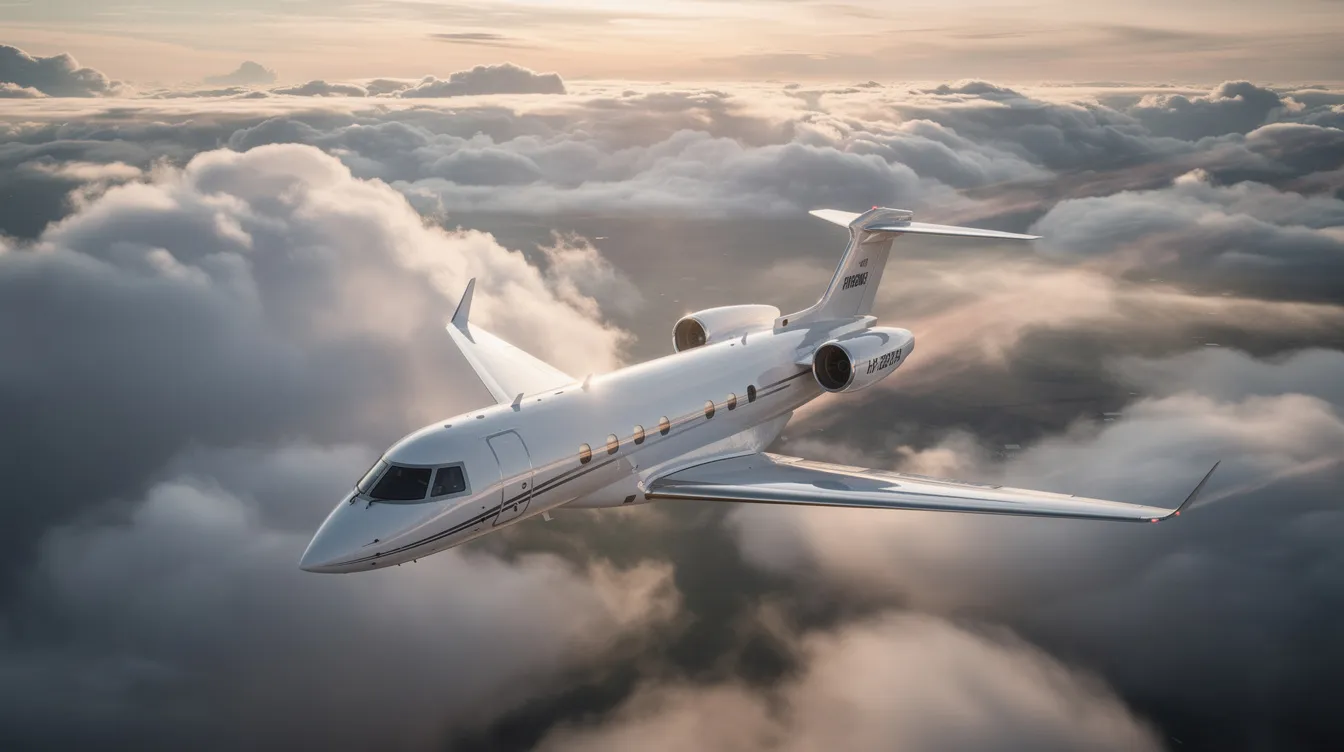
Strategic Investment in Ultra-Long-Range Excellence
This guide is for prospective buyers, corporate flight departments, and aviation professionals evaluating the Gulfstream G700’s total cost of ownership. Understanding the G700’s price and cost structure is essential for making informed decisions in business aviation, ensuring that investments align with operational needs, financial goals, and long-term value.
The Gulfstream G700 is an ultra-long-range business jet with a factory list price of $79 million as of Q2 2025. Dealer ask prices for delivery-ready aircraft reach $90,995,000, driven by backlog scarcity and delivery slots booked into mid-2028.
Total capital commitment for acquiring and operating a Gulfstream G700 often exceeds $100 million when factoring in customization, crew infrastructure, and multi-year operating budgets.
For high-net-worth individuals, Fortune 500 executives, multinational corporations, government and diplomatic teams, and charter or jet card operators weighing global lift options, that price only matters in relation to mission profile, flexibility, and long-term cost.
A commercial first-class ticket from New York to London runs $10,000 to $20,000 one-way.
A G700 charter covering the same 6- to 7-hour leg costs roughly $93,000 to $108,000 at estimated charter rates of approximately $15,500 per flight hour.
For executives flying 200+ hours annually across continents, the math shifts. A private jet eliminates layovers, security queues, and schedule dependency.
The Gulfstream G700 has a maximum range of 7,750 nautical miles, giving it the real-world reach to connect major world city pairs like New York to Hong Kong or London to Singapore nonstop. This places it firmly among the best long range private jets for sale.
The G700 received FAA certification in March 2024 and EASA approval shortly after. Gulfstream delivered the first aircraft in April 2024. By June 2026, the company had delivered the 100th G700, confirming both production stability and strong market demand.
Why the G700 Price Delivers Unmatched Value in Business Aviation
Ultra-Long Range Capability
The G700's maximum range of 7,750 nautical miles eliminates fuel stops on intercontinental routes like Los Angeles to Tokyo or São Paulo to Geneva.
At Mach 0.85, the G700's range is 6,650 nautical miles; its normal range is 7,365 nautical miles.
Fewer stops mean lower landing fees, reduced crew duty hours, and faster door-to-door travel.
Speed That Converts to Productive Hours
The G700 can cruise at a maximum speed of Mach 0.935, the highest maximum operating Mach number among Gulfstream jets.
On a transatlantic crossing, that speed advantage translates to arriving 30 to 45 minutes earlier per leg compared to aircraft cruising at Mach 0.85.
Over 200 annual flights, those minutes compound into days recovered.
Cabin Superiority Built for Work and Rest
The aircraft offers up to five living areas across 2,603 cubic feet of cabin volume.
That spacious interior seats up to 19 passengers and sleeps up to 13.
The cabin altitude is 2,916 feet at 41,000 feet, reducing fatigue on long-range flights.
The G700 features 20 panoramic oval windows, the largest in business aviation, flooding the cabin with natural light.
A shower option and bespoke interior layouts make this all new jet a mobile office and residence, a delivery milestone that also signals strong confidence across the broader business aviation industry.
Engine Efficiency
Powered by two Rolls-Royce Pearl 700 engines, the G700 delivers improved fuel efficiency compared to prior-generation Gulfstream models.
The Rolls-Royce Pearl 700 engines produce lower emissions per nautical mile, aligning with corporate sustainability goals.
Resale Protection
As of August 2026, near-zero pre-owned G700s appear in public listing databases.
The few dealer-direct units available command $84 million to $91 million.
Gulfstream's market leadership and delivery backlog keep residual values firm.
What Separates G700 Pricing From Competitors
The ultra-long-range business jet segment includes three primary competitors. Each occupies a different position on the price-performance spectrum.
The Bombardier Global 7500 lists near $78 million, offering comparable range but a different cabin layout and fewer delivered units. The Dassault Falcon 10X is announced at approximately $75 million but remains uncertified, with entry into service expected around 2029. The Gulfstream G800 sits in the same $80 million to $85 million range but trades cabin length for extended range (roughly 8,200 nautical miles).
What separates the G700 from each:
Certified Performance – The G700 holds both FAA and EASA type certificates earned in 2024. The Falcon 10X, by contrast, has not completed its certification process. Buyers who need a proven, delivered aircraft today have fewer options than they might expect. The G700 is one of them.
Fleet Maturity – By May 2025, the G700 fleet had accumulated over 11,700 flight hours. With 100 aircraft delivered by mid-2026, maintenance patterns, parts availability, and operational reliability data are now well-established through real-world operation. That operational track record matters for charter and jet card operators managing fleet uptime.
Cabin Size and Customization – The G700 underlines the importance of customization in the private jet market. Five living areas, cabin height of 6 feet 3 inches, and width of 8 feet 2 inches create a workspace and rest environment that the Global 7500's cabin cannot replicate at the same dimensions. The Gulfstream Symmetry Flight Deck adds advanced avionics and safety features that reduce pilot workload on long-haul operations.
Carbon-Neutral Operations – Gulfstream's sustainability initiatives, combined with the Pearl 700's efficiency improvements, position the G700 favorably against corporate ESG requirements. For companies reporting Scope 3 emissions, the aircraft's fuel burn per nautical mile is lower than previous-generation models in this class.
Understanding G700 Total Cost Structure and Cabin Volume
Owners should anticipate both fixed and variable costs in aircraft ownership. The annual operating cost for the G700 is $3,799,259 at typical utilization rates. Ownership costs for the G700 can reach multi-million dollars annually depending on usage.
Acquisition Phase
The Gulfstream G700 is priced at $79 million at factory list.
Dealer ask prices for near-term delivery positions reach $90,995,000.
Interior completion adds $2.5 million to $4 million depending on materials, bespoke furnishings, and entertainment systems.
Pre-delivery costs (registration, inspections, initial positioning) add $500,000 to $1 million.
Factors influencing private jet costs include customization, age, and avionics configuration.
Annual Fixed Costs
Crew salaries (two pilots, minimum), recurrent training, hangar fees, insurance, and management run $1.5 million to $2.5 million per year.
These costs remain constant whether the aircraft flies 50 hours or 400.
Hourly Variable Costs
Variable operating costs land between $6,500 and $7,500 per flight hour.
The breakdown: fuel at $2,600 to $3,000 per hour, engine program reserves and airframe maintenance at $2,000 to $2,500 per hour, and trip-dependent fees (landing, handling, navigation) covering the remainder.
Depreciation
Ultra-long-range jets in this class typically depreciate 8% to 12% annually.
Market dynamics, delivery timing, and aircraft condition can impact pricing.
The G700's depreciation curve has been flatter than average; delivery backlog and near-zero pre-owned inventory help examples sell strongly and buoy resale values.
Buyers financing $80 million+ should model 10% annual depreciation as a baseline.
The Gulfstream G700 has a basic operating weight of 25,748 kg, with a maximum payload of 2,715 kg. Maximum payload with full fuel is 832 kg, a constraint worth modeling on the longest routes where passenger and baggage load must be balanced against fuel.
Detailed G700 Pricing Breakdown
Here’s a quick reference table for the G700’s major cost categories:
Cost Category | Amount |
|---|
Base Aircraft Price (2026) | $79,000,000 (factory list); up to $90,995,000 (dealer ask) |
Interior Completion | $2,500,000 to $4,000,000 |
Pre-Delivery Costs | $500,000 to $1,000,000 |
Annual Fixed Costs | $1,500,000 to $2,500,000 |
Variable Cost per Hour | $6,500 to $7,500 |
Annual Operating Cost | $3,799,259 |
200-Hour Annual Budget | $2,000,000 to $3,000,000 (operating only) |
400-Hour Annual Budget | $3,300,000 to $3,800,000 (operating only) |
At 400 hours annually and a variable rate of $6,600 per hour, the cost per nautical mile drops to approximately $0.85.
Higher utilization spreads fixed costs across more hours, improving per-mile economics.
Because few aircraft come up for sale, dealer ask pricing often sets expectations for buyers seeking near-term availability.
For those evaluating private jet ownership cost more broadly, the G700 sits at the upper end of annual budgets but delivers proportionally more range, cabin space, and speed than mid-size or super-mid-size alternatives.
Financing
Aircraft finance typically requires 10% to 20% down with amortization over 7 to 15 years.
Interest rates depend on buyer creditworthiness and prevailing market conditions.
New G700 delivery slots are booked into mid-2028; buyers seeking earlier delivery pay premiums on the secondary market or through dealer inventory.
Who Benefits Most from G700 Investment
Fortune 500 Executives flying 200+ hours annually across global operations. A CEO traveling New York to London, then London to Dubai, then Dubai to Singapore in a single week saves 8 to 12 hours versus commercial connections on each leg. The G700's five living areas equipped with full office infrastructure turn transit time into productive time.
Multi-National Corporation Fleets needing certified ultra-long-range capability for board-level travel. The aircraft's proven reliability (100 delivered, 11,700+ fleet hours) reduces scheduling risk. Companies can manage compliance, safety, and sustainability reporting with a new Gulfstream equipped with current-generation avionics and the Symmetry Flight Deck. Qatar Executive is an early high-visibility operator example.
High-Net-Worth Families combining business and leisure across continents. The cabin size accommodates families with staff; sleeping arrangements for up to 13 passengers make overnight transpacific flights practical rather than punishing.
Government and Diplomatic Services requiring secure, long-range transportation. The G700's cabin can be configured with secure communications, and its range covers most global city pairs nonstop.
Charter and Jet Card Operators offering premium service to customers who demand the latest aircraft. High utilization (300+ hours annually) spreads the G700's fixed costs and generates strong per-hour economics for operators capable of maintaining consistent demand.
Frequently Asked Questions
How does G700 pricing compare to jet card programs?
A 25-hour jet card provides G700-class access without the $79 million+ capital commitment. For travelers flying 25 to 100 hours annually, jet card programs eliminate depreciation risk, crew management, and hangar logistics. Annual jet card spend for G700-tier access typically runs $2 million to $4 million, comparable to the yearly operating cost of owning the aircraft but without the capital outlay.
What financing options exist for G700 purchase?
Lenders typically require 10% to 20% down with terms spanning 7 to 15 years. Qualified buyers with strong balance sheets can negotiate favorable rates. Delivery wait times (currently extending to mid-2028) mean financing commitments often begin well before the aircraft arrives.
How quickly does the G700 depreciate?
Ultra-long-range jets depreciate 8% to 12% annually under typical market conditions. The G700's near-zero pre-owned inventory and strong backlog have compressed depreciation rates below historical averages for this class. Buyers should still model 10% per year for conservative financial planning.
Are there additional costs beyond the list price?
Pre-delivery inspections, registration fees, initial positioning flights, and import duties (where applicable) add $500,000 to $1 million. Interior customization runs $2.5 million to $4 million. Total all-in acquisition cost for a fully equipped, delivery-ready G700 ranges from $82 million to $95 million.
How does the G700 compare to older Gulfstream models on operating economics?
The Rolls-Royce Pearl 700 engines deliver lower fuel burn per nautical mile than the engines powering the G650 and G550. Maintenance intervals are longer on the G700 due to newer airframe and systems technology. Combined, these improvements reduce per-hour variable costs by $500 to $1,000 compared to previous-generation Gulfstream jets of similar size.
Explore Premium Jet Access Without Ownership
For travelers who fly 25 to 100 hours annually, owning a G700 concentrates $80 million+ in a single asset while generating $2 million to $4 million in annual operating costs. A jet card program provides access to ultra-long-range aircraft like the G700 with fixed hourly rates, no depreciation exposure, and no crew management burden.
BlackJet's membership offers 24/7 digital booking, carbon-neutral flights, and access to the world's premier fleet of business aviation aircraft. Flexible 25-hour and 50-hour programs let members fly on G700-class jets at a fraction of the ownership commitment.


 Sign up with google
 Sign up with Apple