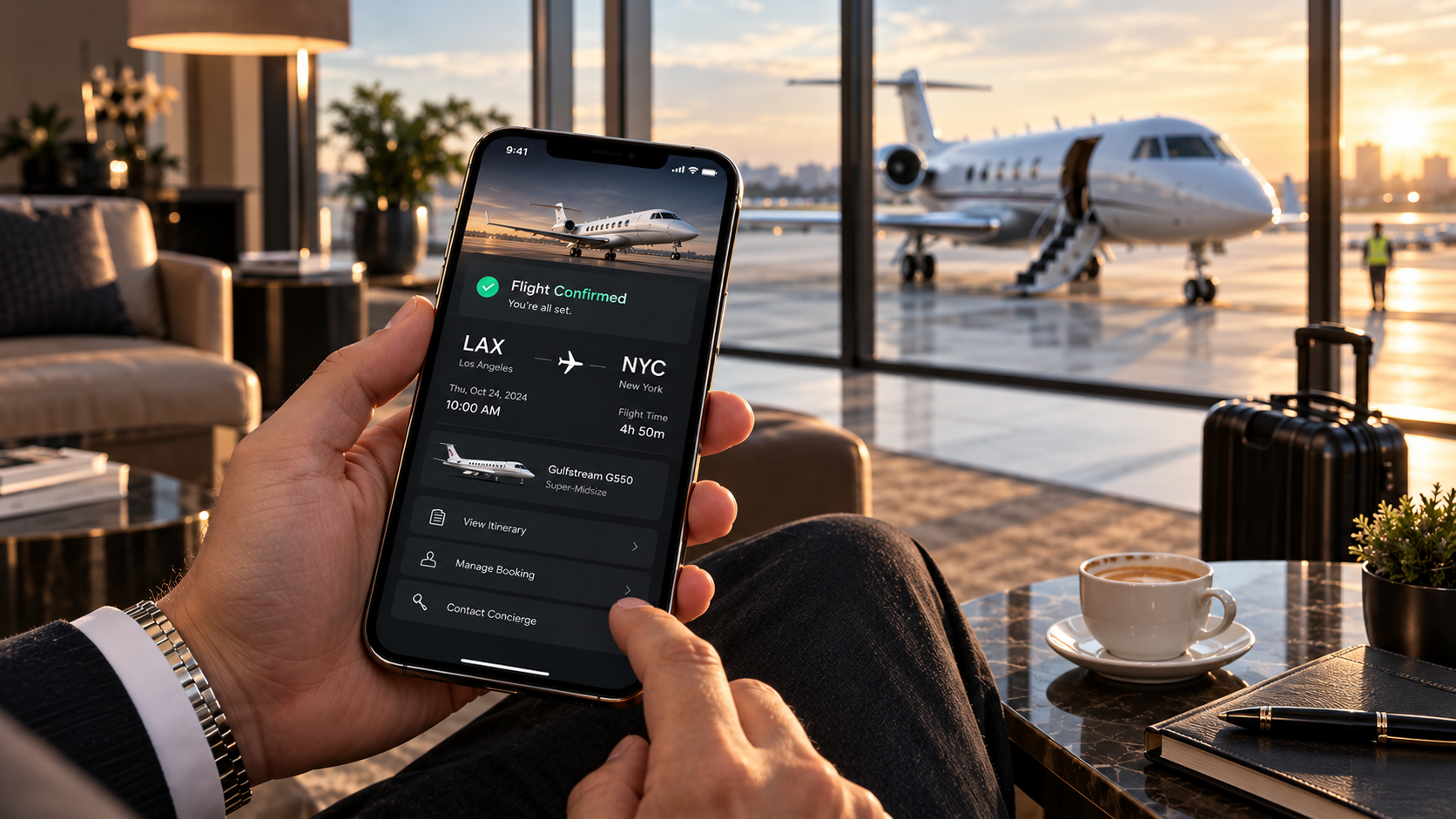
"Guaranteed availability" is the phrase that sells private jet cards. It also causes most of the arguments. The distance between what buyers assume and what a contract actually promises is exactly where trips fall apart on Thanksgiving week or a big race weekend. This guide breaks down what a guaranteed availability jet card really covers in 2026, how booking lead times work, and how to plan around peak demand without paying for surprises you never agreed to.
The Short Answer for 2026
On a jet card, guaranteed availability means the provider commits to supplying an aircraft that meets your contracted terms if you book within the required notice window and within the program's service area, usually for an aircraft category, not a specific tail number or exact model. In practice, a jet card lets travelers buy a specific number of flight hours in advance from one provider.
Guaranteed availability is contractual and conditional. Most Jet Card Programs start at 25 hours and work as a prepaid block of time. Three levers control it: your call-out window, how the program handles peak days, and the boundaries of your service area. Weaken one and you weaken the promise. That structure gives buyers a predictable middle ground between ad-hoc charter and Fractional Ownership.
Most programs guarantee category access (Light, Midsize, Super-Midsize, or Large Cabin) rather than a named model. Weather, crew duty limits, maintenance, and airport constraints can force a swap, so the contract defines what counts as "equivalent."
Call-out window is the minimum advance notice you must give to activate guaranteed availability under your jet card contract.
Guaranteed: an aircraft in your contracted category, booked inside the notice window, within the service area.
Not guaranteed: a specific tail number, an exact departure minute, or nonstop routing unless the contract says so.
Conditional: peak-day pricing and notice, which frequently differ from standard days.
If you can't point to the call-out window and the peak-day rule in writing, you don't have guaranteed availability, you have marketing. For a plain-language primer, BlackJet publishes a short explainer on guaranteed availability meaning, and this page goes deeper on the contract mechanics.
What's Guaranteed Versus What People Assume
Most disputes happen because buyers think "guaranteed" includes things the contract never promised. Vague "24/7/365 guaranteed access" language sounds airtight until a holiday morning proves otherwise. The fix is to translate the marketing into a table you can audit before you pay a deposit, including whether Jet Card Pricing is quoted all-in or plus-FET. If you are still learning the product itself, start with what is a jet card, then come back to the fine print.
Equivalent aircraft means an aircraft that meets the contract's required category and performance or cabin standards, even if it is a different make or model. That single definition decides your cabin size, baggage room, range, and Wi-Fi on a substitution day.
Watch the difference between "or better" and "or equivalent." "Or better" points to an upgrade. "Or equivalent" points to a lateral substitution.
Table 1. The guaranteed availability truth table
What may be guaranteed | Common limitation | Contract wording to look for | Question to ask the provider |
|---|
Notice window | Shorter notice is best efforts, not guaranteed | "Guaranteed with X hours' notice" | What is my exact call-out window in hours? |
Peak days | Different notice or price applies | "Peak-day list" and "peak-day surcharge" | How many peak days per year, and where is the list? |
Aircraft category | Model within the category can vary | "Category access" and "equivalent aircraft" | What aircraft types sit inside my category? |
Aircraft model | Rarely guaranteed by tail or model | "Or equivalent" vs "or better" | Can I guarantee a specific type, and at what cost? |
Service area | Guarantee stops at a boundary | "Primary service area" and "extended area" | Where does my guaranteed zone end? |
Repositioning or ferry costs | May be billed outside the hourly rate | "No repositioning fees on standard bookings" | When do ferry charges apply to me? |
Deicing | Usually a pass-through charge | "Deicing billed at cost" | Is deicing inside or outside my rate? |
Fuel treatment | Surcharge may sit on top of the rate | "Fuel surcharge included" or "excluded," plus-FET, and additional fees | Is fuel folded into my hourly rate, and if pricing is plus-FET, is the 7.5% tax added on top of the base rate? |
Recovery aircraft | Backup terms and price can change | "Recovery aircraft" and "recovery price" | What price applies if you source a backup? |
Cancellations | Windows and penalties vary by date | "Cancellation window" and "peak-day penalty" | What is my free-cancel window on peak days? |
Guaranteed availability usually means a seat in a category on a timeline, not the exact jet you want at the exact minute you want it. Read the table across each row and you will see where the loopholes hide, because contract terms, not slogans, determine whether extra charges sit outside the quoted rate.
Booking Lead Times and How Call-Out Windows Work
Lead time is not just how early you call. It is how your contract defines a confirmed request and what changes restart the clock. Get that wrong on a busy weekend and a "guarantee" quietly becomes best efforts.
Booking lead time is the advance notice between your confirmed request and scheduled departure that your program requires to guarantee an aircraft. Standard days, peak days, and blackout dates each run on different rules, and treating them as one thing is how travelers get caught out.
When does the clock start?
The clock typically starts when the provider accepts your full request under contracted terms: route, passenger count, departure time window, an agreed quote, and any deposit or hour authorization. A casual "hold this date" text is not the same as a confirmed booking.
Do changes reset the clock?
Often yes. Common reset events include changing airports, moving the departure time, adding a leg, or switching aircraft category. Each change can send your request to the back of the queue at the current day's availability.
What counts as confirmed?
Confirmed means the provider has accepted the trip in writing at the contracted rate and category, with the cancellation policy attached. Ask for that confirmation in the app or by email, and keep it. Structuring the request cleanly the first time avoids resets, which BlackJet covers in its flight booking guide.
Table 2. Lead-time examples (illustrative, not universal, terms vary by contract)
Program type | Standard-day notice (as publicly stated) | Peak-day handling | Notes to verify in your contract |
|---|
Operator-affiliated programs | As little as 2 hours on some published programs | Confirm peak-day rules and any recovery pricing | Get the peak-day policy in writing |
Large fractional programs | As little as 48 hours on some published programs | Guaranteed with defined peak-day terms | Request the peak-day calendar and count |
BlackJet | Instant requests via app or text | States guaranteed availability during peak demand; no repositioning fees on standard bookings | Confirm your written call-out window and peak-day treatment |
Other national programs | Published program terms vary | Peak-day rules differ by product tier | Ask for the exact guaranteed notice in hours |
Treat the call-out window like a deadline. Once you cross it, you are no longer buying a guarantee, you are buying best efforts. Industry booking windows commonly run from roughly 24 hours to 72 hours or longer during busy stretches, so build your plan around the guaranteed number, not the optimistic one.
Peak Days, Holidays, and Major Events
Peak days are where guarantees get expensive or get quietly redefined. Demand spikes around predictable windows, and that is when programs lean on their fine print.
Peak days and blackout dates are not the same thing. On a peak day you can usually still fly, just under different terms. On a blackout date you cannot use your contracted terms, and sometimes cannot fly under that program at all. Your agreement should spell out both.
Peak-day surcharge is an additional fee or higher rate applied on designated high-demand dates, even when availability is still guaranteed. Programs typically manage peak demand with three tools: a longer call-out window, a peak-day surcharge, and limited availability in certain categories or types. During high demand periods, those added charges can raise trip costs by roughly 5% to 40%, depending on the program terms and date.
capacity is finite, and even the biggest names manage it. in the real world, guarantees only hold when a provider protects its own capacity. Market context on rising private jet demand explains why peak windows tighten first.
Table 3. Peak demand map for the United States (typical patterns; your provider publishes the actual list)
Window | Typical demand pressure | What usually changes |
|---|
Thanksgiving week | Very high | Longer notice, peak-day surcharge |
Late December to New Year's | Very high | Extended call-out window, tight large-cabin supply |
Spring break weeks (Feb to Apr) | High | Surcharges into leisure markets |
Major sports and event weekends | High, localized | Airport slot limits, repositioning |
Summer holiday peaks (July 4, Labor Day) | High | Peak-day pricing, longer notice |
In peak travel periods, "guaranteed" often means guaranteed under different rules, especially for notice time and pricing. Providers publish anywhere from about 20 to 60 peak or premium days per year, so ask for the exact count before you commit.
What the Guarantee Usually Does Not Cover
Two travelers both held "guaranteed availability." Only one got the trip expected. The difference was not luck. One reader had confirmed the exclusions in writing, the other assumed the brochure covered everything.
Guarantees rarely cover the exact model or tail, nonstop routing, a specific FBO, special cabin amenities, an exact departure minute, or pricing inclusions that were never written down, including excluded trip charges such as Fuel Surcharges of about $300 to $1,000+ per Flight Hour tied to billable flight time. Substitutions happen for practical reasons: maintenance, crew legality, weather, airport curfews, and runway performance limits.
Best efforts means the provider will try to source an aircraft, but you are not contractually entitled to one under the same terms if demand or capacity shifts. That is the quiet risk behind a strong-sounding promise. Recovery aircraft language matters here. Lock the terms before the clock starts by getting an accurate jet quote in writing.
Not covered unless written into your agreement:
A specific aircraft make, model, or tail number
Nonstop routing on longer trips
A named FBO at either end
Guaranteed onboard Wi-Fi, bedding, or catering
An exact departure minute rather than a time window
Deicing, international handling, and airport fees inside the rate; de-icing alone can run about $1,500 to $8,000+ per flight
Overnight crew charges, commonly passed through at about $500 to $1,500 per crew member
Recovery aircraft at your original price
Repositioning at no cost on nonstandard bookings
The biggest hidden risk in private jet charter is not "no aircraft." It is "aircraft available, but not under the terms you budgeted for." That gap between headline rate and all-in cost is where fixed hourly rates either protect you or fail you.
Aircraft Categories, Range, and Fleet Depth
Availability is not only a provider problem. It is often a category choice problem. The bigger and rarer the jet, the thinner peak-day supply tends to be, so mission fit and guarantee realism are linked. Aircraft type and aircraft size both affect availability and cost, and across the market jet card hourly rates can run from about $3,000 to $17,000+.
Four categories cover most missions across a diverse fleet. Light jets suit short hops. Midsize jets add range and baggage. Super-midsize jets handle transcontinental legs. Large cabin jets carry bigger groups on the longest routes.
Interchange is the ability to book a different aircraft category than your base card category under a defined pricing rule, either an upgrade or a downgrade. BlackJet offers 25-hour and 50-hour Jet Cards with access to Light, Mid, Super-Mid, and Large Cabin jets, lists example aircraft inside each BlackJet Certified category, and lets cardholders switch jet sizes at stable, fixed rates across its fleet of aircraft.
Table 4. Category fit and what to verify (BlackJet examples from published program materials)
Category | Typical passengers | Typical mission | What to verify for availability | BlackJet example aircraft |
|---|
Light | Up to 7 | Short hops (New York to Atlanta) | Category supply on peak days; often about $5,000 to $7,500 per hour | Phenom 300, Citation CJ3+, HondaJet, Learjet 75 |
Midsize | Up to 8 | Longer domestic (Austin to New York) | Baggage and range on a substitution | Citation XLS+, Hawker 800XP, Praetor 500 |
Super-Midsize | Up to 8 | Transcontinental (Los Angeles to Boston) | Nonstop capability on your route | Challenger 350, Citation Longitude, Gulfstream G280 |
Large Cabin | Up to 12 | Group and international (New York to London) | Peak-day supply and lead time; heavy-jet-style programs generally exceed $11,000 per hour and can reach $17,000 | Gulfstream G650, Global 7500, Falcon 8X |
Choose the smallest category that reliably fits your typical mission, because the bigger the jet, the tighter peak-day supply tends to be. Readers weighing card size and category for predictable access to private jets can review the BlackJet 50 Jet Card for how aircraft category flexibility is priced. This kind of jet card program design is what makes a guarantee usable rather than theoretical.
Jet Card Pricing Reality Check for Fixed Rates and All-In Cost
The fastest way to get burned is to compare jet cards by hourly rate alone. A low headline rate with fuel and tax stacked on top can cost more than a higher rate that already includes them.
Some customers also face minimum deposits or membership fees beyond the hourly rate.
Three pricing models dominate. All-in or inclusive rates fold most costs into one number. Fixed base plus pass-throughs quote a rate and add fuel, taxes, and fees separately. Dynamic or market-based charter reprices every trip. Jet card options also differ by deposit size and membership fees. Each can be fair; only one is easy to budget.
All-in cost is the total you pay for a trip after taxes and any surcharges or pass-through fees, not the advertised hourly rate. Fuel treatment is the usual culprit. Fuel handling is a live contract variable worth pinning down before you fund anything.
BlackJet publishes base hourly rates that are inclusive of fuel surcharge and Federal Excise Tax on listed cards. The BlackJet 25 Light Jet Card is $50,000 for 25 hours at a base hourly rate of $5,484, fuel surcharge and Federal Excise Tax included. The BlackJet 50 rates run $8,038 per hour Mid, $10,384 Super-Mid, and $13,131 Large Cabin, each inclusive of fuel surcharge and Federal Excise Tax. Those 50-hour hourly rates are guaranteed fixed for 12 months, and Jet Card hours never expire.
For context, a 25-hour light-jet card often costs about $125,000 to $175,000, while 50-hour heavy-jet cards can run roughly $300,000 to $750,000.
Many programs require minimum deposits around $100,000 to $250,000, with heavy-jet programs often starting near $500,000, and some also charge a $10,000 to $25,000 membership fee.
Table 5. Inclusions matrix (general patterns; confirm your own contract)
Cost item | Always included | Sometimes included | Usually pass-through | Must confirm in writing |
|---|
Fuel surcharge | | Yes (BlackJet includes on listed cards) | Yes on many programs | Yes |
Federal Excise Tax | | Yes (BlackJet includes on listed cards) | Often added | Yes |
Deicing | | | Yes | Yes |
Wi-Fi | Yes (BlackJet complimentary) | Yes | | Yes |
Catering | | Basic only | Yes for special orders | Yes |
Repositioning | | Standard bookings on some programs | Yes on nonstandard trips | Yes |
Peak-day surcharge | | | Yes on peak days | Yes |
Illustrative all-in calculation
Assumptions reviewed on 2026-09-21. Hypothetical figures for education only.
Hypothetical midsize program, headline rate $6,900 per hour, fuel and tax not included
Occupied time: 3.0 hours
Fuel surcharge: $400 per hour (illustrative)
Federal Excise Tax: 7.5% where applicable
Winter deicing: $600 (illustrative)
Base: 3.0 × $6,900 = $20,700. Fuel: 3.0 × $400 = $1,200. Subtotal: $21,900. Federal Excise Tax at 7.5% = $1,642.50. Deicing = $600. All-in ≈ $24,142.50, about $8,047 per hour.
The "cheap" $6,900 headline lands near $8,047 all-in. Compare that with BlackJet's published Mid rate of $8,038 per hour that already folds in fuel surcharge and Federal Excise Tax, so the number you see is close to the number you pay before trip-specific items like deicing.
A fixed hourly rate only protects your budget if the contract clearly states what is included, especially fuel treatment and taxes. For how tax lines should appear on invoices for clean budgeting, BlackJet's tax and FET guide covers the details. Fees that can still sit outside a fixed rate include deicing, international handling, special catering, and ground transportation, and those vary by provider and trip.
Jet Card Versus On-Demand Charter Versus Fractional Ownership
Guaranteed availability has value only when scarcity is real, either because you fly often, you fly on peak days, or both. Jet cards are often best for frequent travelers flying roughly 25 to 100 hours per year. Match the product to the pattern, not the pitch.
On-demand charter is pay-per-trip private aviation priced and sourced for each flight, without a guaranteed call-out window. It gives you the widest aircraft choice, but pricing and availability move trip by trip, often on a per-flight basis. A jet card trades some of that flexibility for contractual guardrails: defined booking lead times, category access, set cancellation rules, and reduced exposure to fluctuating charter prices.
Fractional ownership is a longer commitment with management fees and ownership economics, plus its own access rights. It suits very high annual usage more than occasional travel, while jet cards avoid the long term commitment, capital outlay, and management fees associated with owning a share of an aircraft. The full trade-offs are laid out in this fractional ownership breakdown.
A hybrid approach works for many flyers. Use on-demand charter for flexible off-peak trips, and lean on a jet card for peak days when you need the guarantee. That way you shop when time is on your side and lock terms when it is not.
Table 6. Model comparison
Factor | Jet card | On-demand charter | Fractional ownership |
|---|
Price predictability | High (fixed hourly rates) | Low (market pricing) | Medium (fees plus occupied rate) |
Peak-day reliability | High with contracted terms | Variable | High but capital-heavy |
Aircraft choice | By category | Widest per trip | Tied to owned type |
Commitment | Low to medium | None | High (multi-year) |
Best for | Predictable access buyers | Flexible, occasional trips | Very frequent flyers |
If you fly during peak travel periods, a jet card's guarantee can be less about luxury and more about risk management. That is the honest case for private jet card programs over shopping every leg.
Peak-Demand Planning Playbook for 2026
The goal is not just getting a jet. It is getting a jet under your contracted terms. This is the peak demand planning routine to run for holidays and major events.
Confirmation milestone is the point at which the provider accepts your trip under the contracted terms: rate, category, notice, and cancellation policy. Everything below is built to reach that milestone before capacity tightens.
Lock your dates as early as your program allows, ahead of the peak window.
Book the moment the booking window opens for your date, not the night before.
Keep flexibility in your departure time to widen the pool of legal crews and aircraft.
Line up alternate airports within reasonable driving distance.
Pre-approve a category upgrade in writing so a swap does not stall your trip.
Confirm the deicing policy and who pays, before winter travel.
Confirm the cancellation window and any peak-day penalty in advance.
Establish escalation contacts and use fast channels like the app or text.
Backup ladder when your first choice is tight:
Shift the time window by a few hours.
Move to an alternate airport.
Upgrade the category at a pre-agreed price.
Accept a repositioned aircraft with disclosed costs.
Fall back to on-demand charter as a last resort.
Do not reset the clock: provide passenger names early, keep the itinerary stable, and avoid last-minute airport swaps unless truly needed. Every change can send your confirmed request back to current availability.
Table 7. Peak booking timeline
Marker | Action |
|---|
T-30 days | Confirm dates, category, passenger count, budget |
T-14 days | Submit request, get written confirmation of terms |
T-7 days | Finalize passenger names and ground transport |
T-72 hours | Reconfirm aircraft category and any peak-day surcharge |
T-48 hours | Cross most standard call-out windows; lock details |
T-24 hours | Check weather, deicing plan, and FBO details |
T-2 hours | Confirm crew, tail, and departure; short-notice zone |
Peak-demand success comes from planning around constraints: notice time, category supply, and the provider's peak-day rules. Repeat travelers on the same routes should also track jet card hours so they do not run short mid-season. Your contract governs the guarantee, and publicly advertised booking lead times from other programs are only reference points.
How BlackJet Supports Predictable Availability
A credible guarantee is a combination of contract terms, sourcing depth, and operational discipline. BlackJet is built for that kind of predictability, and the claims below come straight from published program materials.
BlackJet offers 25-hour and 50-hour Jet Cards across Light, Mid, Super-Mid, and Large Cabin categories. Pricing is designed to be readable: base hourly rates on listed cards include fuel surcharge and Federal Excise Tax, 50-hour hourly rates are guaranteed fixed for 12 months, and hours never expire. Cardholders can switch jet sizes at stable, fixed rates, and Wi-Fi is complimentary at all times.
Booking runs through a mobile app on iOS and Android for instant requests, with booking by text and a Card Owner web platform as alternatives. Support is available 24/7, with live chat in the app. Round-trip flights can earn up to 15% efficiency discounts on eligible itineraries.
BlackJet Certified is BlackJet's proprietary vetting process that individually certifies the operator, aircraft, pilot, and flight before it is offered to cardholders. Pilots must meet standards that exceed FAR Part 135 requirements, and BlackJet coordinates with certified FAA Part 135 operators in the US and EASA operators in Europe, vetting for ARGUS, Wyvern, or IS-BAO certification. The company states that fewer than 30% of the more than 575 US charter operators pass the certification required to serve its clients.
The safety program draws on more than 10 years of proprietary data, including over 300 million data points on aircraft, pilots, airports, and operations. A Safety Advisory Board of former FAA and NTSB leaders works alongside Chief Safety Officer Jake Miller and a dedicated safety operations task force, and the app shows a pre-flight BlackJet Certified Safety Report once checks are complete. Since the beginning of 2021, every flight flown by BlackJet Jet Card Owners is offset to be carbon and emissions neutral at zero cost, with the sustainability program offsetting 300% of each flight's impact.
BlackJet is built for predictability: fixed rates with a 12-month lock on 50-hour cards, non-expiring hours, fuel-and-tax-inclusive published pricing on listed cards, and app-first booking with 24/7 support. In provider comparisons, some buyers also weigh deposit structure across programs, while Jettly-style programs are marketed with no mandatory long-term deposit. That matters if your travel needs prioritize flexibility in private jet travel rather than prepaying for personalized service. Choosing between blocks is easier once you review 25-hour card costs against your annual usage.
BlackJet verification checklist:
Get your call-out window stated in hours
Get the peak-day treatment and any surcharge in writing
Confirm your service area boundaries
Confirm the "equivalent aircraft" substitution policy
Confirm fuel surcharge and Federal Excise Tax are inside your rate
Confirm the cancellation window on peak days
Confirm no repositioning fees on standard bookings
Confirm how upgrades and downgrades are priced
Buyer Checklist Before You Fund Private Jet Cards
Ask these questions before you wire funds, because the answers decide whether "guaranteed" is real. Copy them into an email to any provider. For deeper cost terminology, BlackJet's guide to jet card pricing pairs well with this list.
Availability terms
What is my exact guaranteed call-out window in hours, and where is it written in the contract?
What counts as a confirmed booking versus a hold?
Which changes reset my booking lead times?
Peak days and blackouts
How many peak days per year, and can you send the current peak-day list?
Do you use blackout dates, peak-day rules, or both, and where is that in the agreement?
Aircraft substitutions
What does "equivalent aircraft" mean for cabin size, range, and Wi-Fi?
Point me to the contract clause that defines substitutions.
Pricing inclusions
Cancellations and changes
Service area and safety standards
Where does my guaranteed service area end?
What safety standards and operator certifications apply, and who holds operational control?
Billing and data security
Do you provide monthly statements with itemized flight logs and tax line items?
How is my personal and payment data protected, and can you point me to that policy page?
The best jet card buyers do not ask "Do you guarantee?" They ask "Under what conditions do you guarantee, and where is it written?" Compare availability windows, peak-day rules, and pricing transparency side by side.
Frequently Asked Questions
What does guaranteed availability mean on a jet card?
Guaranteed availability means your provider is contractually obligated to supply an aircraft that meets your program terms if you book within the required notice window and service area. In most programs that promise applies to an aircraft category, not a specific model, unless your agreement says otherwise.
How far in advance do I need to book?
It depends on your contract's call-out window, which can vary from a few hours to 48 hours on standard days, and longer on peak days. Published examples across the market range from as little as 2 hours' notice to 48 hours, so verify your own written terms before you rely on any of them.
Does guaranteed availability apply on holidays and peak travel days?
Often yes, but peak days usually come with different rules such as longer notice, surcharges, or a published peak-day calendar. Capacity constraints can even push providers to cap sales, so book as early as your program allows and get the peak-day policy in writing.
Are there blackout dates?
Some programs have blackout dates, while others use peak-day lists instead, and your agreement should define both. A blackout date means you cannot use your contracted terms, and a peak day usually means you can still fly under adjusted notice or pricing, so check both clauses in the contract.
Does guaranteed availability mean I can pick a specific aircraft model?
Usually no, most guarantees apply to an aircraft category, not a specific make or model, unless your contract explicitly says otherwise. Most major programs publish upgrade and downgrade language that shows how model and type rules are handled inside the agreement.
What fees can still apply even if availability is guaranteed?
Even with guaranteed availability, fees like deicing, international handling, or peak-day surcharges may apply unless your contract states they are included. Fuel is the most variable line item. A surcharge can swing the real cost, so confirm fuel handling before you compare hourly rates.
Is a jet card better than on-demand charter?
A jet card is typically better when you value predictable pricing and priority access during peak periods, while on-demand charter can be better when your schedule is flexible and you want trip-by-trip shopping. Many flyers run a hybrid: charter for off-peak trips and a jet card for peak days.
How do I choose the right jet size and number of hours?
Choose hours based on how often you fly each month, and choose category based on passengers, typical stage length, and baggage, then verify how upgrades, downgrades, and daily minimums are billed. Cards commonly sell in 25-hour or 50-hour blocks, and comparing 25-hour and 50-hour costs against your yearly usage points to the right fit.
The Bottom Line for 2026
Guaranteed availability is only as strong as the words in your contract. Pin down the call-out window, the peak-day rule, the service area, and the substitution policy, and you turn a marketing phrase into a real guarantee. Compare providers on all-in cost, not headline hourly rate, and plan peak trips around constraints rather than hope.
If guaranteed availability and predictable pricing are your priorities in 2026, ask BlackJet for a written summary of your call-out window, your peak-day treatment, and what is included in your rate, then choose the 25-hour or 50-hour card category that fits your typical mission. Book instantly in the app, by text, or through the Card Owner web platform, with 24/7 support behind you. Call 1-866-321-JETS (1-866-321-5387) or email info@blackjet.com to get your terms in writing before you fund a card.


 Sign up with google
 Sign up with Apple