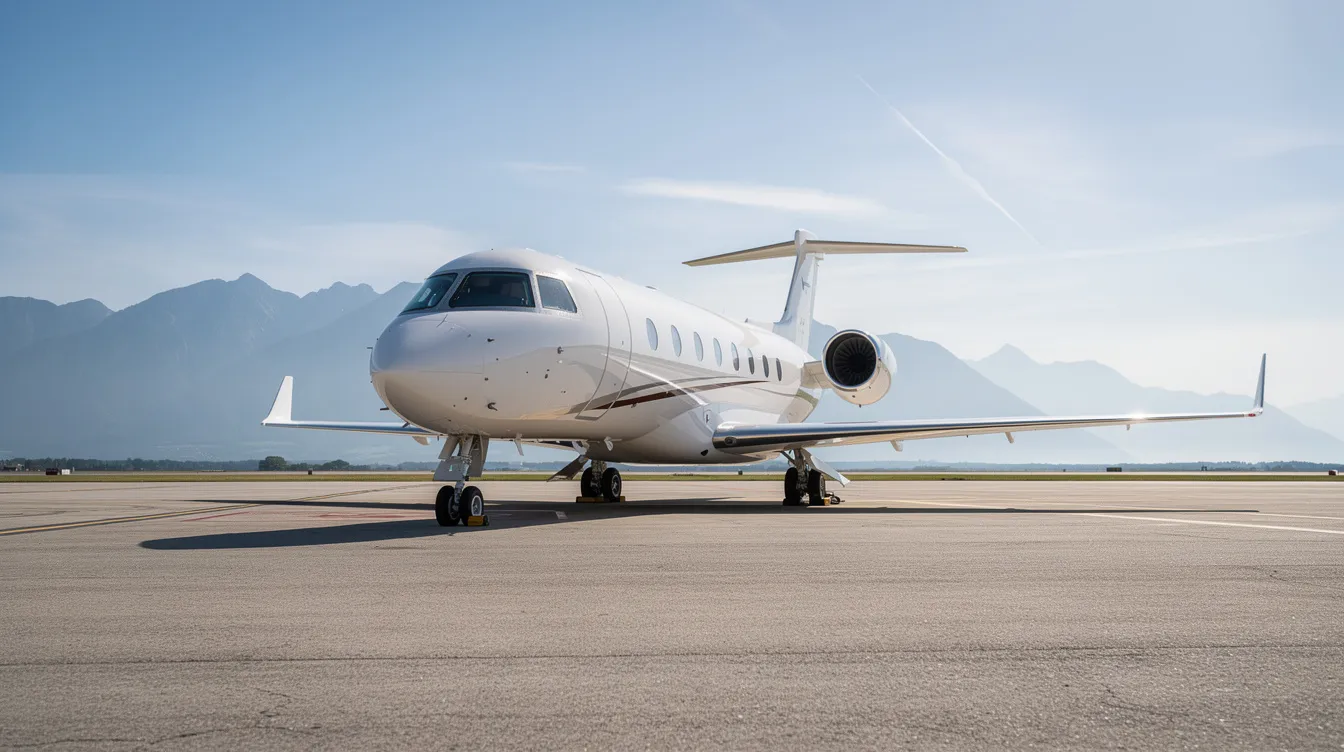
Private aviation is not merely a luxury - it is a strategic advantage. For executives and high-net-worth leisure travelers who need flexible, private, and efficient travel without the burden of aircraft ownership, the Flexjet Challenger 300 is a super midsize private jet built for serious nonstop flying, combining coast-to-coast range, speed, reliability, and a cabin that doubles as an airborne boardroom in a way commercial service simply cannot match.
What makes that combination worth understanding is not just the aircraft itself, but how it fits into smarter private travel decisions. This guide examines the Flexjet Challenger 300’s performance, cabin design, fleet role, operating economics, safety profile, environmental considerations, and how it compares with related Challenger models, including what Jet Card access means for travelers who want luxury, flexibility, and cost control from private aviation.
Strategic Advantages of Flying on a Flexjet Challenger 300
The Bombardier Challenger 300 and its successors - the Challenger 350 and Challenger 3500 - developed the super midsize aircraft category into what it is today. Here is why this class of business jet continues to change the way serious travelers move:
A New York to Los Angeles flight on a Challenger 300 takes roughly five hours nonstop, supporting high-speed cruising at approximately 470 knots. Compare that to commercial first class with connections, which can consume six to eight hours door-to-door - before accounting for security lines, delays, and ground transfers.
Flexibility in scheduling and airport access enhances travel efficiency for business travelers. The design of the Challenger 300 allows for short-field capabilities, accessing smaller airports that are often closer to your final destination.
The aircraft is well-suited for regional or international travel routes of 1,000 to 2,500 nautical miles, making it ideal for coast-to-coast or North America–Caribbean missions.
Flexjet held the distinction of being the launch customer for the Bombardier Challenger 300 when it entered commercial service on January 8, 2004 - an announcement that shaped the aircraft's prominence in fractional ownership and premium charter worldwide.
At BlackJet, we frequently source Challenger 300, Challenger 350, and comparable super midsize aircraft for Jet Card members who demand nonstop range and cabin comfort without the burdens of ownership.
Bombardier Challenger 300: Origins and Technical Profile
Specifications matter to private flyers because they determine whether a mission can be flown nonstop, whether the cabin can accommodate your team, and whether you can reach airports that commercial airlines cannot.
Bombardier Aerospace announced the aircraft (originally called the "Continental") at the 1999 Paris Air Show. Its maiden flight occurred on August 14, 2001, followed by Canadian type approval in May 2003 and FAA certification shortly after. The model was approved and delivered to Flexjet by early 2004.
Classified as a super midsize aircraft, the Challenger sits between traditional midsize jets and large-cabin, long-range types - providing the range needed for transcontinental flying at a lower operating cost.
Core specs: maximum range of approximately 3,100 nautical miles, max cruise speed near Mach 0.82, service ceiling of 45,000 ft, and twin Honeywell HTF7000 engines each producing roughly 6,800 lbf of thrust. The cockpit features auto throttles and the Rockwell Collins Pro Line 21 avionics suite as standard.
Takeoff distance is around 4,810 feet at maximum takeoff weight, and the supercritical wing design helps the aircraft climb efficiently and compete with larger models on fuel economy and runway performance.
Over 450 Challenger 300 jets have been delivered through the end of production in 2014. The line evolved into the Bombardier Challenger 350 - a range variant with upgraded engines - and later the Challenger 3500. The aircraft is designed for a maximum passenger capacity of 10.
Flexjet, Baker Aviation, and Fleet Strategy Around the Challenger 300
Flexjet, a company under the Directional Aviation umbrella, was the first commercial operator of the Challenger 300, and its fractional ownership model is based on the number of flight hours a customer needs; it later became a major operator of the Challenger 350.
Flexjet provides access to nearly 300 private jets in its fleet. The company announced plans to add 22 mid- and super midsized aircraft, including the environmentally friendly Bombardier Challenger 3500, as part of fleet modernization that includes advanced, sustainable aircraft.
As Flexjet transitions fractional aircraft owners into newer types like the Embraer Praetor 600 and Challenger 3500, select older Challenger 300s are transferred through a secondary-market sale as part of that modernization, keeping them productive in charter operations.
In a strategic partnership, Baker Aviation acquired 20 Challenger 300s in a sale from Flexjet. By mid-September, Baker's charter-focused fleet included 21 Citation X and multiple Challenger 300 aircraft, all operating under Part 135 with premium service standards.
For BlackJet and similar providers, these fleet transitions lift supply in the charter and jet card market, ensuring well-maintained Challenger 300/350 aircraft remain available at stable pricing.
Cabin Experience: Comfort, Capacity, and Amenities in the Challenger 300
The Challenger 300 is recognized for its blend of spaciousness and long-range capabilities at a super midsize price point. It provides a solid mix of comfort and cabin space for executive travel.
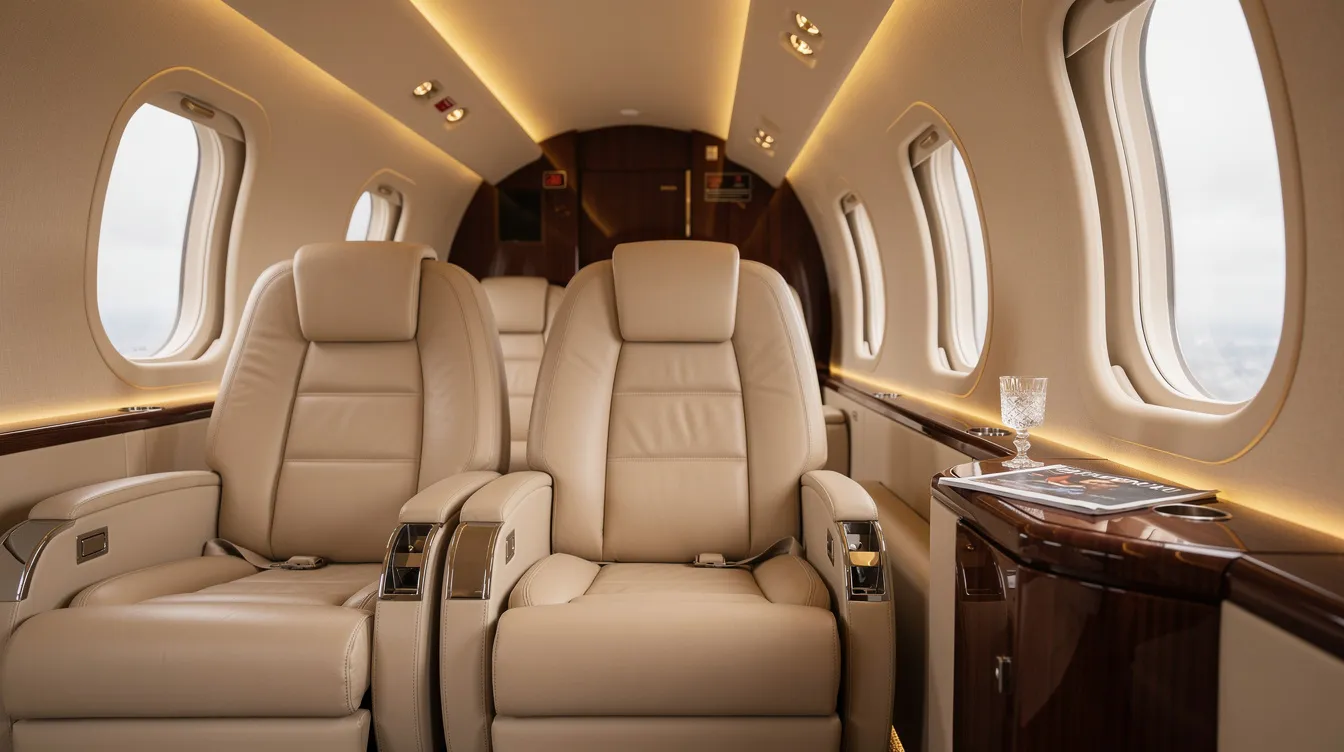
The typical cabin configuration accommodates 8 to 9 passengers in a double-club seating arrangement with an aft lavatory - certified as an extra seat in some configurations. The airplane serves as an effective airborne boardroom with its quiet, spacious cabin.
Cabin length stretches roughly 23 ft 7 in, width sits at about 7 ft 2 in, and the cabin height is 6 feet 1 inch, allowing stand-up movement for most passengers.
The aircraft has a baggage capacity of approximately 106 cubic feet - enough to carry multiple roller bags, golf clubs, or ski equipment for a family or executive team.
Amenities across the Challenger 300 and newer models include high-speed Wi-Fi, power outlets, and modern management systems and connectivity features. The cabin includes systems originally developed by Lufthansa Technik, with refurbished aircraft receiving upgrades in July and throughout each year to keep them current.
Compared to the original Challenger 300, the Challenger 350 and 3500 offer quieter cabins, redesigned seating, ground clutter suppression in weather radar, and improved connectivity - a meaningful change for productivity-focused travelers.
Performance, Operating Economics, and Safety Considerations
Performance and safety are non-negotiable for time-sensitive executives and families who demand reliability on every flight.
Nonstop capabilities include New York–Aspen, Chicago–San Jose, and Miami–Vancouver under typical passenger loads, though weather and runway length can stop or alter mission planning.
The Challenger 300 achieved a 99.79% dispatch reliability rate - meaning high dispatch reliability minimizes mechanical delays for corporate schedules. The Challenger 350 became the world's most delivered super midsized jet, with a range of 3,200 nautical miles and a maximum operating altitude of 45,000 feet. The Challenger 350 can carry up to nine passengers.
For aircraft owners, total annual operating costs run approximately $2.3M, with roughly $609K fixed and $1.69M variable. BlackJet members do not carry these costs - they pay predictable, fixed hourly Jet Card rates instead.
In 2022, the FAA ordered additional safety checks for the Challenger 300, including horizontal stabilizer inspections that received rigorous attention across the fleet. Reputable operators adhere to maintenance schedules, recurrent pilot training, and third-party auditing through ARGUS and IS-BAO.
While a super midsize jet carries a larger carbon footprint than smaller aircraft, BlackJet's carbon-neutral flights offset every Challenger 300 mission automatically - at no extra cost. Flexjet also offers carbon-neutral flights for its customers, providing climate-conscious travelers meaningful options across every page of today's private aviation market.
Frequently Asked Questions about the Flexjet Challenger 300
Q: When did the Bombardier Challenger 300 make its maiden flight?
A: The Challenger 300 made its maiden flight on August 14, 2001, before entering commercial service on January 8, 2004.
Q: What is the typical passenger capacity of the Challenger 300?
A: The aircraft typically accommodates 8 to 9 passengers, with a maximum capacity of 10.
Q: How does the Challenger 300 compare to the Challenger 350 and 3500?
A: The Challenger 350 offers improved range, upgraded engines, and modern avionics, while the 3500 adds advanced cabin amenities like taller windows, quieter cabins, and state-of-the-art technology.
Q: What safety certifications and checks are in place for the Challenger 300?
A: The Challenger 300 adheres to rigorous safety standards, including FAA mandates such as additional horizontal stabilizer inspections ordered in 2022, and operators maintain strict maintenance schedules and pilot training.
Q: Can I access the Challenger 300 through a Jet Card program?
A: Yes, BlackJet offers Jet Card programs that provide prepaid access to the Challenger 300 and other super midsize jets, with flexible scheduling, aircraft upgrades, and 24/7 digital booking and real-time support.
Q: What environmental initiatives are associated with flying the Challenger 300?
A: BlackJet offsets the carbon footprint of every Challenger 300 flight automatically at no extra cost, ensuring carbon-neutral private travel.
Q: What is the range and cruising speed of the Challenger 300?
A: The Challenger 300 has a maximum range of approximately 3,100 nautical miles and cruises at speeds near Mach 0.82 (around 470 knots).
Q: How does the Challenger 300 enhance travel convenience?
A: Its short-field capabilities allow access to smaller airports closer to final destinations, reducing total travel time compared to commercial flights.
Q: Who currently operates the Challenger 300 fleet?
A: Flexjet was the launch customer and major operator, though some Challenger 300s have been sold to operators like Baker Aviation, maintaining high standards of service and reliability.
Q: What cabin amenities can passengers expect on the Challenger 300?
A: Passengers enjoy spacious, quiet cabins with modern connectivity, power outlets, and ample baggage space, making it an effective airborne boardroom and comfortable travel environment.
Choosing Between Challenger 300, Challenger 350, and Challenger 3500 with BlackJet
The Bombardier Challenger family gives travelers a clear upgrade path without leaving the super midsize category. Each model builds on what came before.
The Challenger 350 - a range variant of the original - offers approximately 3,200 nautical miles of range, upgraded HTF7350 engines for better hot-and-high performance, and modern avionics. The Challenger 3500 pushes cabin amenities further with taller windows, refined interiors, and quieter sound insulation.
Flexjet and other operators migrated from the original Bombardier Challenger 300 to the 350 and 3500 to compete across the super midsize segment. This means both older and newer models remain in active demand across charter and fractional operations around the world.
Typical use cases for BlackJet clients: an executive team flying Boston–Dallas for quarterly meetings, a family vacationing from Los Angeles to Cabo, or a same-day multi-city roadshow where a super midsize aircraft optimizes schedule and comfort.
Jet cards provide:
Prepaid access to private jets
25-hour and 50-hour options
Access across multiple cabin types
24/7 digital booking tools
Real-time support, including short-notice scheduling access
Mobile booking platforms for convenient reservations
Flexible aircraft upgrades or downgrades via Flexjet's mobile platform
24/7 real-time flight support services for enhanced customer flexibility and convenience
Compared to purchasing a private jet, a Jet Card membership delivers Challenger-level comfort without capital risk, depreciation, or repositioning surprises. Jet cards allow flexibility without owning a jet - the kind of access needed by travelers who value their time above all.

Elevate your travel - effortlessly. Whether you need to fly coast to coast for a board meeting or escape to the Caribbean on short notice, BlackJet's Jet Card programs deliver Challenger-class performance with rigorous safety, carbon-neutral flying, and unmatched flexibility. Contact our team to discover how BlackJet can reshape your travel - on your terms.


 Sign up with google
 Sign up with Apple