Commercial first class cabins have never been more impressive. But for travelers who measure luxury in hours saved and meetings made, even the finest airline suite has limits. Here's how private aviation with BlackJet changes the equation entirely.
Why First Class Cabins Are No Longer the Ultimate Luxury
The golden age of airline first class keeps evolving. Emirates offers onboard showers on the Airbus A380, Singapore Airlines builds residence-style suites, and Air France serves caviar in La Première aboard the Boeing 777. Ultra-elite fliers even explore private Airbus A380 “flying palace” configurations. Yet every first class cabin still operates within a rigid system: fixed schedules, crowded hubs, and shared spaces with other passengers.
Consider a New York–London trip. A first class ticket on a major carrier means arriving at JFK roughly two hours early, navigating terminal crowds, and landing at Heathrow with ground transfers ahead. A BlackJet midsize jet departs from Teterboro on your schedule, saves two to four hours door-to-door, and the entire cabin belongs to your party. First class provides an upscale travel experience featuring priority airport services, but it cannot match the control of private aviation.
BlackJet offers carbon-neutral Jet Card programs and private jet services with prepaid access to light, midsize, super-midsize, and large cabin jets-an alternative built for executives who value access over amenities alone.
Commercial first class: Individual suites, gourmet meals, designer amenity kits-on someone else's timetable
BlackJet: Choose your departure time, airport, and aircraft category-every flight is yours alone
Time savings: Private aviation routinely eliminates two to four hours of airport friction per trip
What "First Class Cabin" Really Means in Commercial Aviation
A first class cabin is the highest paid cabin on select routes, typically holding fewer than ten to fourteen seats in a dedicated first class section of the plane. International first class is the most luxurious option airlines offer, but the term means different things depending on the route and carrier.
On long-haul international flights, first class suites on aircraft like the Boeing 777 300ER or the Airbus A380 deliver enclosed spaces with lie-flat seats, personal wardrobes, and multi-course dining, but they still differ markedly from the cutting-edge cabins found on the newest generation of private jets. Air France restricts La Première to a handful of flagship routes. Singapore Airlines reserves its class suites for the A380 upper deck. First class seats are significantly larger and more private than standard economy or premium economy, yet availability is shrinking.
In North America, several airlines label their front cabin "first class" on domestic flights, even when it resembles premium business class by international standards. American Airlines and Delta use the term on narrow-body aircraft where the product is closer to spacious seats with extra legroom than the enclosed suites found on long-haul routes. Many airlines across Europe have retired true first class cabins entirely, investing instead in new business class products with sliding doors and lie-flat beds.
Long-haul first class: enclosed suites, full meal service, luxury ground service (Emirates, Singapore Airlines, Air France)
Domestic first class: wider recliners, complimentary drinks, priority boarding-no suites
European trend: several carriers now offer only premium business class, skipping first class altogether
Inside a Modern First Class Cabin: Seats, Suites, and Service
The finest first class cabins blur the line between air travel and boutique hospitality. First class may feature enclosed suites with sliding doors for privacy, with class seats that convert into two-meter lie-flat beds topped with a plush mattress pad and designer linens. First class on Emirates includes onboard showers and a bar on the Boeing 777 300ER, complete with zero-gravity seating and virtual windows. Etihad Airways offers the First Class Apartment on the Airbus A380, with a separate armchair and full-size bed behind higher walls. Japan Airlines equips its A350-1000 first class suites with 43-inch displays and speakers built into the headrest for immersive entertainment.
First class passengers often enjoy gourmet meals and premium drinks that rival the world's best restaurants. First class offers fine dining that rivals Michelin-starred restaurants-Air France partners with celebrated chefs, Lufthansa serves caviar aboard the Boeing 747, and both Cathay Pacific and Virgin Atlantic curate an extensive wine list featuring rare vintages. Meals are served on fine china with real glassware and silverware in first class. Meals in first class often include a welcome drink before departure, and first class typically includes complimentary gourmet meals and drinks throughout the flight.
The passenger-to-flight attendant ratio is exceptionally high in first class, and fewer passengers allow for more personalized service. Large personal touchscreens and noise-canceling headphones are standard in first class across most flights. Passengers receive luxury amenity kits filled with designer skincare products in first class-brands like Hermès, Bulgari, and Lalique are common.
Emirates (Boeing 777 300ER): Enclosed suites, onboard shower, bar lounge
Etihad Airways (Airbus A380): First Class Apartment with separate bed and armchair
Japan Airlines (A350-1000): 43-inch screen, headrest speakers built in, spacious seats
Singapore Airlines (A380): Residence-style suites on the upper deck
Air France (Boeing 777): La Première with chef-curated menus, Lalique amenity kit
Yet even the ultimate first class experience shares the aircraft with hundreds of other passengers and conforms to the airline's schedule-a constraint private aviation eliminates entirely.

Domestic First Class in North America: Premium or Just Less Uncomfortable?
Domestic first class in the United States and Canada typically means a front-cabin seat on smaller planes like the Boeing 737 or Airbus A320 family. These are wider reclining seats with more space, not enclosed suites. First class seats often recline further and offer more legroom, but the experience is a far cry from international first class service.
American Airlines provides Flagship First with lie-flat seats on transcontinental flight routes, though standard domestic first on routes like Dallas–Miami offers 2–2 recliners with complimentary drinks and a basic meal service. Delta Air Lines offers Delta One with lie-flat seats on select transcontinental routes like JFK–LAX, while standard Delta First on shorter flights is a recliner product. United Airlines features Polaris with fully reclining seats on international sectors, but United First on domestic flights is closer to a comfortable recliner with extra legroom. First class usually offers more legroom and better seating than business class on these aircraft.
Discount carriers like Southwest and Frontier skip first class entirely, selling only priority boarding or extra legroom options. A last-minute domestic first class ticket from New York to Los Angeles can exceed $1,500–$3,000 round-trip-money that could fund multiple trips on a BlackJet light jet with guaranteed cabin type and full schedule control.
Economy seats: Limited legroom, basic snack, fixed schedule
Domestic first class seat: Wider recliner, complimentary drinks, priority boarding-still a shared cabin
BlackJet light jet: Private cabin, depart on your schedule, arrive at closer airports, door-to-door time savings
First Class vs Business Class: Where Airlines Are Going in 2026 and Beyond
When both exist on the same aircraft, first class sits above business class in space, privacy, and the flight crew dedicated to your section. Business class features lie-flat beds on many international flights, and business class tickets typically range from $4,000 to $5,000-making it the volume product for premium travel. First class passengers often board before business class passengers, enjoy a smaller cabin with higher crew ratios, and access exclusive ground services like private check-in lounges and limousine transfers.
European carriers continue phasing out first class, investing instead in staggered business class cabin designs with all-aisle access. Asian and Middle Eastern airlines-Emirates, Singapore Airlines, Qatar Airways-maintain flagship first-class products on the Airbus A380 and Boeing 777. Qantas will operate first-class suites on flights starting in 2027, even as many premium travelers weigh those offerings against 10-million-dollar private jet ownership and access options. Airbus is developing a new First Class "Master Suite" concept for the A350-1000, expected around 2030. First class long-haul fares exceed $10,000 per person, while Delta One is available on long-haul international flights, American Airlines offers Flagship First on long-distance flights, and United Polaris provides fully reclining seats on long-haul flights.
Consider a traveler choosing between business class and first class on Air France from New York to Paris and comparing those cabins with the top private jets in the world for luxury and performance. Then consider a third option: a BlackJet super-midsize jet from Teterboro to Le Bourget.
Business class cabin: Lie-flat seat, lounge access, good wine list, shared cabin-$4,000–$5,000
First class: More space, personal flight attendant, exclusive class lounge, chauffeur transfer-$10,000+
BlackJet: Entire cabin to yourself, depart when ready, land at Le Bourget, skip all terminal crowds-total schedule control
Beyond the Seat: Ground Services and Lounges vs Private Terminals
A first class ticket unlocks a parallel airport experience. First class passengers enjoy priority check-in and boarding, dedicated security lanes, and access to exclusive lounges. Some airlines provide private first class terminals at airports-the Lufthansa First Class Terminal in Frankfurt is a standalone building with personal assistants, à la carte dining, and a private car to the aircraft door. The Air France La Première class lounge at CDG offers spa treatments, shower suites, and a dedicated class terminal experience. Emirates' First class lounge in Dubai features fine dining and private rooms. First class passengers can check in two bags for free, and passengers can check in up to two free bags in first class on most carriers.
These are impressive perks. But private aviation operates on a different level. At a private FBO terminal, travelers arrive fifteen to thirty minutes before departure, drive directly to the aircraft, and skip security queues entirely. BlackJet coordinates every detail through its concierge team-car transfers, last-minute schedule shifts, real-time flight support via app and 24/7 advisors.
First class lounge: À la carte dining, spa, shower suites-still inside a busy airport
BlackJet private terminal: Drive to the plane, depart in minutes, zero crowds
Schedule changes: Airlines charge rebooking fees; BlackJet adapts in real time
Transfers: Some first class tickets include a chauffeur; BlackJet arranges full ground service door-to-door
Cost, Flexibility, and Value: Tickets vs Jet Cards
First class fares can exceed $10,000 for long-haul flights- and on flagships like Etihad's Residence or Emirates' newest class suites, one-way fares can surpass $20,000. Domestic transcontinental first class round-trips regularly exceed $2,000. Frequent flyers reduce these costs through elite status upgrades, frequent-flyer miles, and last-minute upgrade offers at the gate, but availability is never guaranteed, which is why many compare these expenses to the structured value of the best jet cards for frequent flyers.
BlackJet's Jet Card model works differently. Members pre-purchase 25 or 50+ hours at fixed hourly rates across cabin classes-light, midsize, super-midsize, and large cabin- which can be compared to independent analyses of 50-hour jet card costs and value. There are no acquisition or exit fees compared with full jet ownership. These structured programs mirror broader trends in jet card pricing, costs, and benefits, and [hourly rates](LINK 6) provide cost predictability that volatile first class ticket pricing cannot match.
Consider an executive who flies ten round-trips New York–Miami and four transcontinental flights annually-the exact profile that benefits from understanding 100-hour jet card cost structures before committing to ongoing premium travel spend. Commercial first class tickets for that itinerary could easily exceed $40,000–$60,000 per year, with no flexibility on departure times. Understanding jet card cost per hour makes it easier to see how a BlackJet Jet Card covering equivalent flight hours delivers guaranteed aircraft, schedule control, and time savings on every leg.
First class ticket: Fixed schedule, variable pricing, airport friction, no guarantee of availability
BlackJet Jet Card: Locked-in hourly rate, choose your departure time, select aircraft category per trip.
Cost predictability: Jet Card rates are set at purchase; airline fares fluctuate daily
Flexibility: Change plans without rebooking penalties or waitlists
Cabin Types in Private Aviation vs Airline Class Cabins
In commercial aviation, class cabins-economy, premium economy, business, and first-share the same aircraft fuselage. On an Airbus A380 or Boeing 747, all four classes fly on the same plane. Your class experience depends on your boarding pass, not the aircraft you select.
Private aviation inverts this model. "Cabin class" means aircraft category. Light jets carry two to six passengers on regional hops. Midsize and super-midsize jets handle coast-to-coast or transcontinental routes. Travelers who understand private jet sizes and categories can better match missions to aircraft, while [large-cabin, long-range jets](LINK 8) like the Bombardier Global or Gulfstream G650 fly intercontinental flights such as New York–London nonstop. BlackJet members choose the right type of private jet for each mission-a light jet for a short business hop, a large cabin jet for a family holiday or board meeting, or a structured 25+ Hour Jet Card when they want fixed-rate access to mid, super-mid, and large cabin aircraft.
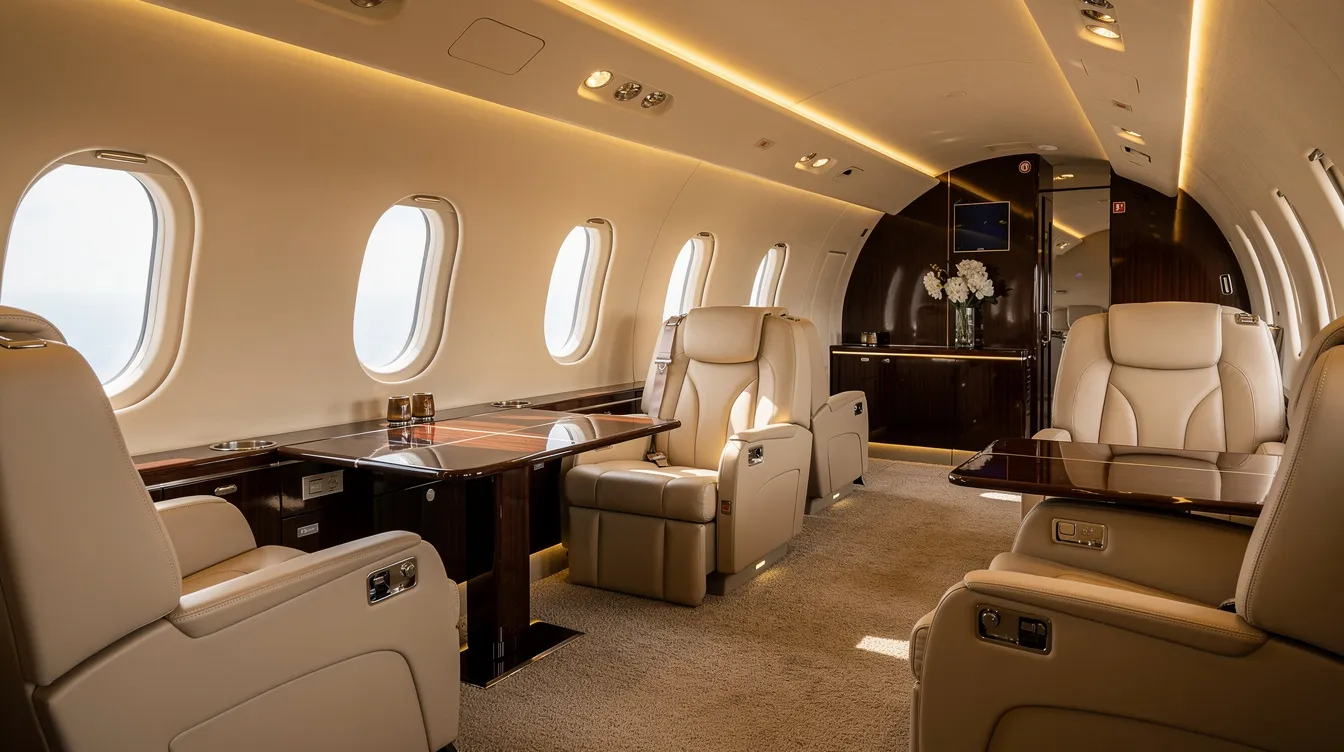
The largest private jet cabins rival or exceed the space found in top first class suites, especially in 16-seat private jet configurations designed for group comfort, but the entire cabin belongs to a single traveling party rather than four to fourteen separate suites sharing a first class section.
Airline class cabins: Multiple classes share one aircraft; your seat is assigned
Private jet categories: You select the entire aircraft; cabin size matches your mission
Flexibility: Switch from a light jet to a large cabin between trips, no class upgrade lottery
Safety, Certification, and Sustainability: Hidden Layers Behind the Luxury
On a commercial flight, safety standards are identical whether you sit in economy seats or the first class section. Economy offers simple pre-packaged meals or snacks with basic drink options, but the safety oversight is the same cockpit-to-tail. Regulatory bodies like the FAA and EASA enforce uniform standards across every class.
BlackJet applies an equally rigorous approach to private aviation. Every operator in the network holds top-tier safety certifications-ARGUS Platinum, Wyvern Wingman, or equivalent standards. Pilot experience minimums and recurrent training are standardized. A centralized operations team provides real-time flight support and monitoring for every leg, and higher cruising altitudes typical of private jets-as explained in analyses of how high a private jet flies compared to commercial flights-ensure that safety is never a variable.
Sustainability matters in premium travel. Research shows that first class and business class increase per-passenger emissions because of larger seat footprints per occupant. Private aviation is carbon-intensive too, but BlackJet commits to carbon-neutral flights by including verified carbon offsets for every member trip at no extra cost. Offsets are calculated based on fuel burn and route distance, then purchased from verified environmental projects covering reforestation and renewable energy.
True luxury in 2026 combines comfort with responsible operations, transparent safety standards, and an understanding of the most expensive private jet options and what drives their cost-not just a larger seat.
Frequently Asked Questions About First Class Cabins and BlackJet Private Aviation
What distinguishes a first class cabin from business class on international flights?
First class cabins offer more space, privacy, and personalized service than business class. Features include enclosed suites with lie-flat beds, premium dining on fine china, higher crew-to-passenger ratios, and exclusive ground services like private lounges and chauffeur transfers. Business class typically offers lie-flat seats but with less privacy and fewer amenities.
How does BlackJet’s private jet experience compare to flying first class?
BlackJet provides exclusive access to the entire aircraft, departing on your schedule from convenient airports, eliminating long airport waits and crowded terminals. While first class offers luxury within a commercial flight, BlackJet delivers full privacy, time savings, and flexible itineraries with a range of aircraft categories tailored to your trip.
Are BlackJet flights carbon neutral?
Yes. BlackJet includes verified carbon offsets for every member flight at no additional cost, supporting projects in reforestation and renewable energy to minimize environmental impact while maintaining premium travel standards.
Can I change my flight schedule with BlackJet without penalty?
Absolutely. BlackJet offers real-time flight support and flexible scheduling, allowing members to adjust departure times or itineraries without the rebooking fees commonly associated with commercial first class tickets.
What types of aircraft cabins does BlackJet offer?
BlackJet members choose from light, midsize, super-midsize, and large cabin jets depending on their travel needs. This flexibility allows travelers to select the perfect aircraft for short regional hops or long-haul international journeys, with cabins that rival or exceed the space of commercial first class suites.
Do first class tickets include checked baggage?
Most first class tickets include the ability to check in two free bags, with some airlines offering up to three depending on the route. BlackJet members receive personalized concierge service to coordinate all baggage and ground transfers seamlessly.
Is the cost of a BlackJet Jet Card comparable to first class ticket prices?
BlackJet Jet Cards offer cost predictability with fixed hourly rates and prepaid flight hours, often providing better value for frequent travelers compared to fluctuating and often higher-priced first class fares, especially for multi-leg or last-minute trips.
When to Choose First Class, and When to Choose BlackJet
A commercial first class cabin still makes sense in specific scenarios. A solo traveler on a fixed route with excellent connectivity-London–Singapore on Singapore Airlines, or New York–Tokyo on Japan Airlines-can enjoy a world-class product at a predictable price, particularly when booking with miles or elite status.
But private aviation creates superior value whenever control, time, or privacy tip the balance-and discerning travelers increasingly compare leading operators using resources like top private jet company rankings:
CEO needing a same-day return: A Los Angeles–New York round-trip on a BlackJet super-midsize jet departs on the executive's schedule, offers onboard meeting space, and avoids overnight stays.
Family of four heading to the Caribbean: No non-stop first class service to many island airports. A BlackJet midsize jet flies directly to smaller planes-friendly runways, eliminating connections, while larger groups can opt for private jets configured for around 20 passengers when the trip demands more seats without sacrificing privacy.
Legal team visiting three cities in two days: Multi-stop itineraries that would require separate first class bookings, layovers, and rebooking risks become a seamless sequence on a single aircraft, with scalable options up to private jets suitable for 50 passengers when corporate teams travel together.
The key trade-offs come down to schedule control, total journey time, privacy, productivity, and cost predictability. A Jet Card membership converts unpredictable first class spending into a fixed, flexible asset.
First class: Best for solo, fixed-route international flights with loyalty benefits
BlackJet: Best for multi-stop trips, group travel, time-sensitive schedules, and destinations underserved by commercial first class
Privacy: First class shares the cabin; BlackJet gives you the entire aircraft
Time: BlackJet eliminates two to four hours of airport overhead per trip
Sustainability: Every BlackJet flight is carbon neutral at no additional cost
The question is no longer whether first class air travel is luxurious enough. It is whether luxury alone is enough when time, privacy, and control define how you fly. Explore BlackJet Jet Card membership and discover how your current premium travel spend translates into private jet access-on your terms.


 Sign up with google
 Sign up with Apple


