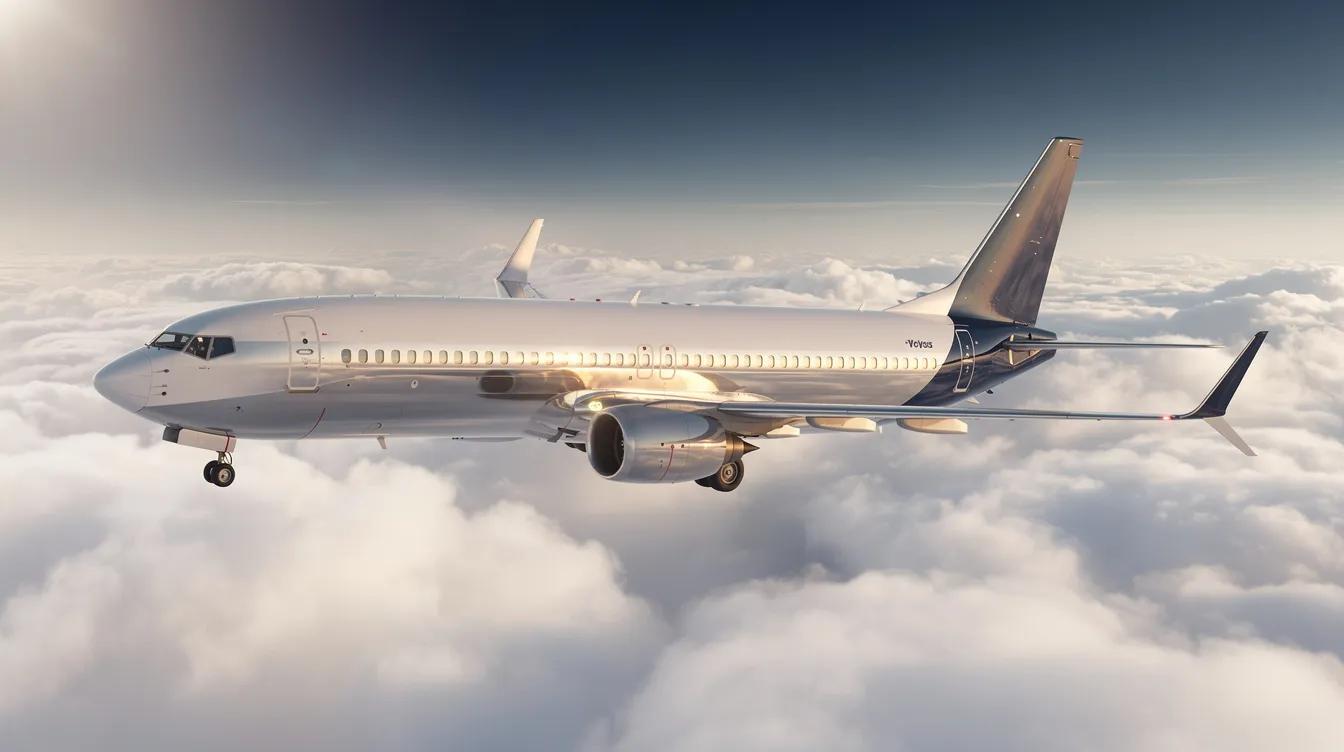
The Boeing 737 typically cruises at Mach 0.78 to 0.79—about 450 to 470 knots true airspeed, or roughly 515 to 540 mph at 35,000 to 39,000 feet. As the most-produced commercial jet in history, with over 11,000 units delivered since 1967, its cruise speed sits at the center of a web of engineering trade-offs: fuel burn, range, structural limits, schedule reliability, passenger comfort, and even environmental impact.
For frequent business travelers and high-net-worth leisure flyers weighing commercial flights against the private jets available through BlackJet’s 25+ Hour Jet Card programs, those numbers shape real decisions about travel time, predictability, efficiency, and onboard experience. This article breaks down 737 cruise speeds by variant, explains what affects them, outlines the aircraft’s operating and safety limits, and compares them with private jet performance to show how cruise speed fits into smarter, more efficient private air travel.
Fast Answer: Typical Cruise Speed Of The Boeing 737
Most Boeing 737 Next Generation aircraft (the -700, -800, and -900 variants) cruise at Mach 0.78 to 0.79. In practical units, that translates to roughly 450 to 470 knots true airspeed, or about 515 to 540 mph (830 to 870 km h). These typical cruise speeds apply at a standard cruising altitude between FL350 and FL390 (35,000 to 39,000 ft).
The 737 MAX family, including the MAX 7, 8, 9, and 10, usually holds a normal cruise of Mach 0.79. The Boeing 737 MAX can reach a maximum speed of Mach 0.82, which is the certified MMO (maximum operating Mach number) for both the NG series and the MAX. The Boeing 737 family generally cruises between Mach 0.74 and Mach 0.82, depending on variant and operating conditions.
A quick note on airspeed versus ground speed: even though the aircraft's cruise speed through the air mass stays near Mach 0.78 to 0.79, a strong tailwind from the jet streams can push ground speed well above 650 to 700 mph. Ground speed can differ from true airspeed by over 100 mph on winter eastbound routes across the US.
For private jet travelers accustomed to business jets that cruise at Mach 0.80 to 0.90, the 737's cruise is comparable to most commercial narrowbody aircraft but sits below what top-tier long-range business jets like the Gulfstream G650 or G700 deliver at Mach 0.85 to 0.90.
Why Cruise Speed Matters For High-End And Business Travelers
Cruise speed shapes two things an executive cares about: total travel time and schedule predictability. A faster aircraft shortens the airborne segment, but for most domestic routes (2 to 4 hours), the real gap between commercial and private aviation lies on the ground.
Consider a New York to Miami trip. A 737-800 flying from JFK at Mach 0.785 covers the route in roughly 3 hours of block time. Add 90 minutes for check-in, security, and boarding, plus 30 minutes for the taxi, and the door-to-door window stretches past 5 hours. A super-midsize private jet departing Teterboro at Mach 0.82, boarding in under 10 minutes, landing at Opa-locka with minimal taxi, can deliver the same passenger in under 3.5 hours door-to-door, despite only a marginal difference in cruise speed.
BlackJet's Jet Card members reclaim those hours not by defying physics but by cutting ground delays, using smaller airports, and flying direct routes. The cruise speed of a 737 is fast; what slows commercial travel is everything surrounding the flight itself.
Understanding Cruise Speed In Aviation
Cruise speed is the steady speed an aircraft maintains during its en-route phase, after climb and before descent. It is not the aircraft's maximum speed. It is the Mach number at which fuel burn per nautical mile, time on task, passenger comfort, and structural limits reach an acceptable balance.
Above roughly 30,000 ft, pilots reference speed as a Mach number rather than mph or knots. The reason is practical: at higher altitudes, thinner air changes the relationship between indicated airspeed and true airspeed. High-altitude air density requires jets to measure speed using Mach numbers rather than ground speed because the local speed of sound drops as temperature falls with altitude. Cruising altitude impacts both drag and true airspeed, making Mach the universal reference above FL300.
For commercial jets like the 737, normal cruise typically falls between 85% and 95% of MMO. With an MMO of Mach 0.82, a 737 operating at Mach 0.78 keeps a comfortable margin below the structural limits where wave drag and compressibility effects spike. The Boeing 737 is optimized for high efficiency on shorter routes rather than high speed, which is why its cruise sits where it does.
Evolution Of Cruise Speeds Across Boeing 737 Generations
Four generations of the 737 have entered service since 1968. Each brought improvements in range, fuel efficiency, avionics, and cabin design, but increases in cruise speed have been modest.
The Boeing 737-100 had a cruising speed of approximately Mach 0.74, powered by Pratt & Whitney JT8D engines with a service ceiling around FL370. The Classic series (-300, -400, -500) that followed in the 1980s kept a similar design cruise. The Boeing 737-300, for instance, stretched the fuselage to increase capacity while maintaining a cruise speed of approximately Mach 0.74, reflecting the aerodynamics and engine technology of that era.
The next generation (NG) variants (-600, -700, -800, -900), introduced in the late 1990s, brought a redesigned wing with roughly 25% more area, higher fuel capacity, and a ceiling up to FL410 on some variants. Cruise speed rose to Mach 0.78 to 0.79.
The 737 MAX, Boeing's current production model, cruises at Mach 0.79 with an MMO of Mach 0.82. The generational gain here came not from flying faster but from burning less fuel through LEAP-1B engines, advanced winglets, and aerodynamic improvements to the fuselage and nacelles—similar to how large-group private jets for 50 passengers emphasize efficiency as well as comfort.
For time-critical missions, private jets in BlackJet's network offer cruise speeds of Mach 0.82 to 0.90 on select aircraft types, and advanced private jet flight time calculators help plan those profiles to cover the same routes with shorter flight times.
Typical Cruise Speeds For Common 737 Variants
Each 737 variant has a narrow band of normal cruise speeds, influenced by aircraft weight and passenger load, route length, and airline cost policies.
The 737-700 typically cruises around Mach 0.78 at FL350 to FL390 under standard payload. It is the smallest of the NG series, often used on medium-haul routes with lower passenger counts.
The Boeing 737-800 typically cruises at Mach 0.785, making it the workhorse of the NG family. United Airlines, Ryanair, and dozens of other carriers operate it on routes from 1 to 4 hours, though private operators may instead charter aircraft for 100 passengers when groups need bespoke routing and schedules. The 737-800 has a maximum speed of 613 mph, though it rarely approaches that figure in revenue service.
The 737-900 and 900ER cruise at the same range, roughly Mach 0.79, with longer-range variants sometimes trading cruise speed for payload or fuel reserve.
The Boeing 737 MAX 8 cruises at Mach 0.79. The MAX 7, 9, and 10 share a similar cruise regime. Airlines may still fly several variants at Mach 0.76 to 0.77 on longer segments to optimize fuel burn, especially when fuel prices rise.
These figures are comparable to the Airbus A320 family, the 737's primary rival, which cruises in the same Mach 0.78 to 0.80 band.
How Pilots Select Cruise Speed On A 737
The Mach number a 737 holds in cruise is not fixed at takeoff. Pilots and the flight management system (FMS) on the flight deck adjust it throughout the en-route phase based on several variables.
The central tool is the cost index, a ratio that tells the FMS how much weight to give to time savings versus fuel savings. A high cost index (say, 40 to 60 on a 737) pushes the aircraft toward faster cruise, around Mach 0.79. A low cost index (below 20) drops it toward Mach 0.76 or 0.77, saving fuel at the expense of a few extra minutes. Cruise speed is influenced by aircraft weight and passenger load; a heavy 737-800 at maximum takeoff weight may cruise slower initially and speed up as fuel burns off.
Many 737-800 crews report cruising between Mach 0.76 and Mach 0.79, adjusting mid-flight for winds aloft, ATC constraints on routes, and schedule recovery. If a flight departs late, pilots can increase the cost index to arrive closer to schedule, burning more fuel per mile.
BlackJet's flight planning partners apply similar logic on private missions, calculating ideal cruise profiles for each leg. The difference: Jet Card members face fewer ATC-driven speed restrictions and no hub-airport congestion, giving pilots broader flexibility in altitude and speed selection.
Fuel Efficiency, Fuel Burn, And Cruise Speed On The 737
Cruise speed and fuel consumption are linked non-linearly. Small increases in Mach near MMO cause outsized jumps in wave drag, which drives up fuel burn per nautical mile.
Two reference speeds matter here: long-range cruise (LRC), a slower speed that maximizes range by minimizing fuel use per mile; and normal cruise, which is slightly faster and trades a bit of fuel for shorter flight times. Airlines with tight schedules tend toward normal cruise; those prioritizing operational costs lean toward LRC.
Reducing a 737's cruise from Mach 0.78 to Mach 0.74 can yield an estimated 5% to 7% fuel burn reduction per hour, according to industry aerodynamic studies. On a 3-hour domestic leg, that translates to roughly 400 to 600 fewer pounds of jet fuel, with only 5 to 10 minutes added to block time.
Airlines factor fuel prices, carbon pricing, and environmental targets into speed decisions on medium-range routes. BlackJet takes a similar approach: every BlackJet flight is carbon-neutral through verified offsets, and the brand favors aircraft types and cruise profiles that minimize fuel use without compromising schedule reliability.
737 MAX: Cruise Speeds, Advanced Technology, And Fuel Burn
The 737 MAX represents Boeing's latest answer to airline demands for lower operating costs. It keeps the 737's familiar cruise regime while overhauling what happens under the cowling and along the wing.
The 737 MAX 8 has a cruise speed of Mach 0.79 at a cruising altitude of approximately 39,000 ft (about 12,000 m), yielding roughly 839 km h in standard atmospheric conditions. Its top speed remains Mach 0.82.
The LEAP-1B engines from CFM International, paired with advanced winglets (Boeing calls them "split-tip winglets") and refined aerodynamics across the nacelle and empennage, deliver roughly 14% or greater fuel burn reduction per seat-mile compared to the NG series. That improvement comes without raising cruise speed; the MAX's cruise regime is designed for fleet commonality, so airlines can swap NG and MAX aircraft on the same routes without schedule disruption.
For BlackJet readers, the 737 MAX illustrates a principle that applies across aviation: advanced technology in engines and aerodynamics tends to reduce fuel consumption rather than increase speed. The same trade-off shapes private jet development, where manufacturers like Gulfstream and Bombardier invest in engine efficiency and drag reduction to extend range at a given cruise Mach number, even on private jets priced under 10 million dollars.
Passenger Comfort At Typical 737 Cruise Speeds
At Mach 0.78 to 0.79, passengers do not feel "speed." What they feel is turbulence, cabin pressure (equivalent to about 6,000 to 8,000 ft altitude), engine noise, and the proximity of other passengers. The Mach number itself is invisible.
A slightly slower cruise can indirectly improve comfort. When pilots are not chasing a tight schedule, they have more latitude to request altitude changes that avoid turbulent layers, resulting in a smoother ride.
Cabin hardware matters more than speed for perceived comfort. Boeing Sky Interior, standard on 737 MAX and retrofitted on many NG aircraft, features sculpted sidewalls, LED mood lighting, and larger overhead bins. These elements improve the feel of the cabin during cruise without changing the aircraft model's performance.
The contrast with private aviation is pronounced. A frequent BlackJet traveler once described moving from a packed 737-800 in single-class configuration (189 seats) to a super-midsize cabin seating 8 as "the difference between a subway car and a living room at the same altitude." Fewer passengers, quieter engines (better insulation, nacelle design), and generous seating capacity per person—hallmarks of small private jets for luxury travel—transform the cruise phase into productive or restful time rather than something to endure.
Ground Speed vs. Airspeed: Why A 737 Sometimes Shows 660+ MPH
Airspeed is how fast the aircraft moves through the surrounding air mass. Ground speed is how fast it moves over the Earth's surface. The gap between them is wind.
Picture a 737-800 cruising at Mach 0.78, producing a true airspeed around 515 mph. Now add a 140-mph tailwind from the winter jet stream over the central United States. The aircraft's fastest ground speed on the flight tracker reads 655 mph, and some flights have logged ground speeds above 700 mph. Jet streams and tailwinds can alter ground speed by 20% or more while maintaining true airspeed within normal limits.
Wind and jet streams can boost ground speed on eastbound routes and penalize it on westbound ones, which is why a New York-to-Los Angeles flight often takes 30 to 40 minutes longer than the return trip. Pilots monitor Mach number and indicated airspeed on the flight deck for structural limits and safety margins; ground speed is relevant mainly for estimating arrival times and fuel burn calculations.
BlackJet's dispatch teams factor forecast winds aloft into every Jet Card trip estimate. On eastbound legs, actual arrival times often beat quoted schedules because tailwinds compress sector times beyond initial projections.
Comparing 737 Cruise Speeds With Other Commercial Jets
Most narrow-body aircraft in airline fleets cruise within a tight band. The Airbus A320 family typically cruises at Mach 0.78 to 0.80, similar to the Boeing 737. The Airbus A320neo typically cruises at Mach 0.78, sitting at the lower end of that range. On a 3-hour route, the speed difference between a 737-800 at Mach 0.785 and an A320neo at Mach 0.78 amounts to roughly 2 to 3 minutes of airborne time, a far smaller distinction than choosing a private jet for 30 passengers instead of a commercial narrowbody for group travel.
Long-haul commercial jets cruise faster. The Boeing 777 and 787 generally hold Mach 0.84 to 0.85, and the Airbus A350 operates in the same range. Over an 8-hour transatlantic crossing, that gap translates to a meaningful time advantage. Over a 2-hour domestic hop, it is negligible.
Airlines do not select aircraft types for cruise speed alone. Passenger capacity, fuel efficiency per seat, range capability on medium-haul routes, and landing gear compatibility with runway lengths at target airports drive fleet decisions.
For BlackJet's audience, the more relevant comparison sits between private jet categories: light jets near Mach 0.76 to 0.78, super-midsize and large-cabin jets at Mach 0.80 to 0.90, each with different Jet Card cost per hour, hourly rates, and cabin configurations.
Seating Capacity, Aircraft Types, And The Role Of Cruise Speed
Boeing 737 variants carry between 130 and 200+ passengers, depending on configuration. A 737-800 in a two-class layout seats about 162; in a single class, up to 189. That high seating capacity spreads fuel and operational costs across many tickets, keeping per-seat economics viable even at moderate cruise speeds, whereas private options like jets configured for 20 passengers trade seat count for privacy and flexibility.
Private jets accessed through BlackJet serve a different calculus entirely, starting with how much it actually costs to rent a private jet:
Light jets (e.g., Citation CJ3+): 6 to 8 passengers, cruise near Mach 0.76, and sit within the category of small private aircraft best suited for short missions
Super-midsize jets (e.g., Citation Longitude): 8 to 12 passengers, cruise Mach 0.80 to 0.84
Large-cabin long-range jets (e.g., Global 7500): 12 to 16 passengers, cruise up to Mach 0.90, overlapping with many of the top 16-seat private jets favored for executive group travel
Each aircraft type matches a mission profile and fits within broader private jet size categories. A light jet suits a 2-hour hop for 4 executives. A large-cabin jet covers transcontinental or transatlantic legs where speed, range, and cabin space all matter.
For an individual or small team, the seat-time experience on a 737 versus a private jet differs by category, not just by speed. Privacy, productivity, and bespoke service are what BlackJet's Jet Card members pay for; cruise speed is one variable among many, and rarely the deciding one.
Safety Limits: MMO, Operating Margins, And Why 737s Don't Fly Faster
The 737 NG and 737 MAX both carry an MMO of approximately Mach 0.82. That figure is a certified structural and aeroelastic boundary; exceeding it risks shock wave formation on the wing, Mach buffet (airframe vibration from compressibility effects), and increased structural fatigue.
Flying at or near MMO pushes the aircraft into a drag regime where fuel burn per mile spikes and ride quality degrades. The "barber pole" indicator on the speed tape in the flight deck warns pilots as the aircraft approaches VMO/MMO, and the control column may shake via a stick shaker if margins narrow further.
Operating comfortably below MMO (by Mach 0.03 to 0.04) preserves safety margins, extends airframe service life, and keeps the ride smooth. Commercial regulations, noise abatement rules, and fuel efficiency targets all reinforce this buffer. No 737-class aircraft is designed for supersonic speeds; the aerodynamics of a swept-wing narrowbody aircraft simply do not support it without a fundamental redesign.
BlackJet applies the same principle across its partner fleet. All operators in the network adhere to rigorous safety certification standards, and flights are planned with speed margins that prioritize passenger safety over marginal time gains.
Environmental Considerations: Cruise Speed, Fuel Burn, And Carbon-Neutral Private Flights
The relationship between cruise speed and CO� emissions follows the same curve as fuel burn: non-linear and punishing at the upper end. Moving from Mach 0.78 to Mach 0.82 on a 737 can increase fuel use per mile by a disproportionate amount due to wave drag escalation.
Airlines manage emissions through several levers. Moderating cruise speeds via economy or LRC modes is one. Installing advanced winglets (blended winglets on NG, split-tip on MAX) reduces induced drag and cuts fuel burn by an estimated 4% to 5% on typical sectors. Fleet modernization matters too: replacing Classic-generation 737s with MAX variants eliminates roughly 14% of per-seat fuel consumption on the same route.
Sustainable aviation fuel (SAF) is an emerging piece. SAF can reduce lifecycle CO� emissions by up to 80% compared to conventional jet fuel, though supply remains limited as of 2026.
BlackJet's commitment is concrete: every flight booked through a BlackJet Jet Card is carbon-neutral at no extra cost to the member, achieved through verified carbon offsets and, where available, SAF sourcing, with transparent Jet Card pricing structures backing those commitments. Cruise speed optimization on every private mission, choosing slightly slower profiles when schedules allow, is part of that strategy.
How 737 Cruise Speeds Compare To Private Jets In The BlackJet Network
Cruise speeds of business jets often exceed Mach 0.85, outperforming commercial airliners like the 737 family. The fastest private jets in BlackJet's network push into territory a narrowbody aircraft simply cannot reach.
Benchmarks across categories:
Turboprops: roughly 275 to 310 knots; slower than a 737 but efficient on legs under 500 nautical miles and often featured among the best small private aircraft
Light jets: near Mach 0.76 to 0.78; comparable to a 737's cruise but with far shorter ground times
Super-midsize jets: Mach 0.80 to 0.84; faster cruise with longer range and larger cabins
Large-cabin, ultra-long-range jets: Mach 0.85 to 0.90; the fastest segment, covering 6,000+ nautical miles non-stop and ideal when you need the best private jet for 15 passengers
The "effective cruise speed" for a Jet Card member is amplified by direct routing, uncongested airports, and boarding times measured in minutes rather than hours, all key advantages highlighted in the best jet cards for frequent flyers. A CEO flying a super-midsize jet from White Plains to Midway at Mach 0.82 gains 10 minutes in the air over a 737 at Mach 0.79; she gains 90 minutes on the ground by avoiding O'Hare security and taxi queues.
That combination of airborne speed and ground efficiency is where BlackJet's value proposition lives.
Using Cruise Speed To Plan Efficient Private Flights With BlackJet
BlackJet's planning process starts with inputs from the Jet Card member: route, passenger count, timing constraints, and cabin preferences. From there, the team recommends aircraft classes that balance speed, range, comfort, and cost.
Cruise speed becomes a strategic variable on multi-leg days within any Jet Card cost structure. Consider this scenario:
Mission: New York to Chicago, meeting at 10:00 AM; Chicago to Boston, dinner at 7:00 PM; return to New York the same night.
Aircraft: A super-midsize jet cruising at Mach 0.82 departs White Plains at 7:00 AM, lands Midway by 9:00 AM local. After the meeting, departs Chicago at 3:00 PM, arrives in Boston by 5:30 PM. Returns to White Plains by 10:00 PM.
Alternative on commercial 737 segments: Each leg requires hub airports, boarding windows, and potential delays. The same three-city day almost certainly requires an overnight stay.
BlackJet helps clients identify when a higher cruise speed (and the associated hourly rate of a faster jet) is justified by schedule compression, and when a slower, more fuel-efficient aircraft model suits a single-leg trip with flexible timing, often through flexible 25-hour Jet Card-style solutions. That calibration, matching speed to mission, is what separates a premium aviation advisory from a simple booking tool.
Typical Cruise Speeds Of Boeing 737 Variants
Variant | Typical Cruise Speed (Mach) | Typical Cruise Speed (Knots) | Typical Cruise Speed (MPH) | Max Speed (Mach) | Max Speed (MPH) | Notes |
|---|
737-100 | 0.74 | ~430 | ~495 | 0.74 | ~495 | Original model, introduced in 1968 |
737-300 | 0.74 | ~430 | ~495 | 0.76 | ~520 | Classic series, introduced in 1984 |
737-700 | 0.78 | ~450 | ~515 | 0.82 | ~545 | Next Generation (NG) series, introduced in 1997 |
737-800 | 0.785 | ~455 | ~520 | 0.82 | 613 | NG series workhorse, introduced in 1998 |
737-900/900ER | 0.79 | ~460 | ~530 | 0.82 | ~545 | Longer-range NG variant |
737 MAX 7 | 0.79 | ~460 | ~530 | 0.82 | ~545 | MAX family, certification expected in 2025 |
737 MAX 8 | 0.79 | ~460 | ~530 | 0.82 | 623 | First MAX variant, introduced in 2017 |
737 MAX 9 | 0.79 | ~460 | ~530 | 0.82 | ~545 | MAX family, introduced in 2018 |
737 MAX 10 | 0.79 | ~460 | ~530 | 0.82 | ~545 | Largest MAX variant, certification pending |
FAQs About Boeing 737 Cruise Speeds And Private Jet Travel
Is a Boeing 737 faster than most private jets?
The 737 cruises at Mach 0.78 to 0.79. Light jets cruise at similar speeds (Mach 0.76 to 0.78), but super-midsize and large-cabin jets reach Mach 0.80 to 0.90. On balance, many private jets cruise faster than a 737.
How much time does a higher cruise speed save on a 2- to 3-hour flight?
Increasing from Mach 0.78 to Mach 0.82 on a 1,500-nautical-mile leg saves roughly 8 to 10 minutes in the air. Ground logistics typically introduce more variability than that.
Why does my flight time vary even on the same route and aircraft?
Winds aloft (headwinds or a strong tailwind), ATC routing, altitude assignments, and aircraft weight all shift block times. A 737-800 on the same city pair can vary by 15 to 20 minutes between winter and summer due to seasonal wind patterns.
Do pilots change cruise speed mid-flight?
Yes. Pilots adjust Mach number throughout cruise based on fuel state, schedule needs, ATC instructions, and turbulence avoidance. The FMS recalculates the optimal speed continuously.
Should I always pick the fastest jet with BlackJet?
Not always. Faster jets carry higher hourly rates and burn more fuel. For a 90-minute leg, a light jet at Mach 0.77 may arrive only 4 minutes after a large-cabin jet at Mach 0.85, at a fraction of the cost, and many clients prefer the cheapest private jet options that still meet their comfort and range needs. BlackJet's team matches aircraft speed to mission requirements so clients avoid paying for speed they do not need.
What does "cost index" mean for cruise speed?
It is a number entered into the FMS that tells the aircraft how to weigh time savings against fuel savings. A high cost index produces faster cruise; a low one favors efficiency. Airlines and private operators both use it.
Can a 737 ever reach supersonic speeds?
No. The 737's aerodynamics, wing design, and structural limits cap it well below Mach 1. Its MMO of Mach 0.82 is a hard ceiling, and routine flying stays near Mach 0.78 to 0.79.
Final Thoughts
The cruise speed of the Boeing 737, around Mach 0.78 to 0.79 depending on variant, reflects decades of engineering balance between fuel efficiency, passenger comfort, and operational reliability. From the original 737-100 at Mach 0.74 to the 737 MAX at Mach 0.79, each generation has prioritized doing more with less fuel rather than flying faster.
For BlackJet's clientele, understanding these numbers clarifies what commercial aviation delivers and where private aviation creates an edge. The 737 is fast enough for the airlines that operate it. But for travelers who measure productivity in hours, not seat assignments, the combination of higher cruise speeds, direct routing, and private terminal access offered through a Jet Card reshapes what a travel day can accomplish.
Discover how BlackJet can turn cruise speed into a strategic advantage for your schedule. Explore our Jet Card membership and premium private jet access today.


 Sign up with google
 Sign up with Apple