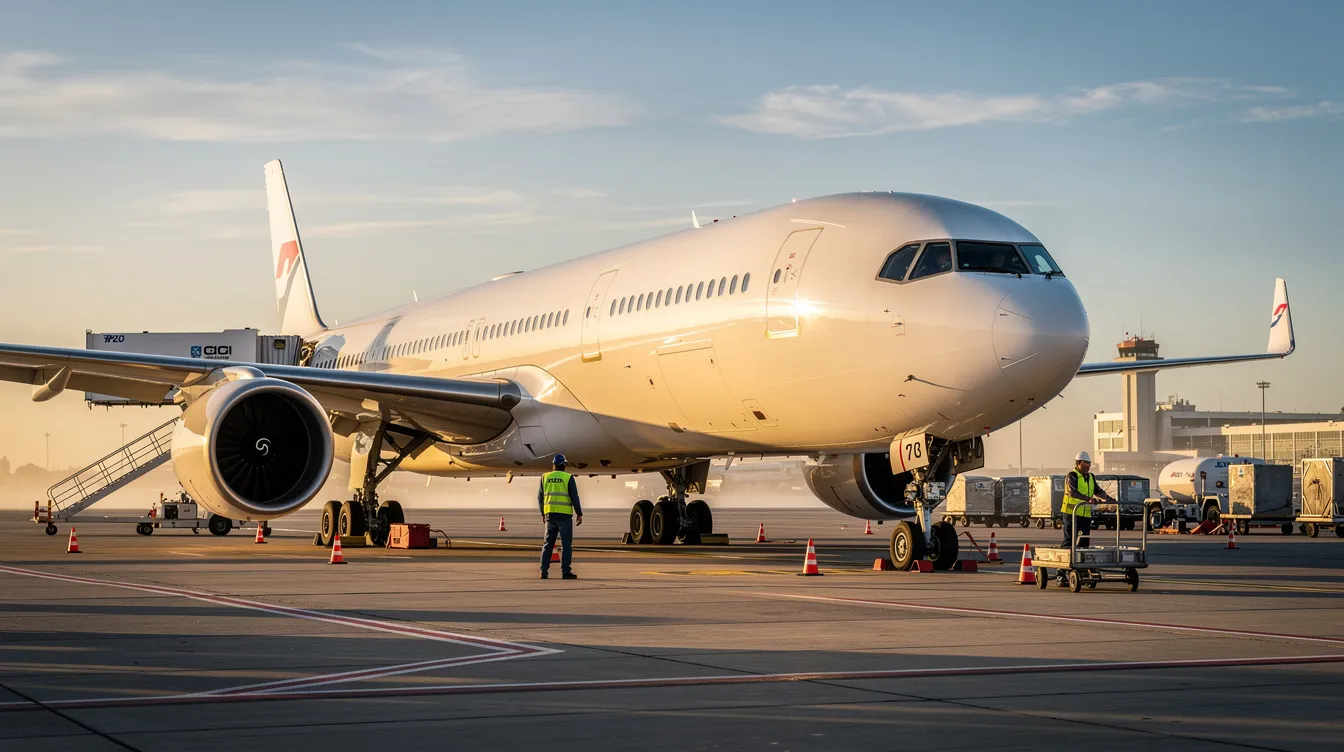
Introduction: Why Boeing Company Aircraft Still Matter to Private Jet Flyers
The Boeing Company has shaped global air travel since 1916, and if you're searching for all Boeing planes, the core lineup follows Boeing’s 7X7 naming system: the 707, 717, 727, 737, 747, 757, 767, 777, and 787 families, with the 797 name still unused, alongside cargo, military, and Boeing Business Jet variants. Over that span, Boeing has produced 126 different aircraft models for passenger, cargo, military, and VIP roles. For frequent business travelers and high-net-worth fliers comparing private aviation options, those airplanes set the benchmark for range, cabin comfort, and reliability—and understanding that benchmark makes it easier to judge what a private jet should deliver.
Consider a New York to Los Angeles business trip. On a 737 MAX, you arrive at a crowded terminal two hours early, clear security, and board on someone else's schedule. On a midsize private jet booked through a BlackJet Jet Card, you pull up to a private terminal 20 minutes before departure, skip every queue, and land at a closer airport. Total time saved: roughly 90 minutes each way. For executives and leisure travelers who value flexibility, privacy, safety, and luxury without owning an aircraft, that difference is the point.
While Boeing builds the fleet that airlines rely on, from the 737, 747-8, 777, and 787 to Boeing Business Jets, BlackJet's focus is matching each mission to the right private aircraft category. This guide connects Boeing’s aircraft families and model naming to the private travel decisions that matter most: how commercial and private aircraft compare, which jet categories fit different trips, how Jet Card access works, and what to look for in safety, sustainability, and overall travel convenience.
Understanding Boeing's Aircraft Families and Naming System
Boeing's aircraft naming convention started with the 707 model, and the company has used the 7X7 format since 1957. This pattern (707, 727, 737, 747, 757, 767, 777, 787) makes it straightforward to categorize all Boeing planes at a glance. The 797 is the only unassigned 7X7 model name.
Model numbers include a hyphen and three series digits (for example, 747-400 or 777-300). The 787 is an exception: it uses a single digit for series designation (787-8, 787-9, 787-10).
Boeing dropped the customer code system after the mid-2010s. Previously, a variant like 737-7H4 identified Southwest Airlines as the buyer.
Suffixes like "ER" indicate extended-range versions, as in the 777-300ER (entered service 2004). "ER" stands for Extended Range, meaning the aircraft can fly longer distances than the standard version. "SR" is used for short range (Short Range), while "LR" denotes long range (Long Range), seen in the 777-200LR (entered service 2006). The "F" suffix denotes freighter versions of aircraft (Freighter), such as the 747-8F (first flight 2011). "BCF" (Boeing Converted Freighter) and "SF" (Special Freighter) mark converted freighters like the 767-300BCF.
Boeing Commercial Airplanes is the division listed as the airline-focused manufacturer. Boeing Business Jets (BBJ) take those same airframes and fits them with VIP interiors for private aviation use.
Current Boeing Commercial Airplanes in Production or Development, Including the 737 MAX
As of mid-2026, Boeing identifies the 737 MAX, 787, and 777/777X as its principal commercial products. Boeing currently produces the 737, 767, 777, and 787 families of aircraft. The active commercial airplane lineup includes single-aisle and twin-aisle jets.
737 MAX Family
The Boeing 737 is a single-aisle aircraft family used for short-to-medium routes. Boeing produces the 737 MAX series aircraft in four variants: MAX 7, MAX 8, MAX 9, and MAX 10. The 737 MAX achieves a 20% reduction in fuel use compared to older models, thanks to LEAP-1B engines and updated aerodynamics.
Capacity runs from about 135 to 230 passengers depending on configuration; the MAX 8 covers roughly 3,550 nautical miles. The fleet was grounded globally from March 2019 to November 2020 after two crashes; deliveries resumed following software and training updates. In July 2026, the FAA allowed Boeing to resume issuing airworthiness certificates for new 737 MAX and 787 airplanes.
747-8
Boeing's 747-8 is the latest version of the 747. The 747 remains significant for cargo operations despite ending passenger production. The last 747-8 was delivered in early 2023.
777 and 777X
The Boeing 777 is a high-capacity long-range twin-engine jet. Current production covers the 777-300ER and 777F. The 777X series is in development, featuring folding wingtips and GE9X engines.
The Boeing 777X is designed for ultra-efficient long-haul routes, with first deliveries expected in 2027.
787 Dreamliner
Boeing produces the 787 Dreamliner, a highly fuel-efficient wide-body jet. Boeing's 787 Dreamliner entered service in 2011. The 787 Dreamliner is constructed largely of composite materials for weight savings and features lower cabin altitude and higher humidity for passenger comfort.
The 787-9 covers roughly 7,500+ nautical miles. Boeing's commercial jets often feature advanced aerodynamics and fuel-efficient engines; the 787 is the clearest example.
Freighters
Boeing's freighters include the 767 Freighter, 777 Freighter, and 747-8 Freighter. Boeing's 767 serves as a freighter and military tanker due to its cargo capacity. The KC-46 Pegasus is derived from the 767 airframe primarily for aerial refueling.
Discontinued but Iconic Boeing Airliners (707 to Classic 747 and 747-8)
Boeing's first commercial jet was the 707 in 1957. It entered service with Pan Am in 1958, launching mass transatlantic jet flight. Over the years that followed, several more types reshaped the industry. Boeing's defense portfolio also includes a variety of aircraft tailored for military applications, and many retired commercial frames found second lives in those roles.
707
The 707 was Boeing's first commercial jet, entering service in 1958. It played a pivotal role in launching mass transatlantic jet flight and set the stage for future jetliners.
727
The 727, a tri-jet introduced in the 1960s, was built for shorter runways and high-frequency domestic routes. Airlines retired most by the late 1990s.
737 Classic and Next Generation
Early 737 variants (737-100/200) arrived in the 1960s. Classic (300/400/500) and Next Generation (600/700/800/900) families carried hundreds of millions of passengers over four decades.
747
The 747 was introduced in 1970 as a wide-body airliner. The 747-400 became the long-haul workhorse of the 1990s and 2000s. Airlines eventually replaced it with more efficient twins like the 777 and 787.
757
The 757 offered narrow-body transatlantic capability on thin routes. It became a favorite for airlines needing flexibility on medium-range flights.
767
The 767 became one of the first twin-aisle twins for medium- and long-haul production runs, later evolving into freighter and tanker platforms.
Many executives who once flew first class on 747s now prefer large-cabin private jets that deliver comparable cabin volume with full privacy and schedule control.
Boeing Business Jets (BBJ): Airliner Platforms as Private Palaces
Boeing Business Jets is Boeing's offering for converting proven airline-derived airframes into ultra-long-range VIP aircraft. BBJ products serve heads of state, global corporations, and ultra-high-net-worth individuals. The airframes carry the same structural certification as their airline counterparts but arrive with bespoke interiors.
The BBJ MAX 7 can fly roughly 6,600 nautical miles nonstop with eight passengers. Wide-body BBJ 787 variants offer up to 9,945 nautical miles of range and 2,300 to 2,700 square feet of cabin space, enough for master suites, boardrooms, and dining areas. The forthcoming BBJ 777X family claims cabin areas exceeding 3,200 square feet and ranges beyond 11,000 nautical miles.
These aircraft differ from typical private jets in scale and cost. Direct variable operating costs for a BBJ 737 MAX run roughly $5,200 to $5,700 per hour; wide-body BBJ variants can exceed $14,700 per hour. Acquisition and crew costs push these into the domain of governments and multinationals, not individuals flying a few times per month.
For most frequent travelers, BlackJet's Jet Card model provides a more practical step into premium private jet card programs and broader Jet Card cost guides: a CEO who once chartered a BBJ for rare global roadshows now books a large-cabin jet from New York to London or Dubai through BlackJet, arriving with lie-flat comfort, in-flight connectivity, and tailored catering at a fraction of BBJ ownership cost.
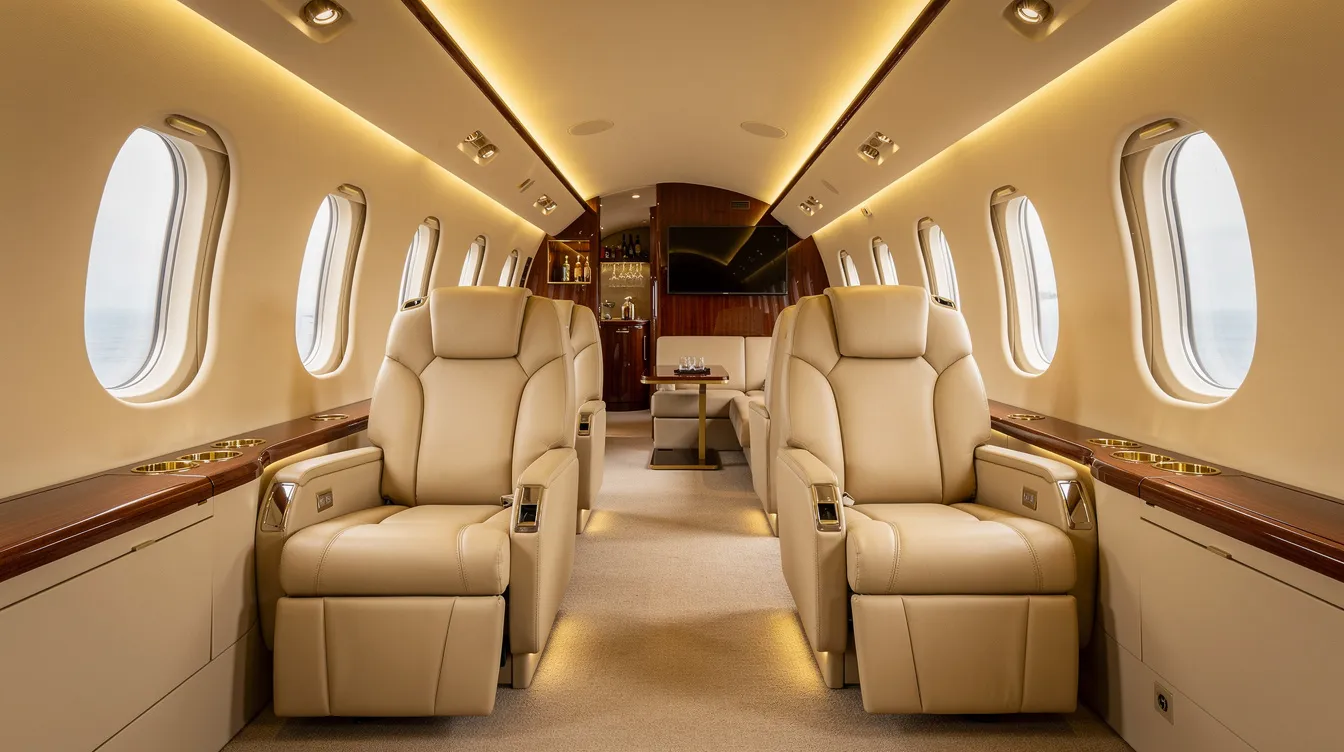
From Boeing Commercial Airplanes to Private Jet Access: Choosing the Right Aircraft for Your Mission
A business-class seat on a 787-9 or 777-300ER offers lie-flat comfort and fine dining. A comparable charter on a large-cabin business jet via BlackJet offers the same, plus full privacy and a departure time you set yourself, with total spend depending on how much it costs to charter a small plane or a heavy jet for longer routes.
The time savings are concrete. Private terminal access means arriving 20 to 30 minutes before departure; commercial flights require 90 to 120 minutes. Flexibility compounds the advantage: you choose the airport, the time, and can shift plans without rebooking fees on most private jet charter programs.
On safety, BlackJet partners only with operators holding top-tier ratings (ARG/US Platinum, Wyvern, or equivalent), ensuring every flight meets or exceeds the regulatory oversight that governs Boeing commercial airplanes. On sustainability, new Boeing types like the 737 MAX and 787 cut fuel burn per seat; BlackJet complements this by making every Jet Card flight carbon neutral through verified offset programs, at no extra cost. Learn more about sustainable private aviation.
BlackJet's digital booking platform proposes aircraft categories based on route, passenger count, and luggage. A 25-hour Jet Card such as the BlackJet 25+ Hour Jet Card, locks in fixed hourly rates and guaranteed availability, and similar analysis applies when evaluating Jet Card cost per hour or stepping up to a 100-hour Jet Card cost structure for very frequent flyers.
For example, a London to Dubai trip on an Emirates 777-300ER business cabin takes about seven hours in the air plus three hours of airport overhead. The same route on a large-cabin private jet booked through BlackJet cuts door-to-door time, lets you hold confidential meetings onboard, and offers catering tailored to your preferences.
Understanding all Boeing airplanes helps you benchmark what performance and comfort look like at scale. BlackJet optimizes the end-to-end journey around your schedule, including bespoke solutions when you need to charter a plane for around 100 passengers on high-priority routes or identify the best private jet for 20 passengers and even private jets suitable for up to 50 passengers for large-group missions.
How BlackJet Helps You Navigate Aircraft Choices
When does flying commercial on a Boeing make more sense than private?
When your group exceeds eight to ten people, the route offers direct business-class service close to your origin, and your schedule aligns with the airline timetable.
Private becomes the better option when you need flexibility, privacy, or access to smaller airports not served by airlines, especially if you choose from the best small private aircraft or other small private jets for luxury travel tailored to short or regional missions, and understand how much it costs to charter a small plane for each itinerary.
How does a Jet Card differ from an ad hoc charter?
A Jet Card commits prepaid hours (for example, 25 or 50 hours) at fixed rates with guaranteed aircraft availability, and guides to 50-hour Jet Card costs and broader Jet Card pricing structures can help you understand how pricing scales with usage.
Ad hoc charter pricing fluctuates by season, repositioning costs, and demand. The details matter: a Jet Card removes negotiation and uncertainty from every booking, and comparing the best Jet Cards for frequent flyers alongside dedicated Jet Card cost-per-hour comparisons clarifies which structure fits your pattern.
Can a smaller private jet match a 787 or 747- 8 business-class cabin?
Large-cabin business jets offer lie-flat seating, full lavatories, and galley service for up to 14 passengers. They carry fewer people but provide a private lounge environment that no shared commercial cabin replicates, which is why understanding private jet sizes and classes is essential when matching aircraft to your group.
What safety standards does BlackJet require?
Every operator in the BlackJet network holds third-party safety ratings equivalent to or above the regulatory framework governing large commercial airplanes. Pilots hold type ratings for each aircraft they fly, and maintenance programs follow Part 135 standards, whether you’re flying light jets, top 16-seat private jet options, or exploring the largest private jets for sale and charter and top private jets worldwide for larger groups.
How does BlackJet address emissions?
Every Jet Card flight is carbon neutral through verified offset programs. Where available, BlackJet coordinates sustainable aviation fuel. Boeing's newer models reduce per-seat emissions; BlackJet applies the same principle at the per-flight level, including for clients comparing private jet pricing in rupees and seeking sustainable solutions in the Indian market.
Conclusion: Why Understanding All Boeing Planes Elevates Your Private Jet Experience
Boeing’s extensive lineup of aircraft—from iconic commercial airliners to bespoke Boeing Business Jets—sets the global standard for range, safety, and cabin comfort. For discerning travelers and executives, knowing the capabilities and distinctions among all Boeing planes provides a strategic advantage when selecting private aviation solutions. Whether choosing a midsize jet for regional business or a large-cabin BBJ for intercontinental journeys, this knowledge helps optimize travel time, privacy, and luxury.
BlackJet leverages this expertise to match your mission with the ideal aircraft category, backed by rigorous safety certification and sustainability commitments. With the convenience of Jet Cards and real-time digital booking, you gain seamless access to premier private jet experiences inspired by the world’s leading aircraft manufacturer. Discover how a deeper understanding of Boeing’s fleet can reshape your travel—effortlessly, efficiently, and exclusively. Learn more about Boeing Business Jets and explore private jet sizes and classes to find the perfect match for your journey.


 Sign up with google
 Sign up with Apple