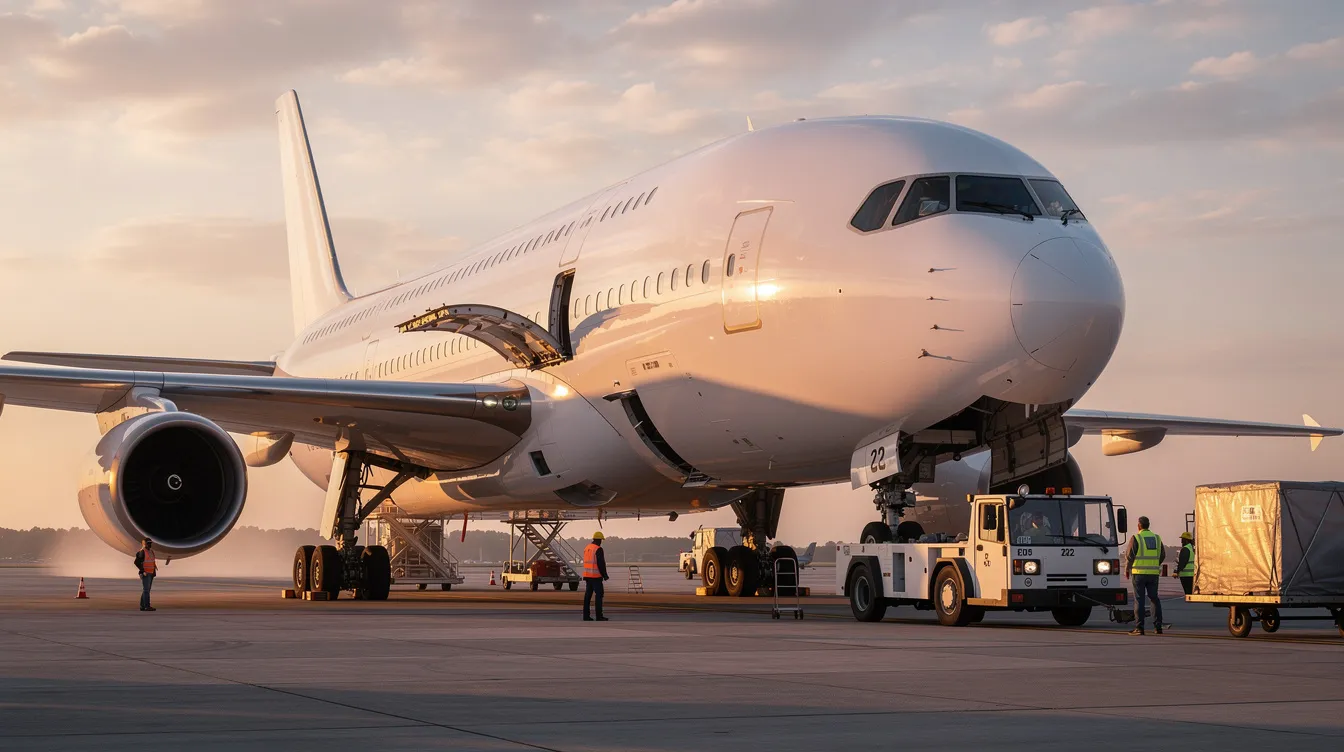
In a world where time is the scarcest resource for decision-makers, the Airbus A380 private plane stands as the most ambitious statement in aviation: an aircraft that can transform over 6,000 square feet of airborne real estate into a mobile headquarters, diplomatic residence, or luxury retreat for up to 100 guests-on a single flight across continents. In 2027, as demand for large-scale private travel accelerates and retired airline frames enter the secondary market, the concept of a privately configured A380 is closer to reality than ever before. This guide examines everything you need to know-from cabin design and performance data to costs, safety, sustainability, and how BlackJet can arrange access to the world's most commanding private jet experience.
Strategic Advantage of Flying on an Airbus A380 Private Jet
Access to a private jet has always been more than a luxury-it is a strategic advantage. For global businesses coordinating multinational leadership summits, governments managing sensitive delegations, sports organizations moving entire teams with support staff, and ultra-high-net-worth families seeking uncompromised privacy, the right aircraft eliminates friction that commercial airliners simply cannot address. When that aircraft is a VIP-configured Airbus A380, the calculus shifts from convenience to genuine competitive advantage.
Consider the comparison between an A380 private charter and commercial first class on a long-haul flight from New York to London:
Time saved: A private A380 departs from a dedicated terminal-no security queues, no gate delays, no boarding chaos. Passengers arrive 30 minutes before departure, not three hours. Flexible departure windows mean the aircraft waits for you, not the reverse.
Privacy and productivity: An entire aircraft dedicated to one client group means confidential board meetings, investor roadshows, or sensitive negotiations happen without an adjacent stranger overhearing a word. No luggage carousel wait; no cramped lavatory shared with 300 people.
Scale without compromise: The Airbus A380 measures 262 feet from wingtip to wingtip and remains the largest passenger aircraft ever built, first delivered in 2007. In its commercial configuration, the A380 can seat up to 800 passengers. When converted to a private jet, it dedicates 6,500 square feet of customizable floor area entirely to one client's group-roughly equivalent to a large luxurious house interior spread across two full decks.
BlackJet positions the A380 at the very top of its access ladder. Members typically use mid- and large-cabin jets through Jet Card programs for routine travel. But for rare mega-capacity missions-a Fortune 100 company flying 90 executives to a global summit, a national sports federation transporting its entire delegation, or a tech company staging a transcontinental product launch-BlackJet can arrange A380 VIP airliner charters via its curated operator network.
Post-2024 demand patterns confirm the need. Large incentive travel programs, global sports tournaments, and simultaneous multi-city product launches have surged, creating scenarios where a single A380 private flight replaces multiple smaller planes and the complex email password log spreadsheets of manifests that come with coordinating them. For the discerning traveler or organization that refuses to compromise on scale, security, or experience, this aircraft is in a class of its own.
The Airbus A380 as a Private Plane: Design, Cabin Concepts & Capabilities
The idea of converting the world's largest commercial airliner into a private jet is not new, but the market conditions in 2027 have made it more tangible than at any previous point. Airbus ended A380 production in 2021, and no full VIP-configured A380 was ever completed or delivered-the most famous attempt, Prince Alwaleed bin Talal's "Flying Palace" announced in 2007, was cancelled before completion. That concept envisioned a prayer room, vehicle garage, and hammam aboard the aircraft, illustrating the sheer scale of what is possible.
What has changed is supply. As airlines retire A380 fleets-Emirates alone operates 96 of these aircraft-specialist firms have stepped in. Sparfell & Partners plans to convert four ex-Singapore Airlines A380s into head-of-state and VVIP configurations, while Lufthansa Technik and several Middle Eastern design houses have drawn up detailed conversion blueprints. By 2027, several conversion programs are underway, and the market for bespoke A380 layouts is slowly taking shape.
Key Technical Parameters
Key technical parameters of a private Airbus A380:
Passenger capacity: A VIP layout can accommodate between 50 and 100 guests, compared to the 500–615 airline seats in a typical three- or four-class configuration. The A380's passenger configuration often prioritizes luxury over capacity, and in private use this philosophy is taken to its ultimate expression.
Cabin dimensions: The A380's cabin width is 21.5 feet, providing spacious interiors unmatched by any other aircraft in the world. It features a main deck measuring over 21 feet wide and 163 feet long. The Airbus A380 offers 6,500 square feet of customizable interiors-the A380 provides approximately 6,000 square feet of floor space across two full-length decks when accounting for structural elements, with the remaining area devoted to galley, crew rest, and equipment zones.
Range: The Airbus A380 has a maximum range of 8,000 nautical miles (roughly 14,800 km), sufficient for routes like New York–Dubai, London–Sydney, or Los Angeles–Tokyo.
Engines and systems: Powered by four Rolls-Royce Trent 900 or Engine Alliance GP7200 high-bypass turbofan engines, the aircraft is equipped with advanced fly-by-wire technology that delivers precise, smooth handling and reduced pilot workload.
Core Cabin Architecture in Private Layouts
Modern 2027 conversion concepts focus on productivity, wellness, and connectivity rather than the pure opulence of the original "Flying Palace" era. Typical configurations designed by specialist firms include:
Lower Deck Layout
20–30 enclosed suites with lie-flat beds, private bathrooms, and personal workspaces-ideal for a board of directors, national delegation, or film production leadership traveling together. Each suite functions as a self-contained apartment rather than merely a seat, offering the privacy of separate apartments within a single fuselage.
Upper Deck Amenities
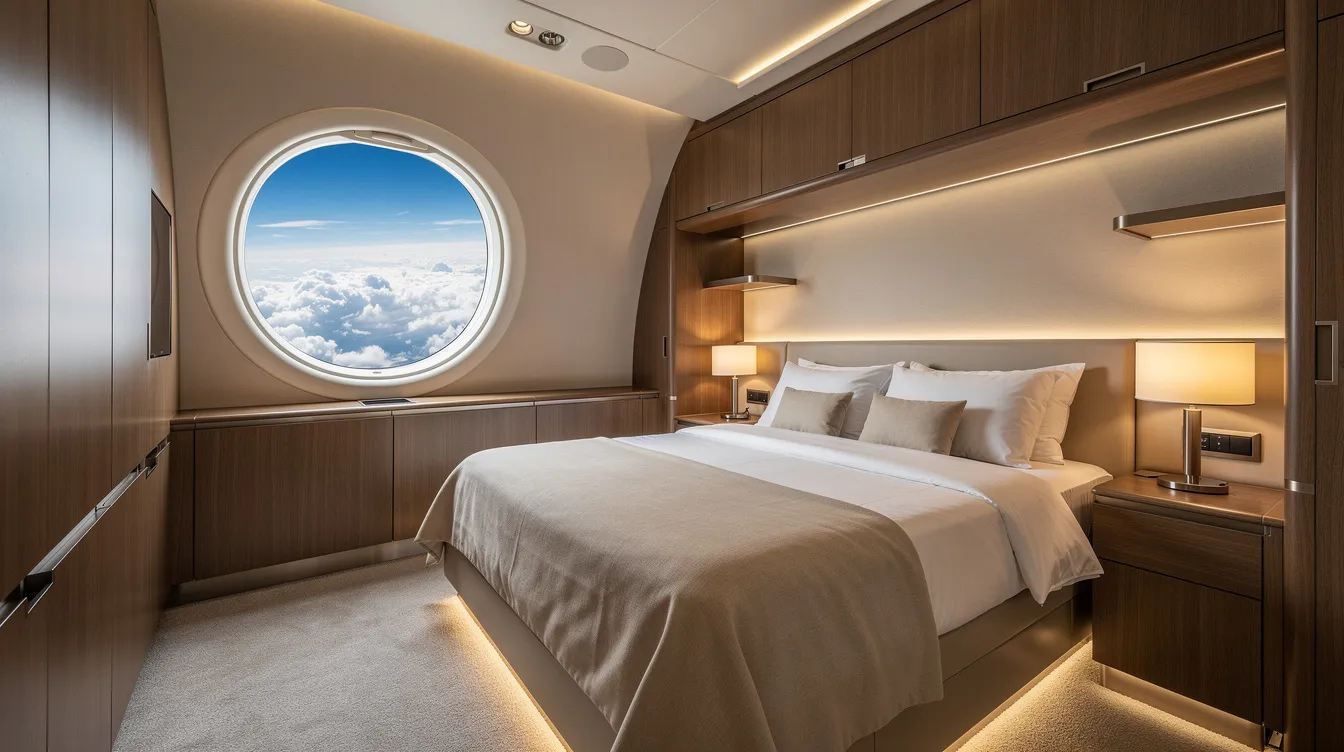
A full-width lounge with bar, dining salon seating 24–30 guests, cinema room, and a spa or gym area with shower suites. Private A380 configurations can include onboard spas and private bedrooms, allowing passengers to arrive at their destination rested and prepared.
Family and Leisure Wing
What a BlackJet Client Can Expect on an A380 Charter
Multi-room privacy with bespoke catering by onboard chefs
Separate crew rest spaces for rotation on 14–16 hour sectors, ensuring the highest operational safety standards
Tailored branding opportunities: corporate livery, onboard product displays for launches, and custom dining areas for hosted events
Passengers can enjoy high-speed Wi-Fi and premium entertainment options throughout the journey, with Ku- or Ka-band satellite connectivity and encrypted VPN access for sensitive corporate work
Performance and Operations
Cruise speed: approximately Mach 0.85 (~560 mph / 485 knots)
Cruising altitude: 35,000–43,000 ft
The A380 requires runways of approximately 10,500 feet for takeoff at maximum weight, making it compatible with major international airports such as London Heathrow, Dubai International, New York JFK, Sydney, and Frankfurt.
Safety and Certification
All A380 private operations arranged via BlackJet are flown by operators that meet or exceed IS-BAO or equivalent safety standards, with dual crews, advanced avionics, and redundant systems. BlackJet works exclusively with operators holding rigorous safety certifications, positioning safety as equal to or higher than top commercial carriers.
Technology and Connectivity
Onboard communication systems go far beyond what passengers encounter on commercial flights. Encrypted satellite phone systems, secure VPN channels, and enterprise-grade Wi-Fi mean that sensitive financial data or legal discussions stay protected-a stark contrast to the consumer-grade networks at commercial airports where prompts to continue with Google accounts or welcome to Pinterest pop-ups compete for attention on public Wi-Fi. Aboard a private A380, every wire and antenna is dedicated to your group's secure operations, not shared with hundreds of strangers trying to log in to discover social feeds or enter a Pinterest login to browse more ideas.
When Is the A380 the Right Tool?
Choose an A380: Global roadshows, major film productions, sports teams with sponsors and support staff, state visits, or events requiring 80–100 guests in a single aircraft.
Choose a large-cabin jet via a Jet Card: 8–14 passengers on intercontinental flights-a Gulfstream G700, Bombardier Global 7500, or Dassault Falcon offers more than enough space and flexibility, with the ability to operate into smaller airports, while 16-seat private jets are ideal when you need extra capacity without moving into full airliner territory.
Inside the Cabin: Luxury, Space, and Wellness at Scale
Step aboard a private Airbus A380 in 2027 and the first sensation is unexpected silence. The cabin environment of the A380 is widely regarded as one of the quietest in aviation, a product of its double-deck structure, advanced acoustic insulation, and the smooth power delivery of four turbofan engines. Soft circadian lighting shifts across warm tones as you enter, and the air feels fresher than any long-haul flight you have flown before.
The A380 is recognized for its potential to provide extensive living spaces that rival the finest boutique hotels. Here is what a passenger experiences:
Ceiling Height and Freedom of Movement
Distinct Living Zones
A private A380 converts its vast interior into a reception lobby, library or meeting room, formal dining room, spa with shower suites, cinema, and a master bedroom suite. The scale means these are genuinely separate rooms, not curtained-off sections. The touch of real materials-hand-stitched leather, solid wood veneers, natural stone in bathrooms-creates an ambiance closer to a five-star residence than an aircraft.
Wellness Engineering
Standard A380 designs feature rapid air exchange that refreshes cabin air every two to three minutes, dramatically reducing fatigue and airborne contaminants. Cabin pressurization is maintained at a lower effective altitude than many legacy jets-typically equivalent to 5,000–6,000 feet-and higher humidity systems combat the dehydration that plagues conventional long-haul flights. Circadian LED lighting profiles are programmed to match destination time zones, reducing jet lag on routes like New York–Hong Kong or Paris–Buenos Aires.
Entertainment and Connectivity
Passengers can enjoy high-speed Wi-Fi and premium entertainment options across dedicated media rooms, personal screens in suites, and communal viewing areas. The A380 can comfortably seat up to 100 passengers in private configurations, and each can access tailored entertainment libraries, live news feeds, and real-time market data via satellite—making it a benchmark for understanding 100-passenger charter costs and logistics in the private aviation space.
Example journey: Imagine a BlackJet client organizing a 5-city investor tour-New York to London to Dubai to Singapore to Tokyo-using a privately configured A380 as a mobile headquarters. During the overnight London–Dubai sector, executives sleep in enclosed suites while the investment team prepares briefing documents in the upper-deck boardroom. By morning, fresh catering is served in formal dining areas, and the team reviews real-time market updates via encrypted satellite links. No hotel check-ins, no airport transfers, no time wasted. The aircraft converts from workspace to rest space to social venue as the journey demands-the ultimate expression of private aviation at scale.
Range, Speed, and Airport Access
The Airbus A380 delivers long-range capability that can connect major global hubs non-stop, making it one of the most capable platforms for intercontinental private missions.
Performance figures:
Range: Maximum range of 8,000 nautical miles, depending on configuration and payload. When configured for approximately 80–100 passengers with tailored fuel loads, the aircraft can operate the world's most demanding routes without refueling.
Speed: It cruises at a speed of Mach 0.85 (900 km/h), making its block times comparable to modern commercial long-haul airliners-but with completely private usage throughout.
Example nonstop missions:
Los Angeles (LAX) to Sydney (SYD): approximately 6,500 nm
London (LHR) to Singapore (SIN): approximately 5,900 nm
New York (JFK) to Johannesburg (JNB): approximately 6,900 nm
Each of these routes falls within the A380's operational envelope for a VIP-configured load, allowing passengers to land at their destination without intermediate stops.
Operational constraints-addressed honestly:
The A380's broad wingspan and high takeoff weight create logistical challenges that must be planned around. The A380 requires specialized Code F runway infrastructure, limiting its access to small airfields. Specifically:
Minimum runway length of approximately 10,500 feet for takeoff at or near maximum weight
Runway width of at least 150 feet (45 m) with appropriate shoulders
Suitable taxiway width, pavement strength, and gate or stand infrastructure
This means the A380 operates best from major international airports-London Heathrow, Dubai International, New York JFK, Sydney Kingsford Smith, Frankfurt, and similar large hubs. BlackJet's partner operators plan meticulously around these requirements, using compatible international hubs and, where viable, coordinating access to large, well-equipped secondary airports.
Fuel and environmental considerations, and how they compare with major Jet Card providers like NetJets:
While the A380's four engines consume more fuel per hour than smaller private jets, modern operational procedures-optimized flight planning, altitude management, and strategic routing-help manage consumption, just as they do on regional missions such as private jet charters in Karachi. BlackJet applies carbon offsetting to all flights arranged through its programs, including A380 charters, keeping the environmental profile as responsible as possible for an aircraft of this size.
BlackJet Access: A380 Private Charter vs. Jet Cards, Costs, Safety & Sustainability
BlackJet is a private aviation company built around Jet Card membership, offering programs such as the BlackJet 25+ Hour Jet Card and 50-hour packages that provide prepaid access to a curated fleet of light, midsize, super-midsize, and large-cabin private jets. A380 VIP airliner access is available as a bespoke charter arrangement for qualifying missions-coordinated by BlackJet's team on behalf of members or prospective clients who need to move large groups across continents.
Jet Card Overview
How BlackJet's Jet Card works:
Clients pre-purchase flight hours at transparent, fixed hourly rates organized by cabin class, making it easy to compare Jet Card cost per hour against alternatives like ownership or on-demand charter. Booking is handled via 24/7 digital tools and real-time support. This model suits frequent travelers who typically fly in smaller groups-8 to 14 passengers-rather than the 80–100 who might justify an A380, and it aligns with how the best Jet Cards for frequent flyers are structured in the wider market. For those routine missions, a Jet Card eliminates the complexity of ownership and the unpredictability of on-demand charter pricing.
Cost Comparison
Three models compared, including how Jet Card costs stack up against ownership and on-demand charter:
Model | Capital Outlay | Ongoing Responsibility | Best For |
|---|
Jet ownership | Very high (aircraft purchase, hangar, depreciation) | Full: crew salaries, maintenance, insurance, scheduling | Organizations flying 400+ hours annually on consistent routes or exploring premium private jets for sale as strategic assets. |
On-demand charter | None upfront | Variable pricing, availability not guaranteed | Occasional travelers with flexible schedules |
BlackJet Jet Card | Prepaid hour blocks at fixed rates | None-BlackJet handles operator selection, safety vetting, logistics | Frequent travelers wanting predictable costs and guaranteed access |
A380 charters fit into the bespoke charter category: arranged by BlackJet's dedicated team on top of a client's usual Jet Card flying when a mega-event or large-group mission demands it. Think of it as an airliner charter for large groups elevated to the highest level of customization, with alternatives available on 30-passenger private jets when full A380 capacity is not required.
Pricing reality for large-group jets and 50-passenger private aircraft:
Operating costs for the A380 can exceed $30,000 per flight hour at the operational level, and VIP charter rates-factoring in crew, fuel, repositioning, ground handling, and interior services-typically range from $40,000 to $60,000 per flight hour depending on configuration and routing. All-in costs for a one-way mission vary significantly:
New York to London: approximately $600,000–$1,000,000+
Los Angeles to Tokyo: approximately $900,000–$1,500,000+
Los Angeles to Sydney: approximately $1,300,000–$2,000,000+
These figures shift based on repositioning requirements, airport slot availability, onboard customization, catering, and group size. Rather than publishing a price list that would quickly become obsolete, BlackJet provides tailored quotes for every inquiry. The key insight for prospective clients: when you buy an A380 charter, you are often replacing the cost and complexity of chartering multiple large-cabin jets, consolidating VIPs, security teams, and equipment onto a single aircraft, and gaining the ability to host a flying product launch with a full media suite aboard.
Safety and Security
All A380 operators BlackJet works with hold leading safety certifications-IS-BAO, ARGUS Platinum, or equivalent-and adhere to rigorous maintenance and crew training standards.
Private terminals (FBOs) provide discrete arrivals, controlled access lists, and streamlined boarding that replaces chaotic commercial processes. No more juggling separate email password spreadsheets or consumer-level tools to manage guest lists-BlackJet's digital platform handles manifest management, digital consent, and NDA processes when needed.
Onboard data security is paramount. BlackJet encourages secure corporate VPN use over high-grade satellite connectivity, ensuring that sensitive communications never travel over the kind of open networks where a Google search or QR code scan at an airport lounge might expose corporate data.
Sustainability
BlackJet is committed to carbon-neutral flying across its Jet Card programs in 2027, competing with established providers like Flexjet Jet Card programs while emphasizing sustainability alongside flexibility. Every flight is automatically offset through verified environmental projects-at no extra cost to the client. This commitment extends to large-aircraft charters, including A380 private flights. Advisors can present detailed impact data for each mission upon request, allowing clients to review the environmental footprint and offset allocation before the aircraft has even flown.
Example Scenario: A Global Luxury Brand Launch Using an A380 and 20-Passenger Private Jets
A prestigious fashion house in 2027 is launching a new collection. The plan: fly 90 guests-press, influencers, and senior executives-on a private A380 from Paris to New York, then onward to Los Angeles. BlackJet coordinates the entire operation:
A380 charter for the core Paris–New York–Los Angeles routing, with branded interiors, curated catering, and onboard content studios for social media production
Carbon offsets calculated and applied before departure
Feeder legs using large-cabin jets from BlackJet's Jet Card fleet, bringing VIPs from Milan, London, and Berlin into Paris for the main departure
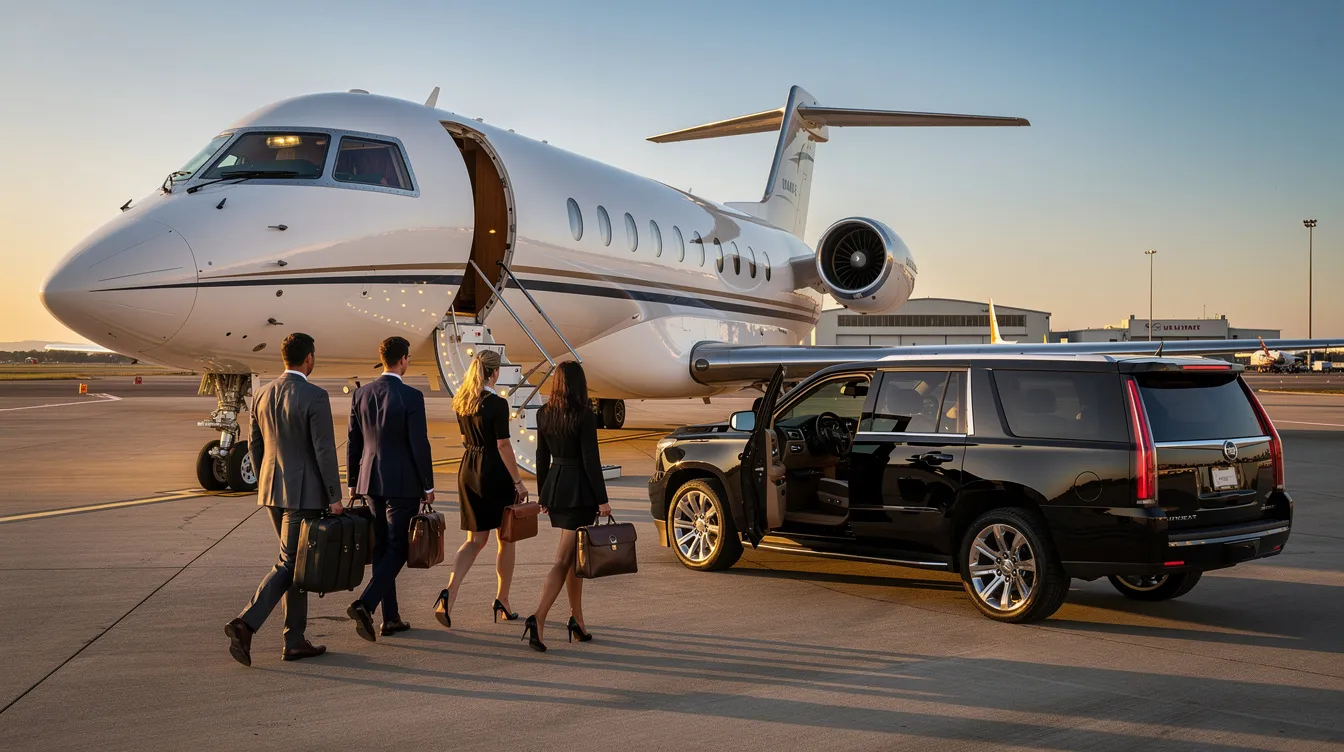
Ground coordination at each destination: discrete arrivals, pre-cleared customs, vehicles waiting on the tarmac
The result: 90 guests experience a seamless, branded journey from select European cities to two American destinations without a single commercial terminal, without arrows pointing them through immigration queues alongside hundreds of strangers, and without the fragmented logistics of booking multiple airlines.

When to Choose an Airbus A380 vs. Other Private Jets
Not every mission calls for the world's largest private jet. The key is matching aircraft to purpose:
Choose an A380 private jet when you need to move 60–120 people in absolute privacy on a single long-haul route: a multinational leadership summit, a national team plus delegates and media, a film cast plus production crew, or a major incentive travel program where the journey itself is part of the experience.
Choose a large-cabin private jet (Bombardier Global 7500, Gulfstream G700, Dassault Falcon 10X)-accessible via a BlackJet Jet Card-for 8–14 passengers on intercontinental flights. These aircraft operate into a far wider range of airports and offer exceptional comfort for smaller groups, and overlap with many of the best private jets for 15 passengers when your group size grows slightly.
Choose midsize or super-midsize jets for regional hops: New York to Miami, London to Geneva, Dubai to Riyadh, with 6–9 passengers who need speed and flexibility above all.
Practical decision-making means bigger is not always better. For many high-net-worth individuals and executives, a Jet Card solution with flexible access to multiple aircraft types throughout the year is more strategic than a single A380 charter. One corporate client, planning to move 85 people from York (via Manchester) and London to Dubai for a global conference, initially explored a full A380. After BlackJet's team modeled the options-factoring in time, costs, and airport access at both origin cities- and compared them with 50-passenger private jet solutions, the client opted for a "shuttle" model using three large-cabin jets departing simultaneously, allowing each group to board at their nearest hub without positioning flights. The A380 remains the right answer when consolidation, shared experience, and onboard programming outweigh the flexibility of splitting the group.
How to Arrange an A380 Private Charter with BlackJet in 2027
The process of chartering a plane of this magnitude is bespoke from the first conversation. Here is the operational pathway from inquiry to wheels-up:
Initial inquiry: A BlackJet member or prospective client contacts the team with dates, approximate passenger count, and key city pairs. This can begin with a phone call, a secure message through BlackJet's platform, or a request through a dedicated relationship manager. No need to sign into a consumer platform or navigate public search engines-this is a direct, confidential conversation.
Feasibility analysis: BlackJet conducts a comprehensive review of airport compatibility (runway length, Code F infrastructure, slot availability), ground handling logistics, and crew positioning. The team presents aircraft options: a full A380, alternative large airliners (Boeing 777 or 787 VIP), or a fleet of multiple large-cabin jets. Each option includes trade-offs on cost, timing, and destination flexibility.
Detailed proposal: The proposal covers route planning, estimated flight times, cabin concept (seating vs. suites mix, dining areas layout, lounge configuration), catering preferences, branding requirements, and a carbon-offset plan. Clients select the configuration that best serves their mission. Where applicable, digital NDA processes are handled through BlackJet's secure platform-no need for the kind of generic "continue" prompts or public login flows that characterize consumer services.
Confirmation and operations: Once confirmed, BlackJet assigns a dedicated operations liaison who provides 24/7 support. Digital itineraries are distributed to all passengers. Ground teams at departure and arrival airports are briefed. The aircraft is prepared-interiors finalized, catering loaded, crew briefed, and every detail verified before the first guest steps aboard.
Unlike standard Jet Card bookings-which can often be completed entirely via app-an A380 charter involves strategic planning calls, security briefings, tailored onboard service design, and coordination across multiple time zones. BlackJet's technology still plays a central role: centralized manifest management, secure communication channels between client teams and flight operations, and real-time status updates ensure nothing falls through the cracks, even when making last-minute adjustments.
Discover What's Possible: Your Next Move
The Airbus A380 private plane represents the apex of what is achievable in airborne travel-an aircraft that converts the sky into a living, working, and entertaining space of unmatched scale. Whether your next global gathering demands the commanding presence of a double-deck superjumbo or the agile precision of a large-cabin jet accessible through a Jet Card, BlackJet ensures every journey is managed with the same commitment to safety, sustainability, and seamless execution.
Explore BlackJet's Jet Card programs today, and speak with our team about bespoke large-aircraft solutions when your calendar demands something truly extraordinary, using a solid grasp of Jet Card pricing to benchmark your options. With rigorous safety standards, carbon-neutral performance built into every flight, and the technology to manage even the most complex missions, BlackJet is where refined, meaningful travel becomes your new standard.
Frequently Asked Questions
Can you actually charter an Airbus A380 as a private plane in 2027?
While Airbus ended A380 production in 2021 and no full VIP-configured A380 was ever delivered, conversion programs are underway. Sparfell & Partners plans to convert four ex-Singapore Airlines A380s, and several design firms in Europe and the Middle East are actively developing VVIP interiors. BlackJet can arrange full A380 airliner charters-including premium cabin buyouts-and will offer access to converted VIP frames as they become available.
How many passengers can a private A380 carry?
An A380 can accommodate between 50ando 100 guests in a VIP layout, compared to its ability to transport hundreds of passengers in its commercial configuration. The exact number depends on the interior concept: a layout emphasizing private suites and extensive lounge space may carry closer to 50, while a layout with more open seating and fewer enclosed rooms can comfortably seat up to 100 passengers in private charter configurations.
What does it cost to charter an A380 private jet?
Operating costs for the A380 can exceed $30,000 per flight hour at the base level, with VIP charter rates typically ranging from $40,000 to $60,000 per flight hour. All-in mission costs depend on route, repositioning, customization, and group size. BlackJet provides tailored quotes for every inquiry-contact our team for a detailed proposal.
What airports can an A380 land at?
The A380 requires specialized Code F runway infrastructure-runways of approximately 10,500 feet, a minimum 150-foot width, and reinforced pavement. This limits access to major international hubs. BlackJet's operations team identifies compatible airports for every mission, ensuring smooth ground handling and customs clearance.
How does BlackJet handle sustainability for A380 charters?
BlackJet is committed to carbon-neutral flying across all its programs. Every flight-including A380 private charters-is automatically offset through verified environmental projects. Clients can request detailed impact reports for each mission to explore the environmental data behind their travel.
Is a Jet Card or an A380 charter right for me, and how do Jet Card pricing structures influence the decision?
For most frequent private flyers traveling in groups of 2–14, a BlackJet Jet Card offers the ideal balance of flexibility, predictable pricing, and guaranteed access, with options that scale from 25 hours up to 100-hour Jet Card programs for heavy users. An A380 charter is a bespoke solution for specific large-scale missions. Many clients use both: a Jet Card for regular travel throughout the year, and a one-time A380 charter when a major event or gathering demands it. New to private aviation? Start by exploring what a Jet Card is and how it fits your travel pattern, then compare options like a 50-hour Jet Card if you anticipate flying regularly but not quite at the 100-hour level.
Conclusion: A380 Scale, Matched to the Mission
The Airbus A380 private plane represents an extraordinary vision of private aviation: up to 6,500 square feet of customizable space, long-range capability, and room for as many as 100 guests in a VIP layout. Yet its size also brings real constraints. Code F airport infrastructure, high operating costs, and the fact that no full VIP-configured A380 has been completed mean it is a specialized option—not a practical replacement for every private flight.
For global delegations, major brand launches, sports organizations, or large corporate groups, an A380 charter can consolidate people and purpose into one carefully coordinated journey. For routine travel with smaller groups, a BlackJet Jet Card program offers more flexible access to aircraft suited to the trip, without the obligations of ownership. Clients can compare Jet Card pricing with charter and ownership, while BlackJet’s private aviation safety standards and carbon-neutral flight commitment help inform the decision. BlackJet helps clients weigh capacity, airport access, timing, safety standards, and carbon-offset options before choosing an aircraft.
Whether your plans call for a large-aircraft charter or a more agile private jet, the advantage lies in matching access to the mission. Explore BlackJet’s Jet Card programs and speak with the team about bespoke charter options to make your next journey seamless, secure, and thoughtfully planned.


 Sign up with google
 Sign up with Apple