Updated July 10, 2026 · By the BlackJet Editorial Team, reviewed by BlackJet flight operations
Buying a 25-hour jet card should be simple. Pick a cabin class, read the hourly rate, multiply by 25. Real costs rarely land that neatly. The cabin class you choose is the biggest driver of 25-hour jet card pricing, but what sits inside the published rate (taxes, fuel, and peak-day rules) is what determines your true cost per hour. This guide breaks down pricing across light, midsize, super-midsize, and large cabin jets, shows what each cabin actually buys you, and hands you a repeatable way to compare any provider on equal terms.
Quick Answer on 25-Hour Jet Card Pricing by Cabin Class
Light jets carry the lowest hourly rate. Large cabin jets carry the highest. The biggest pricing swing between two similar-looking quotes is usually what each rate includes (FET, fuel surcharges, peak days) and how each provider deducts your hours.
A 25-hour jet card is priced and sold by cabin category, not by a guaranteed tail number, and the program's billing policies shape your real cost as much as the sticker price. Jet cards are sold at fixed hourly rates by cabin, so your rate holds steady across trips even as spot charter prices move. This page uses an effective hourly rate method to normalize every quote so you can compare fairly. Effective hourly rate is the real per-hour cost after adding required taxes and surcharges and adjusting for how a provider deducts hours (flight time vs taxi time) and any minimum billable time. Confirm inclusions and billing rules in writing before you buy. For a deeper program walkthrough, see our 25-hour jet card guide.
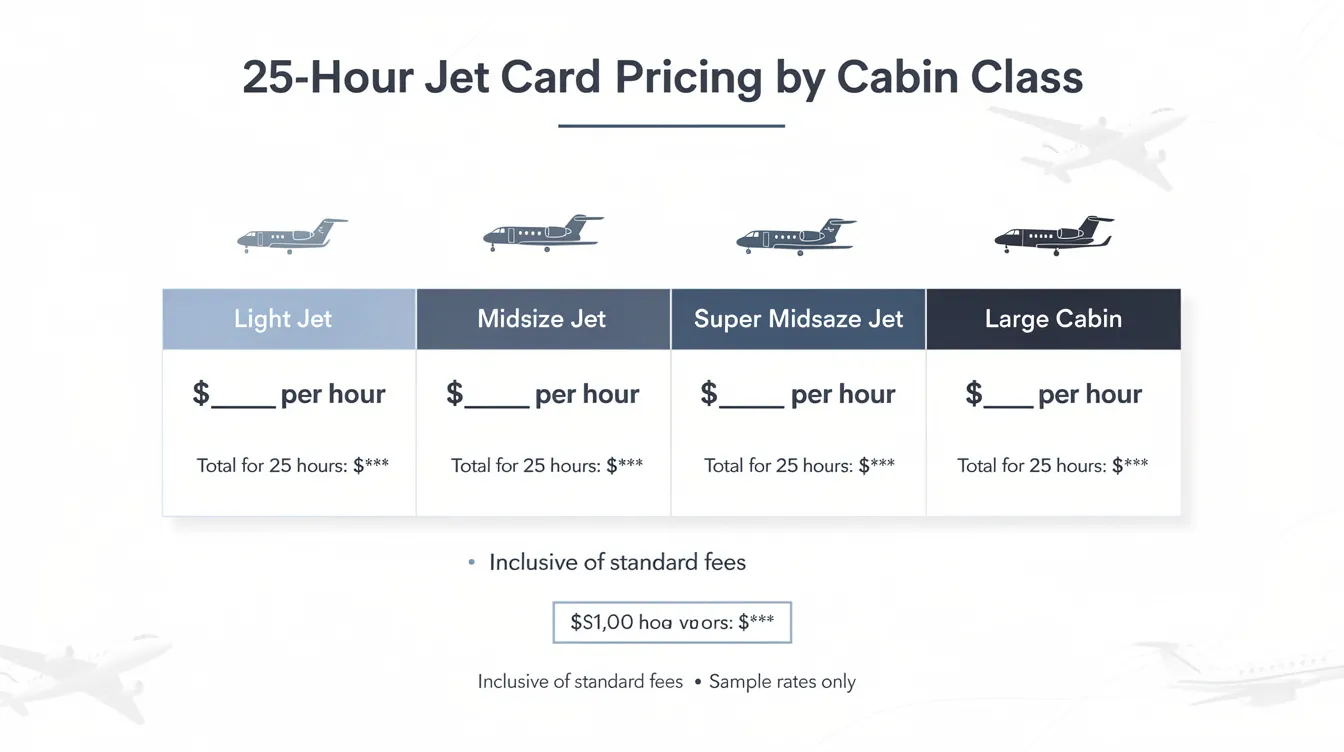
| | | | | Table 1. 25-Hour Jet Card Pricing by Cabin Class (Typical Ranges + What You Get) |
Cabin class | Typical hourly range | Typical 25-hour budget | Typical passengers | Best for | Fees most likely to move the headline price |
|---|
Light | $5,000 to $7,000 | $125,000 to $175,000 | Up to 7 | Short regional hops | Fuel surcharges, taxi time, daily minimum |
Midsize | $6,000 to $9,000 | $150,000 to $225,000 | Up to 8 | Longer domestic trips | FET treatment, peak day surcharge |
Super-midsize | $9,000 to $12,000 | $225,000 to $300,000 | Up to 8 | Coast-to-coast missions | Peak days, repositioning, daily minimum |
Large cabin | $10,000 to $15,000 | $250,000 to $375,000 | Up to 12 | Transcontinental and transatlantic | International handling, de-icing, overnight crew |
All figures are examples; confirm exact pricing and inclusions for your program.
What Is a 25-Hour Jet Card and How Hours Are Deducted
A 25-hour jet card is a prepaid private aviation program that lets you buy 25 flight hours at a set hourly rate for a defined aircraft category (like light, midsize, super-midsize, or large cabin) instead of pricing each trip from scratch.
Most 25-hour cards give you category access, meaning you are guaranteed a light, midsize, super-midsize, or large cabin aircraft rather than one specific plane. Tail numbers within a category can vary in age and layout, so ask what a program guarantees. A 25-hour card usually carries a slightly higher effective hourly rate than a 50-hour card, paired with a lower upfront deposit. Smaller blocks suit lighter flyers who want predictable pricing without a large commitment. Business aviation demand has held strong through the mid-2020s, per the 2023 NBAA Annual Report, which keeps guaranteed availability and fixed pricing attractive.
Four billing concepts decide your real jet card cost per hour. Taxi-time billing covers whether a provider charges only flight time or adds a fixed amount per leg. Daily or segment minimums set a floor on billable hours. Peak-day rules add surcharges or notice requirements on busy dates. Cancellation windows govern change and refund terms. A daily minimum is the minimum amount of flight time (in billable hours) a provider charges for a day of flying, even if the actual flight time is shorter. A 25-hour jet card does not just lock a rate, it locks a set of billing rules, and those rules often determine the real cost more than the advertised hourly number. If you are new to the product, our primer on what a jet card is covers the basics.
| | | 25-Hour Card vs 50-Hour Card vs On-Demand Charter |
Factor | 25-hour card | 50-hour card | On-demand charter |
|---|
Price predictability | High (fixed hourly rates) | High (fixed hourly rates) | Low (market pricing per trip) |
Upfront capital | Lower | Higher | Pay per flight |
Ability to shop aircraft | Limited to category | Limited to category | Full, trip by trip |
Fee variability | Low | Low | High |
Best use case | Lighter, steady flyers | Frequent flyers | Irregular, opportunistic flying |
BlackJet's 25-Hour Jet Card Options (Pay-As-You-Fly vs Fully-Funded)
BlackJet offers two ways to start a 25-hour jet card: Pay-As-You-Fly and Fully-Funded. The Pay-As-You-Fly option is priced at $50,000, and the Fully-Funded 25-Hour Jet Card is priced at $225,000. A Pay-As-You-Fly jet card is a structure where you make an initial program payment and then pay for flying as hours are used, rather than fully prepaying the entire 25 hours upfront. Confirm exactly what each figure covers in the program terms before you sign.
BlackJet's 25-hour jet card is available across light, midsize, super-midsize, and large cabin categories, with two purchase structures: Pay-As-You-Fly and Fully-Funded. Mid-size and super-midsize access is tied to the BlackJet 25+ Card tier, which sits above the base 25-hour Light card. Cardholders can switch jet sizes up or down at stable fixed hourly rates, so a single program can cover a quick regional hop and a long-haul week later.
The technology layer is where the daily experience lives. BlackJet's mobile booking app, available on the Apple App Store and Google Play, handles instant bookings, real-time safety-check status, and access to a pre-flight BlackJet Certified Safety Report. Card Owners can request quotes and book by text message, and support runs 24/7. As BlackJet CEO Justin Crabbe frames the buying decision, transparency matters more than a headline rate.
"Private aviation buyers should evaluate jet card programs the same way they evaluate any major investment, with transparent pricing, clear contract terms, and a complete understanding of how flight hours are calculated. When those elements are clearly defined, comparing providers becomes straightforward and far more meaningful."
- Justin Crabbe, CEO
| | | | BlackJet 25-Hour Options |
Option | Upfront price | How charges typically occur | Best for | Questions to confirm |
|---|
Pay-As-You-Fly | $50,000 | Initial program payment, then pay for flying as hours are used | Flyers wanting a lower entry deposit | What the $50,000 covers, hourly rate by cabin, how hours draw down |
Fully-Funded | $225,000 | Larger upfront funding of the 25-hour block | Flyers wanting the block prepaid | Refundability, expiration, rate-lock terms |
Ready to compare the structure against your own routes? Start with the BlackJet Jet Card overview.
Pricing by Cabin Class, From Light to Large Cabin
Cabin class drives the hourly rate through three levers: range, passenger capacity, and operating cost. A bigger, faster, longer-legged aircraft burns more fuel and costs more to crew and maintain, so its fixed hourly rate climbs. Private aviation pricing guides placed the market-wide average near $11,426 an hour in early 2026, though that single number hides the cabin-by-cabin spread that actually sets your budget. The four sub-sections below pair citable numbers with the capability that justifies each step up, plus a decision rule for each cabin. For the underlying logic, see our breakdown of jet card cost per hour.
"Every cabin category serves a different mission. A light jet can be the most economical choice for short regional flights, while a large cabin aircraft delivers greater range, passenger capacity, and onboard comfort for longer domestic and international travel. Selecting the right category is one of the easiest ways to maximize value."
- Justin Crabbe, CEO
| | | | | Table 2. Cabin Class Breakdown of Price Drivers and Capability |
Cabin class | Typical seats | Range example (route) | Typical speed | Common aircraft examples | What you pay for |
|---|
Light | Up to 7 | 1,149 mi (New York to Atlanta) | 516 mph | Citation CJ3+, Phenom 300, HondaJet | Low hourly rate, short-haul efficiency, quick field access |
Midsize | Up to 8 | 1,790 mi (Austin to New York) | 463 mph | Citation XLS+, Hawker 800XP, Praetor 500 | Baggage volume, cabin comfort, longer domestic legs |
Super-midsize | Up to 8 | 3,950 mi (Los Angeles to Boston) | 555 mph | Challenger 350, Citation Longitude, Gulfstream G280 | Coast-to-coast range, speed, stand-up cabin |
Large cabin | Up to 12 | 5,100 mi (New York to London) | 535 mph | Gulfstream G650, Global 7500, Falcon 8X | Transatlantic range, capacity, livable cabin |
Light Cabin, Lowest Hourly Cost and Best for Short-Haul Efficiency
Light jet 25-hour cards are typically the most cost-effective choice for short trips, especially when you do not need coast-to-coast range or a larger cabin. BlackJet's light category seats up to 7 passengers, cruises at an average 516 mph, and covers an average range of 1,149 statute miles (New York to Atlanta is the reference route). BlackJet Certified light jets include the Citation Bravo, Citation CJ2+, Citation CJ3+, Citation Encore+, Citation M2, HondaJet, Learjet 70/75, Lear 40XR, Phenom 300, and Beechjet 400A.
The BlackJet 25 Light Jet Card costs $50,000 for 25 hours with a base hourly rate of $5,484, inclusive of fuel surcharges and Federal Excise Tax. Confirm how the $50,000 relates to that hourly rate in the structure you select, since Pay-As-You-Fly and Fully-Funded treat the block differently. For broader context, compare against typical private jet hourly prices.
Midsize Cabin, More Space and Better Range for Longer Domestic Trips
Midsize jet cards usually cost more per hour than light jets, but they can reduce compromises on baggage space, cabin comfort, and longer-range routing. BlackJet's midsize category seats up to 8 passengers, cruises at an average 463 mph, and reaches an average range of 1,790 statute miles (Austin to New York). BlackJet Certified midsize jets include the Hawker 800XP, Praetor 500, Learjet 75, and Citation XLS+.
BlackJet's published base 25-hour reference price for the Mid category is $224,625 before fuel surcharge and FET. Read that label carefully, since a "before fuel and FET" figure is not the same as an all-in number and needs normalizing before you compare it to any all-in quote.
Super-Midsize Cabin, the Sweet Spot for Coast-to-Coast Efficiency
Super-midsize is where many travelers pay a premium for reliable coast-to-coast range without stepping up to a large cabin budget. BlackJet's super-midsize category seats up to 8 passengers, cruises at an average 555 mph (the fastest average of the four categories), and covers an average range of 3,950 statute miles (Los Angeles to Boston). BlackJet Certified super-midsize jets include the Challenger 350, Citation Longitude, Citation Sovereign+, Praetor 600, Citation X+, Gulfstream G280, and Hawker 4000.
BlackJet's published base 25-hour reference price for the Super-Mid category is $274,500 before fuel surcharge and FET. The extra range here often removes fuel stops that eat into your billable hours on transcontinental days, which changes the math beyond the sticker rate.
Large Cabin, Highest Rates With Maximum Range and Space
Large cabin jet card pricing is highest because you are buying long-range capability, higher passenger capacity, and a more livable cabin for long missions. A large cabin jet card typically buys you higher passenger capacity, longer range for transcontinental or transatlantic missions, and more cabin space for work, rest, and onboard service, at a higher fixed hourly rate than light or midsize categories. BlackJet's large cabin category seats up to 12 passengers, cruises at an average 535 mph, and reaches an average range of 5,100 statute miles (New York to London). BlackJet Certified large cabin jets include the Gulfstream G650, Gulfstream G550, Challenger 600, Falcon 8X, Global 7500, and Legacy 650.
BlackJet's published base 25-hour reference price for the Large Cabin category is $324,750 before fuel surcharge and FET. BlackJet states its Large Cabin Jet Card provides guaranteed, extended access to key EU destinations including Rome, Paris, Milan, and Frankfurt, with fixed guaranteed rates for both domestic U.S. travel and international flights to Europe. If Europe is on your calendar, our guide to booking a private jet to Paris shows how that plays out.
Fees and Fine Print That Change Your Real Cost
Most misunderstandings happen because providers quote prices differently. All-in pricing includes Federal Excise Tax (FET) in the published rate, while plus-FET pricing adds FET on top, so two "different" hourly rates can end up nearly the same after tax. All-in pricing is a jet card rate that already includes required taxes such as FET and any mandatory program surcharges that apply to every flight. U.S. domestic FET runs 7.5%, per JetCards.org pricing data, so a plus-FET rate of $10,000 becomes $10,750 all-in before any other add-ons.
Common pass-throughs vary by provider and can include de-icing, international handling and permits, overnight crew expenses, premium catering, and ground transportation. Peak days add another layer. Peak day surcharge ranges run roughly 5% to 40%, based on competitor disclosures and industry reporting, and busy dates can also require extra advance notice. Taxi time is the quiet one: some programs bill takeoff-to-touchdown only, and others add a fixed taxi allotment per leg, as Jets.com program terms illustrate. A "lower" hourly rate can be more expensive if it is quoted plus-FET, adds fuel surcharges, and deducts extra time per flight leg. BlackJet CEO Justin Crabbe puts the comparison plainly.
"The best way to compare jet cards isn't by asking who has the lowest advertised hourly rate, it's by understanding what's actually included. Taxes, fuel surcharges, billing policies, and aircraft category all influence the real cost of ownership far more than the headline number alone."
- Justin Crabbe, CEO
Run through this list before you buy:
FET inclusion (all-in vs plus-FET pricing)
Fuel surcharge policy and how it is indexed
Peak day calendar and how many days it covers
Advance notice and callout windows
Taxi-time billing per leg
Daily minimum by cabin class
Cancellation and change windows
Interchange rules for switching cabin categories
International surcharges, permits, and handling
Refundability, expiration, and unused-hour treatment
Recovery policy if your aircraft cannot fly
Guaranteed availability, no blackout dates, Wi-Fi, and catering inclusions
For a plain-English breakdown of the tax side, our jet card tax guide walks through FET and what is commonly included.
The Apples-to-Apples Method for Any 25-Hour Quote
Use this 3-step method before you compare providers. To compare 25-hour jet card pricing, convert every quote into an effective hourly rate by confirming (1) whether FET is included, (2) whether fuel surcharges apply, and (3) how hours are deducted (flight time only vs taxi time, plus any daily minimums and peak-day premiums). Price normalization is the process of converting different providers' quotes into the same format, so you can compare true all-in hourly cost and total 25-hour budget on equal terms.
Convert plus-FET into an all-in equivalent. Take a $9,000 plus-FET rate, add 7.5% FET, and you land at $9,675 all-in. Now it lines up against a quote that already bakes in tax.
Add predictable program surcharges. Fold in a known fuel surcharge per hour and, if you will fly on busy dates, a realistic peak day surcharge. A $500 per-hour fuel add-on pushes that $9,675 to $10,175.
Adjust for hour-deduction rules. Apply taxi time per leg and any daily minimum to your typical itinerary. Two short legs a day with a 12-minute taxi allotment each and a daily minimum can inflate billable hours well past your flight time.
The simplest apples-to-apples comparison is: effective hourly rate = (published hourly rate + required taxes + predictable surcharges) ÷ (billable hours you'll actually be charged after minimums and taxi-time rules). Our Jet Card Price Normalizer applies this formula for you. Enter cabin class, quoted hourly, FET status, fuel surcharge per hour, peak surcharge percentage, legs per trip, taxi time per leg, daily minimum, and expected peak-day percentage, and it returns your effective hourly rate and effective 25-hour total. When you are ready to test it against real dates, get a private jet quote and normalize it the same way.
Provider Comparison Snapshot
These providers are often cited in jet card comparisons; use this table as a starting point, then normalize the quotes. The best jet card provider is not just the lowest hourly rate, it is the provider whose tax, fuel, peak-day, and hour-deduction policies match how you actually fly. Provider policies vary by program and change over time, so verify current terms directly.
Updated July 10, 2026.
BlackJet's differentiators sit beyond the rate card: BlackJet Certified safety vetting, a pre-flight safety report in the app, emissions-neutral offsetting on every Card Owner flight at no cost, 24/7 support, the ability to switch jet sizes at stable fixed hourly rates, and up to 15% efficiency discounts on eligible round-trip flights. For competitor context, Sentient Jet's SJ25+ page lists example base 25-hour prices around $235,850 for Mid, $288,225 for Super-Mid, and $341,000 for Large Cabin, with fuel surcharge and FET applying on top.
| | | | | Provider Snapshot |
Provider | Cabin classes | Pricing disclosure style | Hours expire? | Notable policy to verify | Source |
|---|
BlackJet | Light, Mid, Super-Mid, Large | Light 25 card all-in of FET and fuel | Confirm per structure | Cabin switching at fixed rates, guaranteed availability | BlackJet |
Sentient Jet | Mid, Super-Mid, Large | Base rate plus fuel and FET | Verify | Peak days and surcharge structure | Sentient |
NetJets | Light through Large | Program-specific | Verify | Peak day count and daily minimum | NetJets |
Jet Linx | Light through Large | Membership plus hourly | Verify | Base and membership fee structure | Jet Linx |
Jets.com | Light through Large | All-inclusive positioning | Verify | Takeoff-to-touchdown billing, peak days | Jets.com |
For a closer look at one commonly searched competitor, read our breakdown of NetJets jet card cost.
Real-World Examples of What 25 Hours Might Cover
Here are examples you can adapt, replacing the flight hours with your own routes. If your typical trip has many short legs, billing rules like daily minimums and taxi-time deductions can change your effective cost more than the quoted hourly rate.
Scenario A, short hops. Ten regional legs of 1.5 to 2.0 hours each fill roughly 17 to 20 flight hours. Add a daily minimum and a taxi allotment per leg, and billed hours can climb past 22. A light jet keeps the hourly rate low here, so the value hinges on how gently the program deducts time.
Scenario B, regional plus one transcon. Six trips that mix short domestic legs with one coast-to-coast run may total 15 to 18 hours. A super-midsize jet can complete the transcon without a fuel stop, which trims a tech stop and its extra taxi and minimum charges out of your block.
Scenario C, international and long range. Three long missions, including a transatlantic leg, can consume 20 to 24 hours fast. A large cabin jet is often required for the range and capacity, so ask about international handling, permits, overnight crew, and de-icing as pass-through costs on top of the fixed hourly rates. Round-trip patterns can also earn efficiency savings, which our guide to round-trip discounts explains.
How 25 hours spreads across ten short hops, six regional trips, or three long-range missions. This distribution highlights how the type of travel impacts the utilization of your jet card hours and ultimately affects your effective hourly cost.
Ten Short Hops: In this scenario, each flight leg typically lasts between 1.5 to 2 hours. Over ten legs, you accumulate roughly 17 to 20 flight hours. However, because jet card programs often apply daily minimums and add taxi-time allotments per leg, the billable hours can increase to over 22 hours. Light jets are usually the most cost-effective for these short regional trips, but the billing policies on taxi time and minimums can significantly influence your total hours charged.
Six Regional Trips Plus One Transcontinental Flight: This mix involves a combination of shorter domestic legs and one longer coast-to-coast journey, totaling approximately 15 to 18 flight hours. Choosing a super-midsize jet for this itinerary can be advantageous because it often eliminates the need for fuel stops on the long leg, thereby reducing extra taxi time and minimum charges. This cabin class balances range and comfort, making it a popular choice for travelers who require both regional and transcontinental capabilities.
Three Long-Range Missions: Longer missions, such as transatlantic or extended international flights, can consume nearly the entire 25-hour block quickly, often totaling 20 to 24 hours of flight time. Large cabin jets are typically necessary for these trips due to their extended range, greater passenger capacity, and enhanced onboard amenities. Additional costs such as international handling fees, de-icing, overnight crew expenses, and permits may apply as pass-through charges on top of the fixed hourly rates. Planning these trips carefully can also unlock efficiency savings, especially when flying round-trip patterns.
Understanding how your typical travel patterns align with these scenarios helps you select the right cabin class and jet card structure, optimizing your investment in private jet travel. It also underscores the importance of reviewing billing rules and surcharges to anticipate your true cost per hour accurately.
Safety, Transparency, and What You Get Beyond the Jet
A jet card is a service contract, not just a rate card. With BlackJet, the value of a jet card is not only the cabin category, it is the safety vetting, real-time safety transparency in the app, and service consistency around every trip.
BlackJet Certified is BlackJet's proprietary safety vetting process that certifies every operator, aircraft, pilot, and flight, with a pre-flight safety report available to Card Owners in the BlackJet app. The four-part process draws on more than 10 years of proprietary data and over 300 million data points, with pilot standards that exceed FAR Part 135 requirements. A Safety Advisory Board of former FAA and NTSB leaders works alongside Chief Safety Officer Jake Miller. BlackJet states that fewer than 30% of the more than 575 charter jet operators in the U.S. have passed the certification required to serve its clients. The app shows in real time when an aircraft has cleared its safety checks, and Card Owners can track jet card hours and bookings from the same place.
Sustainability is built in at no extra cost. Since the beginning of 2021, every flight flown by BlackJet Jet Card Owners is offset to be both carbon and emissions neutral. BlackJet offsets 300% of each flight's impact, covering more than CO2 alone (which is about one-third of aviation emissions) to also address water vapor, aerosols, and nitrous oxide. The service layer rounds it out with complimentary Wi-Fi at all times, 24/7 support, text-message booking, guaranteed availability, and partner benefits at luxury resorts and private residence clubs. You can review how to track jet card hours before your first flight.
Frequently Asked Questions
How much does a 25-hour jet card cost?
A 25-hour jet card typically costs anywhere from the low six figures for light jets to several hundred thousand dollars for large cabin categories, depending on what's included in the rate and how hours are billed. BlackJet's light 25 card starts at $50,000 with an all-in base hourly rate of $5,484, and larger cabins scale up from there. Convert every offer into an effective hourly rate that accounts for FET, fuel surcharges, and minimum billable time, then run it through the normalization calculator.
Are fuel surcharges included in jet card pricing?
Sometimes. Fuel surcharges may be included in an all-in rate, but many programs quote fuel separately, so confirm this in writing. Fuel is often indexed to a benchmark price, which means a separate surcharge can move month to month and change your effective hourly rate.
What is FET and is it included?
FET (Federal Excise Tax) is a U.S. tax that may be included in an all-in jet card rate or added on top of a plus-FET quote, which can materially change your total cost. At 7.5% domestic, a $10,000 plus-FET rate becomes $10,750 all-in, so a lower headline number is not always the lower real cost.
What cabin class should I pick for coast-to-coast trips?
For many coast-to-coast trips, super-midsize jets are a common sweet spot because they balance range and cabin comfort without the full large-cabin price point. Payload, weather, and runway performance can shift the ideal choice, so confirm the aircraft can make your route nonstop with your passenger and bag count.
Can I switch cabin sizes on a jet card?
Many jet card programs allow you to move up or down in cabin category, but the rate and hour-conversion rules are program-specific, so confirm the interchange policy before you buy. BlackJet lets Cardholders switch jet sizes larger or smaller at stable fixed rates, which keeps the pricing predictable across mixed trips.
Do jet card hours expire?
Some programs set expiration windows and others do not, so treat expiration as a contract term to verify rather than a standard feature. If you fly irregularly, expiration, refundability, and unused-hour treatment can matter as much as the hourly rate.
Is a 25-hour jet card worth it vs on-demand charter?
A 25-hour jet card can be worth it if you value predictable budgeting and simplified booking, but on-demand charter may be cheaper for irregular flying or when you want to shop specific aircraft each trip. Weigh the effective hourly rate against the opportunity cost of committing funds upfront, and match the choice to how often you actually fly.
What should I ask a jet card provider before paying?
Before paying for a jet card, ask for a written breakdown of what's included, how hours are deducted, what peak days cost, and what happens if your aircraft can't fly (the recovery policy). A short list to bring to every call: Is FET included? Is fuel included? Flight time or taxi time? Any daily minimum? How many peak days? What is the recovery plan?
Conclusion
Cabin class sets the range of your 25-hour jet card pricing, but inclusions and billing rules decide your true cost per hour. Normalize every quote into an effective hourly rate, confirm FET, fuel, peak days, and taxi time in writing, and match the cabin to how you actually fly. Want an apples-to-apples 25-hour comparison for your routes? Request a BlackJet quote and we will break down cabin class options, inclusions, and effective hourly cost, before you commit.
References
2023 NBAA Annual Report - business aviation demand and industry context.
Jettly Jet Card Pricing Guide - market ranges, peak day surcharges, and fee explanations.


 Sign up with google
 Sign up with Apple