Introduction
If you want to fly in first class, you’re seeking more than just a seat—you’re investing in a luxury travel experience that promises priority ground services, time savings, and an elevated journey. This article is designed for frequent business travelers and high-net-worth leisure travelers who are comparing the best ways to travel: first class on commercial airlines versus private jet travel with BlackJet. Understanding the differences between these premium options matters because your choice impacts not only comfort and privacy, but also how much time you save and the overall quality of your travel experience.
Whether you’re searching for the ultimate in luxury, aiming to maximize productivity, or simply want to know what you actually get when you fly in first class, this guide will help you make an informed decision.
Quick Summary: What Do You Get When You Fly in First Class?
Feature | Definition/Benefit |
|---|
Luxury travel experience | Flying in first class provides a luxury travel experience with priority ground services. |
Priority check-in & boarding | First class offers priority check-in and boarding, allowing you to skip lines and board early. |
Lounge access | First class often includes access to exclusive airport lounges for relaxation, dining, and amenities. |
Lie-flat seats & more legroom | First class seats usually offer more legroom and lie-flat options for maximum comfort and sleep. |
Complimentary gourmet meals & drinks | First class typically includes complimentary gourmet meals and drinks, often served course-by-course. |
Personalized service | First-class passengers receive personalized service due to a lower passenger-to-crew ratio. |
Private suites | Some first class cabins offer private suites with doors for added privacy. |
Dedicated overhead space | First class often features dedicated overhead space for luggage. |
VIP transfers & chauffeur | Some international first-class services include VIP transfers to and from the aircraft; Emirates provides complimentary chauffeur service. |
Fewer passengers | First class typically has fewer passengers than business class, ensuring a quieter, more exclusive environment. |
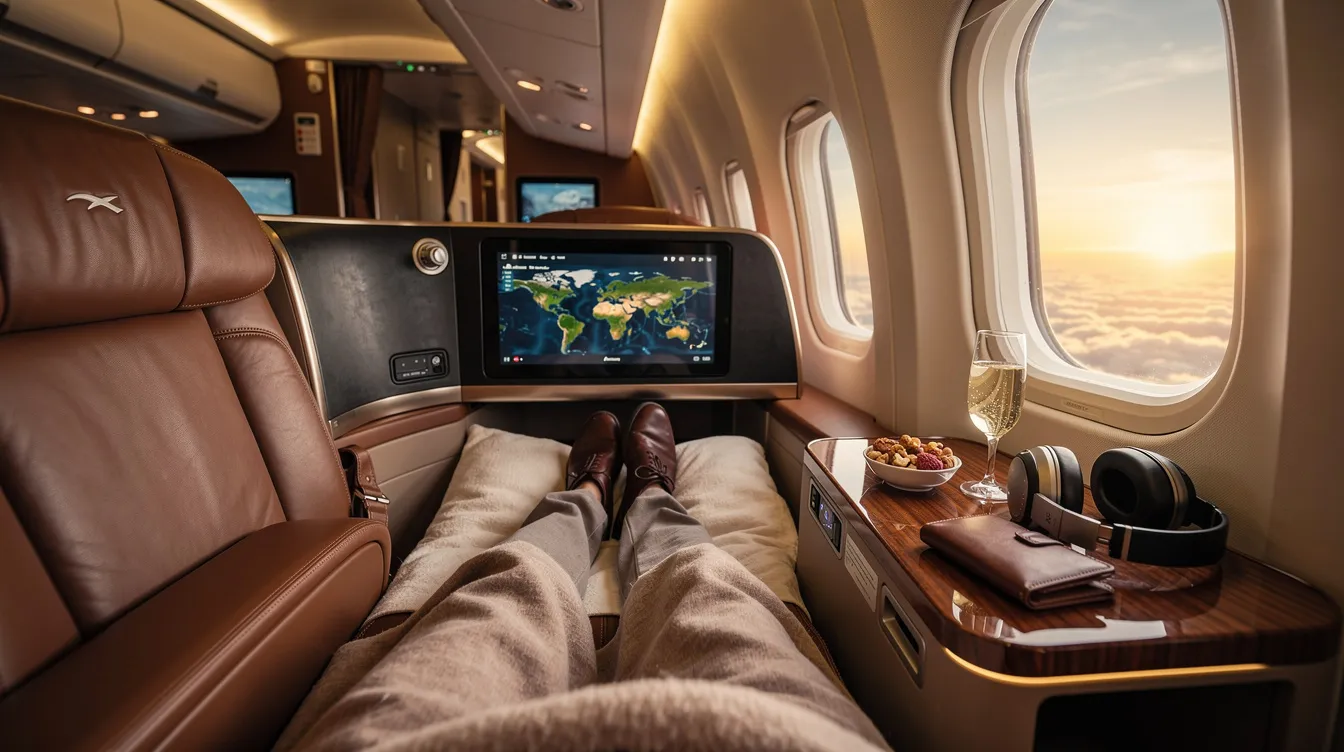
Key First Class Concepts Defined
Priority Check-in & Boarding: First class passengers enjoy expedited check-in and early boarding, reducing wait times and streamlining the airport experience.
Lounge Access: Exclusive airport lounges offer premium amenities, gourmet dining, and a quiet space to relax before your flight.
Lie-Flat Seats & More Legroom: First class seats usually provide extra legroom and can often recline fully flat, allowing for restful sleep on long-haul flights.
Personalized Service: With a lower passenger-to-crew ratio, first class travelers receive attentive, individualized service throughout the journey.
Complimentary Gourmet Meals & Drinks: Meals are typically served course-by-course, featuring high-quality ingredients and a selection of fine beverages.
Private Suites: Some airlines offer enclosed suites with doors, providing maximum privacy and comfort.
Dedicated Overhead Space: First class cabins often include dedicated overhead bins for your luggage, ensuring space and convenience.
VIP Transfers & Chauffeur: Select airlines, such as Emirates, offer complimentary chauffeur service and VIP transfers directly to and from the aircraft.
Fewer Passengers: First class cabins are smaller, creating a more exclusive and tranquil environment.
Foundational Definitions: What Does "First Class" Mean?
Before diving deeper, it’s important to clarify what “first class” means in different contexts:
Domestic First Class (U.S.): The forward cabin on two-cabin aircraft, offering wider seats, more legroom, and better food, but rarely lie-flat beds.
International First Class: Enclosed suites above business class on long-haul flights, often with lie-flat beds, private suites, and premium amenities.
Business Class (International): Now often includes lie-flat beds and pod-style privacy, sometimes rivaling older first class products.
These distinctions are crucial for frequent business and high-net-worth leisure travelers comparing first class and private jet travel, as the experience varies significantly by airline, route, and aircraft.
Comparing the Journey: First Class vs. Private Jet
Consider a New York–London journey:
Commercial First Class: Arrive at JFK 90–120 minutes early, navigate check-in and security, board with other passengers, and add customs, baggage claim, and ground transport on arrival. Door-to-door: roughly 12–14 hours.
BlackJet Private Jet: Depart from Teterboro, arrive 20 minutes before wheels-up, walk directly to the aircraft, and land with a car meeting you on the apron. Door-to-door: often 8–10 hours—a 2–4 hour advantage per trip.
This time savings, combined with privacy and control, is why many frequent business and high-net-worth leisure travelers are considering private jet travel as the next step beyond first class.
What "First Class" Really Means on Different Flights
Domestic vs. International First Class
The term "first class" varies greatly:
Transition: Now that you know what first class means on different flights, let’s explore how domestic first class in the U.S. compares in terms of comfort and luxury.
Domestic First Class in the U.S.: Comfort Upgrade or True Luxury?
Key Features of Domestic First Class
On carriers like American Airlines, Delta, and United Airlines, the typical domestic first class cabin offers a narrow-body equivalent to smaller types of private jets for short- and medium-haul missions:
Wider seats: 20–21 inches wide, with more legroom (37–39 inches seat pitch).
Priority check-in and boarding: Skip lines and board early.
Complimentary drinks and meals: Full meal service on longer flights; snacks on shorter routes.
Recline: Seats recline farther than business class seats, but are not lie-flat.
Dedicated overhead space: More room for your carry-on luggage.
Fewer passengers: Smaller cabin for a quieter experience.
Lounge access: Sometimes included, especially on premium transcontinental routes.
Example: On transcontinental routes like JFK–LAX, American Airlines’ Flagship First includes lie-flat seats and premium meals.
Transition: Now, let’s look at how international first class raises the bar even further with private suites, gourmet dining, and exclusive services.
International First Class: Suites, Lie-Flat Beds, and Flagship Cabins
Standout Features of International First Class
Private suites with doors: Maximum privacy for rest and work.
Lie-flat beds: Full-length beds with premium bedding for optimal sleep.
Exclusive lounge access: Access to the most luxurious airport lounges.
Personalized service: Lower passenger-to-crew ratio for attentive care.
Complimentary gourmet meals and drinks: Multi-course, restaurant-quality dining.
VIP transfers and chauffeur service: Emirates and other airlines offer complimentary chauffeur and VIP transfers.
Dedicated overhead space: Ample room for your luggage.
Fewer passengers: Intimate cabin environment.
Examples:
Emirates First Class: Private suites, onboard shower, chauffeur service.
Singapore Airlines Suites: Double Suite for two, enclosed privacy.
Air France La Première: Bespoke French dining, exclusive lounge.
Transition: With international first class setting the standard for luxury, how does business class compare—and when is it worth upgrading to first?
Business Class vs First Class: How Big Is the Real Difference?
Key Differences
Dimension | Business Class | First Class |
|---|
Seat | Lie-flat pod, some with doors | Enclosed suite with door |
Privacy | Moderate (open shells/partial doors) | High (full enclosure/private suites) |
Bedding | Duvet and pillow | Premium mattress pad, turndown service |
Dining | Multi-course menu | On-demand, caviar, vintage champagne |
Crew ratio | ~1:8–12 | ~1:3–4 (personalized service) |
Cabin size | 30–60 seats | 6–12 seats (fewer passengers) |
Lounge access | Premium lounges | Exclusive first class lounges |
Overhead space | Shared | Dedicated overhead space |
Transition: Even with the best first class, you’re still sharing the aircraft and schedule. For travelers starting to compare cabin comfort with ownership, charter, or jet cards, understanding the full private jet price list and access models is the next logical step. Next, let’s break down the full first class journey from booking to arrival.
What You Actually Get When Flying First Class
Booking
Flexible fares: First class tickets often allow changes and rebooking.
Discounted upgrades: Last-minute upgrades may be available 24–72 hours before departure.
Elite upgrades: Frequent flyers can use systemwide upgrades (e.g., American Airlines Executive Platinum).
At the Airport
Priority check-in: Dedicated counters for fast processing.
Priority boarding: Board early and settle in before other passengers.
VIP transfers: Some international services include VIP transfers to and from the aircraft.
Lounges
On Board
Lie-flat seats/private suites: Seats recline fully flat; some airlines offer private suites with doors.
Personalized service: Lower passenger-to-crew ratio ensures attentive care.
Complimentary gourmet meals and drinks: Meals are served course-by-course, with premium beverages.
Dedicated overhead space: Ample room for your carry-on luggage.
Arrival
Priority baggage handling: Bags are delivered first.
Chauffeur service: Emirates and some others provide complimentary chauffeur service.
Customs and immigration: Still required, but sometimes expedited for first class.
Transition: Now that you know the full first class experience, let’s discuss when paying for first class makes sense—and when it might not.
Is First Class Worth It? When Paying More Makes Sense—and When It Doesn't
When Upgrading Makes Sense
Long-haul overnight flights: Sleep quality is crucial.
Business trips: Arrive rested for meetings.
Special occasions: Honeymoons, anniversaries, or milestone events.
Elite status: Additional miles, better rebooking, and baggage allowances.
When It’s Less Compelling
Short flights: Limited time to enjoy amenities.
Daytime routes: Less need for sleep.
Minimal difference from premium economy: On some domestic routes.
Transition: If you want to experience first class for less, there are strategies to access premium cabins without paying full fare.
How to Fly First or Business Class for Less
Miles and Points
Discounted Fares and Upgrades
Last-minute upgrades: Available 24–72 hours before departure.
Paid upgrades at check-in: Sometimes offered at a discount.
Midweek and red-eye flights: Less likely to be full, increasing upgrade chances.
Transition: For those who want even more control, privacy, and time savings, private jet travel with BlackJet is the next level.
First Class vs Private Jet: Time, Privacy, and Control (BlackJet's Value Proposition)
Time
Privacy
Private jet: Only your party on board, with safety standards that rival top airlines as detailed in our guide on how safe private jet travel really is.
First class: Fewer passengers, but still shared with others.
Control
Private jet: Choose your schedule, aircraft, and catering.
First class: Fixed airline schedules and menus.
Cost Framing
Transition: Beyond luxury, safety, sustainability, and technology are increasingly important for discerning travelers.
Safety, Sustainability, and Technology: Beyond the Champagne
Safety
Commercial airlines: Operate under strict regulations.
Private aviation: BlackJet Certified® process ensures top safety standards, while structured jet card programs for frequent flyers add predictability around aircraft quality and availability.
Sustainability
First class: Higher per-passenger emissions than economy.
Private jet: BlackJet flights are automatically carbon-neutral, and the newest generation of innovative long-range private jets is being designed with efficiency and lower emissions in mind.
Technology
Airline apps: Seat selection, boarding passes, Wi-Fi.
BlackJet platform: 24/7 booking, real-time tracking, and transparent management, whether you’re chartering a whole aircraft or simply buying a seat on a private jet.
Transition: If you’re considering private jet access, Jet Cards offer a structured, predictable way to fly.
Jet Cards and Cabin Classes: How BlackJet Structures Private Access
BlackJet Aircraft Categories
BlackJet Category | Commercial Equivalent | Best For |
|---|
Light jet | Domestic first class | Regional hops, 1–4 passengers using the BlackJet 25+ Hour Jet Card |
| Midsize / Super-midsize | International business class | Cross-country, Caribbean, 4–8 passengers | | Large cabin | International first class | Transatlantic, long flights, 6–14 passengers |
Typical Use Cases
Transition: For those who have mastered flying first class, private jet travel is the logical next step. From the top 10 private jets in the world to large-cabin aircraft for 20-passenger groups or even 50-passenger private jet charter solutions, there is a full spectrum of options. You can explore the largest private jets available for sale and charter, compare the most expensive private jet options for 2025, or focus on the best $10 million private jet choices, standout $15 million private jet features, and what a $20 million private jet delivers. As you evaluate providers, it also helps to understand how the top private jet companies for luxury service structure ownership, jet card, and charter access.
Conclusion: Choosing Your Next-Level Experience
The journey from main cabin to first class to private jet is about more than comfort—it’s about reclaiming your time, privacy, and control. For frequent business and high-net-worth leisure travelers, flying in first class offers a luxury experience with priority ground services, but private jet travel with BlackJet takes efficiency and exclusivity to the next level.
If you regularly book first or business class, consider evaluating your next trip by effective cost per productive hour and total door-to-door journey time.
Explore BlackJet's Jet Card programs, speak with an advisor about matching aircraft categories to your typical routes, and experience how private, carbon-neutral aviation redefines what "first class" truly means.


 Sign up with google
 Sign up with Apple


